Getting a translation from English to Myanmar that actually makes sense is harder than most people expect. You can’t just paste text into a generic tool and trust the result, especially if you’re dealing with business documents, medical information, or anything where a mistake would be embarrassing or costly. This guide walks you through the most reliable methods, the tools that work best for the Burmese language, and the common pitfalls that trip people up.
Quick Answer: For casual phrases, Google Translate or Bing Translator work acceptably. For anything important, use a professional human translator or a Myanmar-specific translation service, because the Burmese script and grammar create accuracy problems that generic machine translation still struggles with.
Now let’s get into the details, starting with why this language pair is uniquely tricky.
Why English to Myanmar Translation Is Different
Burmese, the official language of Myanmar, uses a completely different writing system and grammatical structure than English. It’s not just swapping words. It’s restructuring how ideas are expressed.
The Burmese script is an abugida, meaning consonant-vowel sequences are written as units. There are 33 consonants and 12 basic vowels, but the way they combine creates hundreds of possible syllable forms. The script flows in a circular pattern, and spacing between words is inconsistent, which creates real challenges for text processing.
Grammar adds another layer of difficulty. Burmese is a subject-object-verb language, while English is subject-verb-object. So the English sentence “I eat rice” becomes “I rice eat” in Burmese word order. Beyond that, Burmese uses postpositions instead of prepositions, and it has a complex system of honorifics that change depending on who you’re talking to.
These structural differences mean that a word-for-word translation produces garbage. The translator has to understand the full meaning first, then rebuild the sentence from scratch in the target language.
Pro Tip: If you see a translation tool producing Burmese text that looks like a jumble of separate words with no grammatical particles, it’s probably doing word-level substitution rather than true translation. That’s a red flag for accuracy.
Understanding these structural challenges helps you choose the right translation method for your specific situation.

Machine Translation Tools for English to Myanmar
Several major platforms now support Burmese, but their quality varies significantly. Here’s an honest comparison based on how each handles the language pair.
| Tool | Best For | Accuracy Level | Cost | Notes |
|---|---|---|---|---|
| Google Translate | Casual phrases, basic comprehension | Moderate | Free | Has improved significantly since 2018, but still struggles with formal registers |
| Bing Translator | Short sentences, travel phrases | Moderate | Free | Similar limitations to Google, sometimes better with news text |
| ChatGPT / Claude | Contextual translation, explanation | Moderate to High | Free to $20/month | Better at understanding nuance, but can hallucinate rare words |
| MyOrdbok | Dictionary lookups, word definitions | High (for single words) | Free | Myanmar-specific dictionary, very reliable for vocabulary |
| Professional human translators | Legal, medical, business documents | Highest | $0.08-$0.25 per word | Essential for anything with legal or financial consequences |
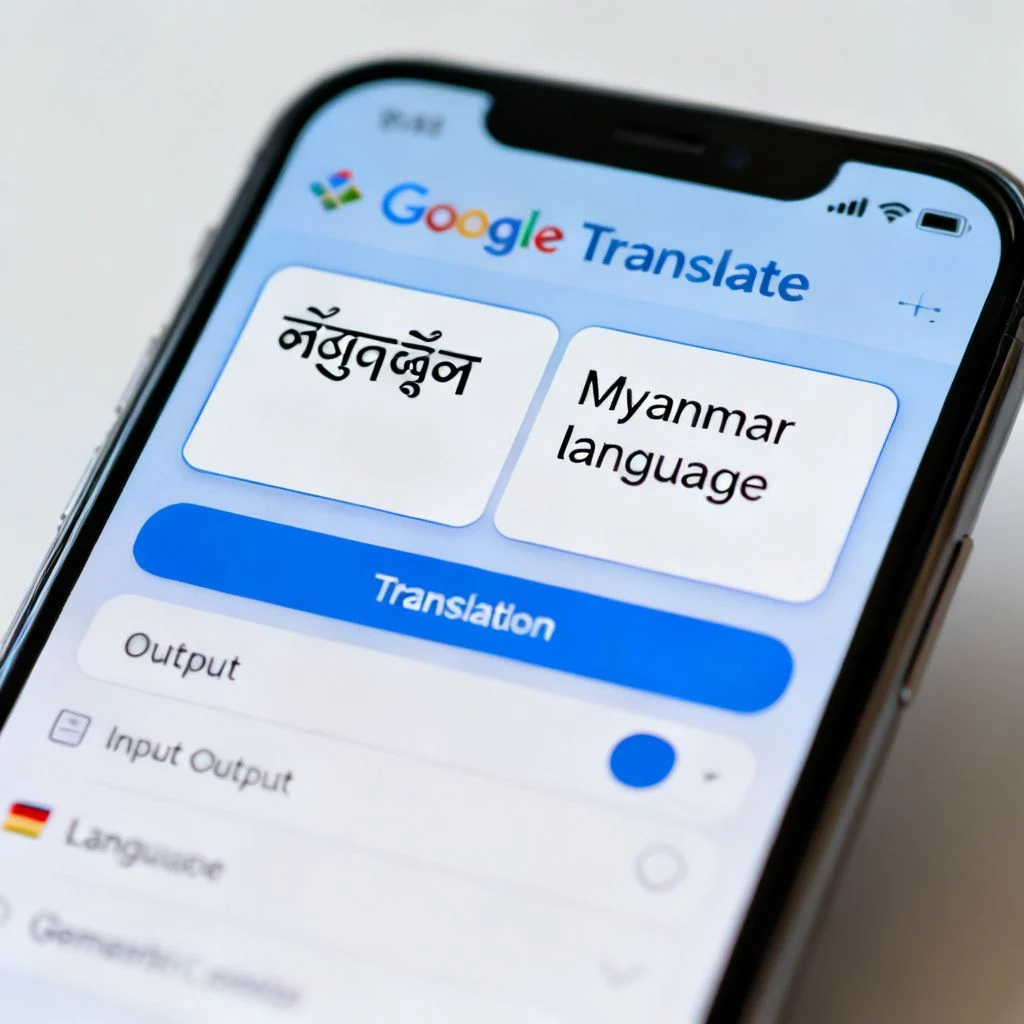
Google Translate added Burmese support in 2014, and its quality has improved substantially since then. But “improved” doesn’t mean “reliable.” For everyday phrases like “where is the bathroom” or “how much does this cost,” it works fine. For a rental contract or a medical diagnosis, you’re gambling.
What machine tools handle well:
- Simple present-tense sentences
- Common travel and shopping vocabulary
- Short questions with basic structure
- Numbers, dates, and times
What machine tools handle poorly:
- Honorific language and formal registers
- Idioms and cultural references
- Compound sentences with multiple clauses
- Technical or specialized terminology
- Anything requiring politeness nuance
Pro Tip: When using Google Translate for Burmese, always translate back to English and compare. If the round-trip translation doesn’t match your original meaning, the Burmese output is unreliable.
Machine translation has its place, but knowing its limits saves you from embarrassing mistakes.
The Burmese Script: What You Need to Know
If you’re planning to communicate in Myanmar, understanding the basics of the script helps you verify translations and catch obvious errors.
Burmese is written from left to right, but unlike English, there are no spaces between every word. Spaces typically mark phrase boundaries or sentence breaks. This means a string of Burmese characters might represent multiple words, and a translation tool has to correctly segment the text before it can even begin translating.
The script includes several character types that don’t exist in English:
- Consonants form the base of each syllable
- Vowel diacritics attach above, below, or around the consonant
- Medial consonants modify the initial consonant sound
- Tone markers indicate which of the four tones to use
Burmese is a tonal language with four distinct tones: low, high, creaky, and checked. The same syllable with different tones can mean completely different things. For example, “ka” with a low tone means “dance,” but “ka” with a creaky tone means “car.”
This tonal system creates a problem for written translation because the tone is embedded in the script, not marked separately. A translator needs to understand the tone from context and the written form, which adds another layer of complexity.
Why this matters for translation:
- A mistranslated tone changes the word entirely
- Machine tools sometimes drop tone markers in their output
- Native speakers will immediately notice incorrect tones
- Written Burmese without proper tone markers is hard to read
Pro Tip: If you’re learning to read Burmese, start with a frequency list of the most common 200 words. You’ll recognize most of what you need for daily communication, and it makes verifying translations much easier.
The script isn’t just a different alphabet. It’s a different way of encoding meaning, and that affects every translation decision.
When to Use Human Translation Services
For certain situations, machine translation isn’t just inadequate. It’s actively dangerous.
Documents that always need human translation:
- Legal contracts and agreements
- Medical records and prescriptions
- Birth certificates, marriage certificates, and other official documents
- Academic transcripts and diplomas
- Business proposals and financial statements
- Marketing materials aimed at Myanmar consumers
The reason is straightforward. A mistranslation in these contexts can cause financial loss, legal liability, or medical harm. The cost of a professional translator is trivial compared to the cost of getting it wrong.
Professional translation from English to Myanmar typically costs between $0.08 and $0.25 per word, depending on the complexity of the subject matter and the turnaround time. A standard one-page document (about 300 words) would cost roughly $25 to $75.
How to find qualified translators:
- ProZ.com lists professional translators with verified credentials
- TranslatorsCafe has a directory of Myanmar language specialists
- Local translation agencies in Yangon offer certified translations for official use
- Upwork and Fiverr have freelance translators, but verify their credentials carefully
Pro Tip: For official documents that need to be submitted to Myanmar government agencies, you often need a certified translation with a notarized statement. Ask the agency if they provide this service before you commit.
Human translation costs more and takes longer, but for important documents, it’s the only responsible choice.
Common Mistakes and How to Avoid Them
After reviewing hundreds of English to Myanmar translations, certain errors appear again and again. Here are the most frequent ones and how to prevent them.
1. Literal word-for-word translation
As mentioned earlier, Burmese word order differs from English. A literal translation produces grammatically broken Burmese that native speakers struggle to understand. Always use a tool or person that understands Burmese grammar, not just vocabulary.
2. Ignoring honorifics and politeness levels
Burmese has different forms of address depending on the relative status of the speaker and listener. Using the wrong form can come across as rude or presumptuous. When in doubt, use the more polite form.
3. Mixing formal and informal registers
Written Burmese and spoken Burmese differ significantly. A translation meant for a document should use formal written Burmese, while a translation for casual conversation should use colloquial forms. Machine translation often mixes these registers unpredictably.
4. Dropping tone markers
Some older translation systems omit tone markers entirely, which makes the text nearly unreadable. Always verify that the Burmese output includes proper tone markers.
5. Translating idioms literally
English idioms like “it’s raining cats and dogs” or “break a leg” have no Burmese equivalent. A good translator finds a functionally equivalent Burmese expression or rephrases the meaning directly.
6. Incorrect segmentation of compound words
Because Burmese doesn’t use spaces between all words, translation tools sometimes merge or split words incorrectly. This creates nonsense output even when individual words are translated correctly.
Pro Tip: If you’re working with a Burmese speaker, ask them to read the translation aloud. Errors that look subtle on paper often become obvious when spoken.
Avoiding these common mistakes requires attention and verification, but it dramatically improves the quality of your translations.
Key Takeaways
- Burmese uses a completely different script and grammar system than English, making translation more complex than simple word substitution
- Machine translation tools work for casual phrases but fail on formal documents, idioms, and nuanced language
- The Burmese tonal system means that even correct words can be wrong if the tone is incorrect
- Professional human translation costs $0.08-$0.25 per word and is essential for legal, medical, and business documents
- Always verify machine translations with a round-trip translation or a native speaker before using them for anything important
Frequently Asked Questions
Q: Is Google Translate accurate for English to Myanmar?
A: Google Translate handles simple, everyday phrases reasonably well, but its accuracy drops significantly for complex sentences, formal language, and specialized terminology. It’s fine for getting the gist of a message, but not reliable for anything where accuracy matters.
Q: How much does professional English to Myanmar translation cost?
A: Professional translation typically costs between $0.08 and $0.25 per word, depending on the subject matter and turnaround time. A standard one-page document costs roughly $25 to $75.
Q: Can I learn to read Burmese script quickly?
A: The Burmese script takes most learners several weeks to recognize basic characters and several months to read fluently. It’s achievable, but it requires consistent practice. Focus on the most common 200 words first to build recognition.
Q: What’s the difference between formal and informal Burmese?
A: Formal Burmese is used in writing, official documents, and when speaking to elders or authority figures. Informal Burmese is used among friends and family. The vocabulary and grammatical particles differ significantly between the two registers.
Q: Do I need a certified translation for official documents in Myanmar?
A: Yes, most Myanmar government agencies require certified translations for foreign documents. This means the translation must be done by a recognized translator or agency and often needs notarization.
Q: Why does Burmese text look like circles and curves?
A: The Burmese script evolved from the Brahmi script of ancient India, and its rounded shapes developed because writing was traditionally done on palm leaves. Straight lines would tear the leaves, so the script evolved to use curves instead.
Q: Can I use ChatGPT for English to Myanmar translation?
A: ChatGPT can produce reasonable translations for general text and is often better than Google Translate at understanding context. However, it can occasionally produce incorrect or invented words, especially for rare or technical terms. Always verify important translations.
Q: How do I type in Burmese on my computer or phone?
A: Both Windows and macOS support Burmese keyboard layouts that you can enable in system settings. On mobile devices, you can add the Burmese keyboard from your language settings. The standard layout is based on the Myanmar3 or Zawgyi systems, though Myanmar3 is now the official standard.
References & Further Reading
- Ethnologue: Burmese Language Profile – Comprehensive linguistic information about the Burmese language
- Omniglot: Burmese Script – Detailed guide to the Burmese writing system
- Wikipedia: Burmese Language – Overview of grammar, phonology, and history
- MyOrdbok – Reliable Myanmar-English dictionary resource
—
About This Article
This guide draws on practical experience working with Burmese language translation across multiple contexts, including document translation, software localization, and cross-cultural communication. The information about translation tool performance reflects current capabilities as of early 2025 and may change as machine translation systems continue to improve. The pricing information reflects market rates observed across major freelance platforms and translation agencies serving the Myanmar market.


Pingback: ENG Myanmar Guide: How to Learn English in Myanmar…