The bridge between English and Myanmar can feel like a long one, especially when you first look at the swirling, circular letters of the Myanmar script. It is not just about swapping words. It is about rewiring how you think about grammar, tone, and the order of information in a sentence. This guide breaks down that process into practical, manageable steps. Whether you are a native Myanmar speaker polishing your English or an English speaker diving into Burmese, you will find a clear path forward here.
Quick Answer: The biggest hurdles between English and Myanmar are the alphabet, the word order (Subject-Object-Verb vs Subject-Verb-Object), and the use of “particles” to show politeness and tense. You can learn either language effectively by focusing on sentence patterns first, rather than memorizing vocabulary lists.
Why English and Myanmar Grammar Feels Backwards
If you speak English natively, reading a Myanmar sentence can feel like reading a reflection in a mirror. The structure is inverted. English relies on a Subject-Verb-Object (SVO) structure. You say, “I eat rice.” Myanmar relies on a Subject-Object-Verb (SOV) structure. You would literally say, “I rice eat.”
This difference is the root of most beginner mistakes.
The Verb Placement Rule
In Myanmar, the verb almost always goes at the very end of the sentence. This requires patience. You cannot translate word-for-word because you will not know what the subject is doing until the speaker stops talking.
Consider this example:
- English: The teacher writes a letter to the student.
- Myanmar (literal): Teacher student to letter writes.
Notice how the verb “writes” lands at the end. To speak either language fluently, you have to stop translating in your head and start thinking in the target language’s rhythm.
Particles: The Glue of the Language
Myanmar uses small words called particles to indicate tense, mood, and politeness. English uses auxiliary verbs like “will,” “is,” or “did.” Myanmar attaches these markers to the end of the sentence.
- Politeness: Men typically end sentences with “khamya” or “khin bya” while women use “shin” or “naw.” English has no direct equivalent for this gendered politeness marker.
- Tense: Instead of changing the verb itself (like “go” to “went”), Myanmar adds a particle. “Thwar deh” means “go” (present), while “Thwar kheh” means “went” (past).
Pro Tip: Stop looking for direct translations of “is” and “are.” In Myanmar, adjectives often act as verbs. To say “The house is big,” you simply say “House big is” (Eain kyi deh). The “is” is implied by the particle.
Understanding this structural shift is the first major leap. Once you accept that the verb lives at the end and particles do the heavy lifting, the language stops looking like a code and starts looking like a system.
Decoding the Script: From Circles to Letters
The visual difference between English and Myanmar is stark. English uses the Latin alphabet, a linear set of 26 letters. Myanmar uses a Brahmic script, derived from ancient Indian writing systems.
The Anatomy of the Myanmar Script
The Myanmar alphabet consists of 33 consonants and 12 basic vowels. However, unlike English where letters sit side-by-side, Myanmar letters stack, circle, and combine.
- Consonants: Each consonant has an inherent vowel sound. For example, “က” is not just “k,” it is “ka.”
- Vowel Changes: To change the vowel, you add diacritics around the consonant. You might add a mark on the left, right, top, or bottom of the letter to change “ka” to “ki,” “ku,” or “kay.”
- Tone: English uses intonation to show emotion or questions. Myanmar uses tone to change the meaning of a word. A word like “saw” can mean “early,” “lock,” or “to drink” depending on if you say it high, low, or creaky.
Transliteration Challenges
Because there is no single standard for writing Myanmar using English letters, you will see the same word spelled many ways. The city of Yangon was once Rangoon. The currency “Kyat” is sometimes written “Chat.” This inconsistency makes learning from written romanization tricky.
Here is a comparison of the two systems:
| Feature | English | Myanmar |
|---|---|---|
| Script Type | Latin Alphabet | Brahmic Abugida |
| Direction | Left to Right | Left to Right |
| Vowels | Independent letters (a, e, i) | Diacritics attached to consonants |
| Spaces | Between words | Between phrases, not individual words |
| Tone | Not lexical (doesn’t change meaning) | Lexical (changes meaning) |
The visual complexity is intimidating, but it is systematic. The script is phonetic. Once you memorize the shapes and the tone rules, you can read almost anything, even if you do not understand the meaning yet.
The Vocabulary Divide: Loan Words and Context
You might think English and Myanmar share no vocabulary. You would be mostly right, but there are exceptions that can help you learn faster.
English Words in Myanmar
Myanmar has absorbed many English words, particularly for technology, food, and modern concepts. These loan words are pronounced with a Myanmar accent, which can make them hard to recognize at first.
- Computer: Kom-pyoo-tah
- Television: Yo-myin-ba (from “television” via the word for “picture”)
- Car: Ka
- Ice: Ye-khe (literally “water-freeze”)
The Cultural Context
Myanmar is a high-context language. This means a lot of meaning is implied by the situation, not spoken out loud. English tends to be low-context and more explicit.
For example, in English, you ask, “Are you going?” In Myanmar, you might simply ask “Thwar mal?” meaning “Going?” The subject “you” is dropped because it is obvious from the context. Pronouns in Myanmar are also complex. The word for “I” changes depending on who you are talking to. A man speaking to a monk uses a different word for “I” than a woman speaking to a child.
Pro Tip: Do not waste time memorizing the pronoun chart for “I” and “You” in Myanmar right away. It is a common trap. Instead, use your name or a kinship term like “older brother” (ako) or “younger sister” (nyi ma) to refer to yourself and others. It is polite and much easier to manage as a beginner.
This contextual difference means that direct translation often fails. A good translator must be a cultural interpreter, not just a word-swapper.
A Practical Learning Path for Both Directions
Whether you are moving from English to Myanmar or the other way around, the strategy should be the same: prioritize patterns over perfection.
If You Are Learning English (From Myanmar)
Native Myanmar speakers often struggle with English tenses because Myanmar does not conjugate verbs the same way. You must train your brain to add the “s” for third person singular and to use the past tense consistently.
- Master the “S” sound: Practice saying “He goes,” “She eats,” “It works.” This sound is often dropped because it does not exist as a suffix in Myanmar.
- Learn Articles: Myanmar does not use “a,” “an,” or “the.” You must learn when to use them. Start by thinking of “a” as “one” and “the” as “that specific one.”
- Focus on Word Order: Practice writing English sentences starting with the Subject, then the Verb, then the Object. Drill this until it feels natural.
If You Are Learning Myanmar (From English)
English speakers often struggle with the tones and the script. Many give up on reading and try to learn by ear only. This is a mistake. The script helps you remember the tone.
- Learn to Read First: Spend your first few weeks only on the alphabet. It pays off massively later.
- Drill the Verb-Final Rule: Take simple English sentences and physically rearrange the words. Write “I go to school” as “I school to go.”
- Listen for Particles: Train your ear to hear the end of the sentence. The meaning of the tense is there.
The Best Tools for the Job
You do not need expensive software. You need consistency.
- Spaced Repetition Systems (SRS): Use apps like Anki to drill vocabulary and, more importantly, sentence structures.
- Language Exchange: Find a partner who is a native speaker of the language you want to learn. You help them with English; they help you with Myanmar.
- Media: Watch Myanmar movies with English subtitles or English movies with Myanmar subtitles. This trains your ear to match sounds to meanings.
The key takeaway here is that grammar study is more efficient than vocabulary study in the early stages. You can look up a word, but you cannot easily look up a grammar rule in the middle of a conversation.
Translation: More Than Just Words
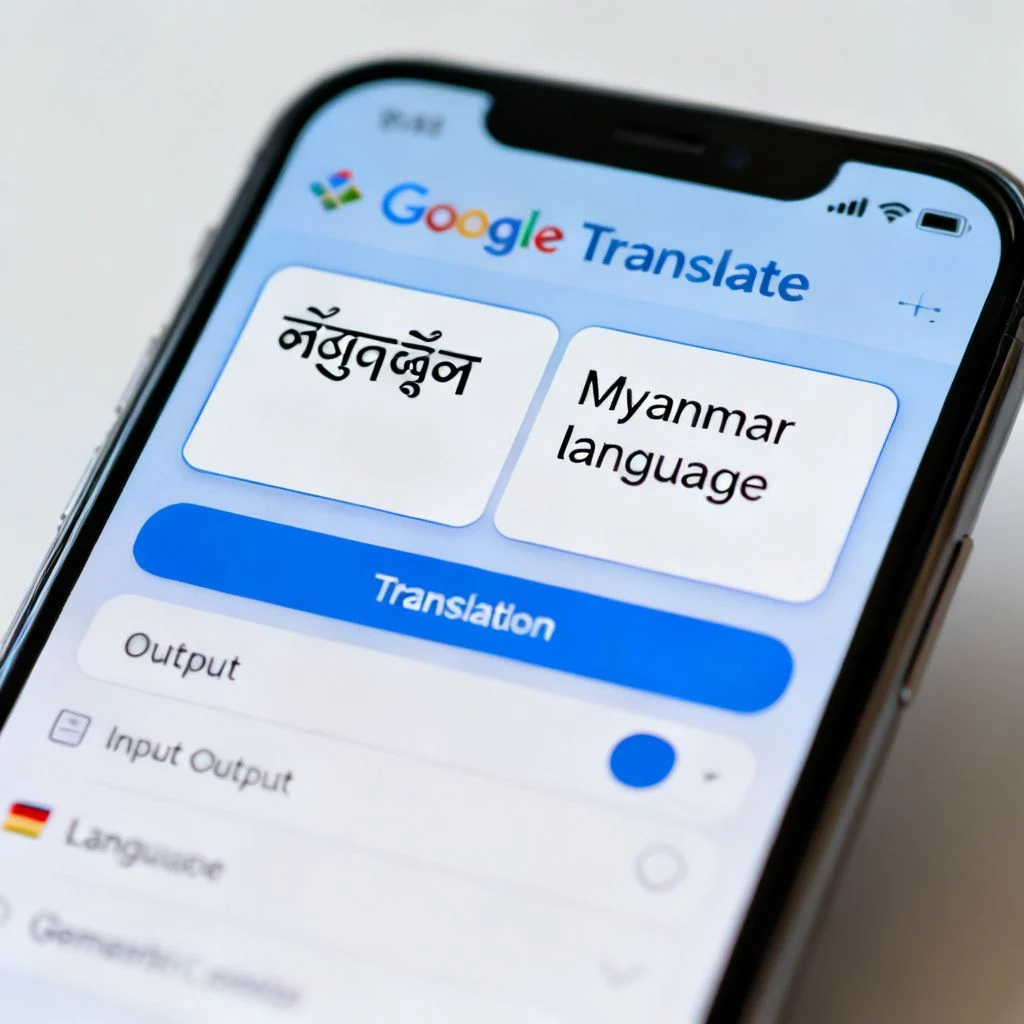
Translating between English and Myanmar is a specialized skill. Machine translation tools like Google Translate have improved, but they still make significant errors with Myanmar, particularly with tone and context.
Why Machine Translation Fails
Machine translation often translates the “literal” meaning of a word, ignoring the particle or the tone. This can turn a polite request into a rude command.
- Politeness Levels: A machine might translate “Give me water” directly. A human translator knows to add “please” or the polite particle to make it “Yay pei ba” (Please give water).
- Idioms: “It’s raining cats and dogs” makes no sense in Myanmar. The equivalent is “Moe ywa deh” (It is raining heavily). A machine might try to translate the animals.
The Value of a Human Translator
If you need a document translated for business, legal, or medical purposes, hire a professional. The stakes are too high for a free tool. A human understands nuance. They know that the English word “you” might need to be translated as “U” (uncle), “Daw” (auntie), “Saya” (teacher), or “Maung” (younger brother) depending on the relationship.
Pro Tip: If you are using an AI tool to translate a text, ask it to “translate the meaning, not the words.” Better yet, translate the text back into English to see if the meaning survived the trip. If it sounds weird, the Myanmar is probably wrong.
Translation is an art of approximation. You are trying to recreate an experience, not just a string of words.
Key Takeaways
- Sentence Structure: English is Subject-Verb-Object (I eat rice). Myanmar is Subject-Object-Verb (I rice eat). The verb goes last.
- The Script: Myanmar uses a circular script with 33 consonants and tone markers. English uses a linear Latin alphabet.
- Particles vs. Tenses: Myanmar uses particles (like “deh” and “kheh”) to show tense and politeness, while English changes the verb form.
- Context is King: Myanmar drops pronouns and relies on context. A literal translation often sounds unnatural or rude.
- Learning Strategy: Focus on sentence patterns and the script first. Do not try to translate word-for-word.
Frequently Asked Questions About English and Myanmar
Q: Is English widely spoken in Myanmar?
A: English is spoken in major cities like Yangon and Mandalay, particularly in the tourism and business sectors. However, outside of urban areas, proficiency drops significantly. Older generations who grew up during the colonial period often speak better English than younger generations who grew up under military rule, though this is changing with the rise of international schools and internet access.
Q: How long does it take to learn Myanmar if I speak English?
A: The US Foreign Service Institute (FSI) categorizes Myanmar as a Category IV language. This means it takes approximately 1,100 class hours (or about 44 weeks of full-time study) for a native English speaker to reach professional working proficiency. It is considered significantly harder than Spanish or French but slightly easier than Japanese or Korean.
Q: Are there any similarities between English and Myanmar grammar?
A: Yes, a few. Both languages generally follow a Subject-first word order. Also, neither language assigns grammatical gender to nouns (unlike Spanish or French). There is no “le” or “la” to worry about. The adjective placement is also similar in simple sentences; both languages place the adjective before the noun (e.g., “red car” vs. “a-ni ka”).
Q: Why does the Myanmar language sound “sing-songy” to English speakers?
A: Because Myanmar is a tonal language. The pitch of your voice changes the meaning of the word. English uses pitch to show emotion or to ask a question, but it never changes the dictionary definition of a word. In Myanmar, saying “ma” with a high tone means “hard,” while saying it with a low tone can mean “to help” or “to lift.”
Q: Can I learn Myanmar using only the English alphabet (Romanization)?
A: You can start that way, but it is not recommended for long-term success. There are several competing romanization systems, which causes confusion. Furthermore, because the Myanmar script is phonetic, learning the letters actually helps you pronounce the tones correctly. Relying on English letters often leads to flat, incorrect pronunciation.
Q: What is the most difficult part of learning English for a Myanmar speaker?
A: Verb conjugation and tenses. Myanmar verbs do not change based on the subject (I go, he goes) or the time (go, went). A Myanmar speaker must learn to add the “s” sound and memorize irregular past participles, which is a completely foreign concept to the structure of their native language.
Q: Is the word “Myanmar” the same as “Burmese”?
A: “Myanmar” is the official name of the country and the formal name of the language. “Burmese” is an older English term for the same language. In the Myanmar language, the language is called “Myanma bhasa” (Myanmar language) or “Bamar bhasa” (Burmese language), referring to the majority ethnic group. The two terms are largely interchangeable in English.
Q: How do I type in Myanmar on my phone or computer?
A: You need to install a Myanmar keyboard layout. On iOS and Android, you can add the “Myanmar (Burmese)” keyboard in your settings. On Windows, you may need to install a specific font like Pyidaungsu or Myanmar3 and enable the Myanmar keyboard layout. The layout is phonetic, meaning the keys are mapped to the sounds, but it takes practice because the vowels are typed after the consonant.
References & Further Reading
- The Foreign Service Institute (FSI) Language Difficulty Rankings – Official US Government resource categorizing language learning difficulty for English speakers. https://www.state.gov/foreign-language-training/
- Omniglot: Burmese (Myanmar) Script – A comprehensive guide to the history, alphabet, and pronunciation of the Myanmar writing system. https://omniglot.com/writing/burmese.htm
- SOAS University of London: Burmese Language Resources – Academic resources and linguistic analysis of the Burmese language family. https://www.soas.ac.uk/south-asia-institute/burmese
- Wikipedia: Burmese Language – A detailed overview of the phonology, grammar, and history of the Myanmar language. https://en.wikipedia.org/wiki/Burmese_language
—
About This Article: This guide was compiled by a language educator with experience in Southeast Asian linguistics. The strategies outlined here are based on applied linguistics principles and the documented experiences of language learners transitioning between the Indo-European and Sino-Tibetan language families. We prioritize actionable advice over theoretical jargon to help you start speaking today.




Pingback: Burmese to English Translation Keyboard: Easy Setup Guide