A burmese thai translation assistant is the practical middle ground between a full human translator and a basic dictionary. Whether you are a business owner in Mae Sot dealing with suppliers across the border, a healthcare worker in Bangkok serving a growing Burmese-speaking community, or a traveler crossing at Myawaddy, you need something that handles the quirks of both languages without falling apart on the first colloquial phrase.
The problem is simple: Burmese and Thai share almost no structural DNA. One is a tonal Sino-Tibetan language written in a circular Brahmic-derived script. The other is a tonal Kra-Dai language with its own alphabet and completely different grammar. Most translation tools treat both as afterthoughts.
Quick Answer: The most reliable approach is to use Google Translate or Microsoft Translator as a base layer, then verify output with a dedicated dictionary like SEAlang or the Ornagai Burmese-Thai dictionary. For professional documents, a hybrid workflow with human review is non-negotiable.
Why Burmese and Thai Are a Hard Translation Pair
Machine translation quality depends heavily on how much parallel text data exists between two languages. English to Spanish? Massive datasets, excellent output. English to Burmese? Decent. Burmese to Thai directly? Thin.
The Structural Gap
Burmese is an agglutinative language with subject-object-verb (SOV) word order. Thai is an analytic language with subject-verb-object (SVO) word order. A sentence that works naturally in Burmese often requires complete restructuring in Thai, not just word substitution.
Consider a simple phrase:
| Language | Sentence | Literal Translation |
|---|---|---|
| Burmese | ကျွန်တော် ထမင်း စားတယ် | I rice eat |
| Thai | ผมกินข้าว | I eat rice |
A word-for-word swap produces nonsense. The tool has to understand both grammars deeply enough to rearrange the sentence. That is a hard problem for statistical models trained on limited data.
The Script Problem
Both languages use non-Latin scripts, which creates a second failure point. Optical character recognition (OCR) for Burmese is notably less mature than for Thai. If you are scanning a document or pointing your phone at a sign, the extraction step alone can introduce errors before translation even begins.
Pro Tip: When using camera translation for Burmese text, make sure the text is well-lit and flat. Curved surfaces like bottles or rounded signs cause more OCR errors in Burmese than in Thai due to the circular letterforms.

What a Burmese Thai Translation Assistant Can Actually Do
Let me be direct about capabilities so you can set realistic expectations.
Where Current Tools Work Well
Modern neural machine translation handles simple declarative sentences reasonably well. Directions, basic commerce phrases, menu items, and short administrative text often come through with minor errors that a human can spot quickly.
Google Translate added Burmese support in 2014 and has improved steadily since. Microsoft Translator also supports both languages and offers an API that businesses can integrate into custom workflows.
For word-level lookups, SEAlang Library hosts a Burmese-Thai dictionary project that is genuinely useful for disambiguation. The Ornagai dictionary (Burmese-English) helps when you need to verify a Burmese word’s meaning through English as a bridge language.
Where Tools Break Down
Honorifics and politeness registers are the biggest trap. Thai has elaborate politeness particles (ครับ / ค่ะ) and royal language. Burmese has honorific prefixes like ဦး (U) for older men and ဒေါ် (Daw) for older women. Machine translation often drops these entirely or applies them incorrectly, which can range from mildly awkward to genuinely offensive.
Loanwords create another layer of confusion. Thai borrowed heavily from Pali and Sanskrit. Burmese borrowed from Pali too, but the words evolved differently in each language. A tool might recognize a Pali-derived term in one language and fail to map it to the cognate in the other.
Regional dialects are a third failure point. Burmese spoken in Yangon differs from Burmese spoken in Mandalay or among ethnic minority communities. Thai has distinct regional variants too. Tools are almost always trained on standard central dialects.
A Realistic Comparison Table
| Tool | Burmese-Thai Direct Support | Best Use Case | Major Limitation |
|---|---|---|---|
| Google Translate | Yes (via neural MT) | Casual phrases, travel, quick checks | Struggles with honorifics and formal documents |
| Microsoft Translator | Yes (API available) | Business integration, batch translation | Similar accuracy limits to Google |
| SEAlang Dictionary | Yes (dictionary lookup) | Word disambiguation, etymology | Not a sentence translator |
| Ornagai | Burmese-English only | Verifying Burmese meanings | Requires English bridge |
| Human translator | N/A | Legal, medical, contracts | Cost and turnaround time |
The pattern is clear: no single tool covers all use cases. A good assistant workflow combines two or three tools.
Building a Practical Translation Workflow
The most effective approach I have seen in real-world use combines machine translation with targeted human verification. Here is a workflow that works for most non-critical needs.
Step 1: Start With the Right Input
Clean input matters more than people expect. If you are typing Burmese, use a proper Burmese keyboard layout (not a phonetic approximation). If you are scanning, check the OCR output before translating.
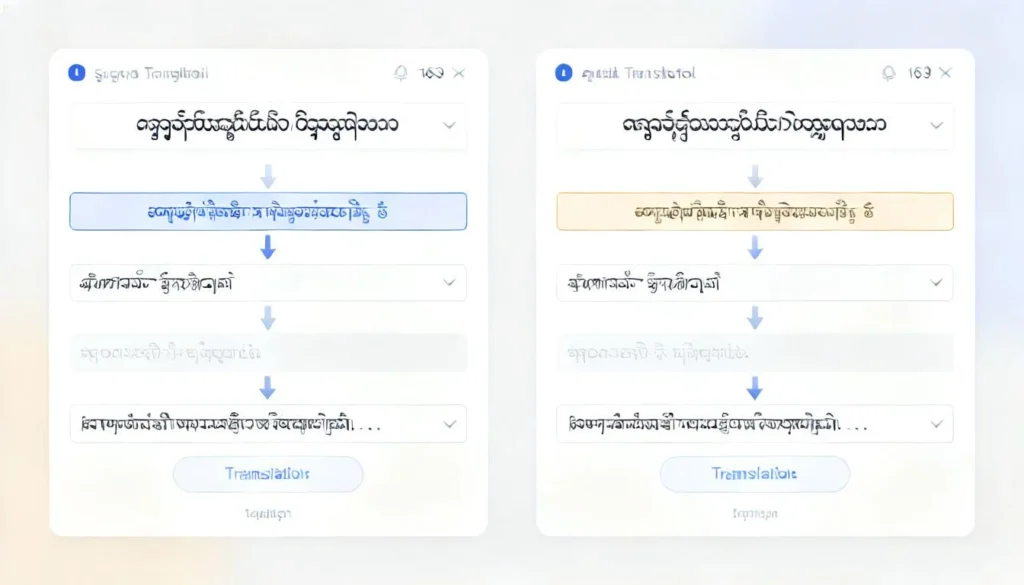
Step 2: Run Through Two Engines
Run the same text through Google Translate and Microsoft Translator. Compare the outputs. Where they agree, you can be reasonably confident. Where they diverge, flag that section for closer review.
This dual-engine approach catches many errors because the two systems are trained on different data and make different mistakes.
Step 3: Verify Key Terms With a Dictionary
For any word that carries legal, financial, medical, or cultural weight, check it against SEAlang or another reputable dictionary. Do not trust machine output for terms where a mistake could cause real harm.
Step 4: Human Review for Anything That Matters
If the document is a contract, a medical consent form, a legal notice, or anything with financial consequences, get a human translator involved. Machine translation is not a substitute for professional judgment in high-stakes contexts.
Pro Tip: For recurring business translation needs, build a glossary of approved terms in both languages. Feed this glossary to your translator or use it to post-edit machine output. Consistent terminology builds trust with your Burmese-speaking customers or partners.
Common Mistakes People Make
Most translation failures are not tool failures. They are workflow failures. Here are the patterns I see repeatedly.
- Trusting machine output for legal or medical text. This is the most dangerous mistake. A mistranslated dosage instruction or contract clause can have serious consequences.
- Ignoring tone and register. A translation can be grammatically correct but socially wrong. Using informal Thai with an elder or formal Burmese with a child both read as errors to native speakers.
- Translating idioms literally. Burmese and Thai idioms rarely map one to one. A phrase like “when pigs fly” has no direct equivalent in either language.
- Forgetting that names and proper nouns need special handling. Burmese names do not follow Western first-name/last-name patterns. Thai nicknames are completely separate from legal names. Tools often mangle both.
- Not checking the direction. Some tools default to detecting language automatically, and the detection can be wrong for short phrases or mixed-language text. Always confirm the language pair is set correctly.
Choosing a Burmese Thai Translation Assistant for Your Needs
Your choice depends on what you are actually doing.
For Travelers and Everyday Use
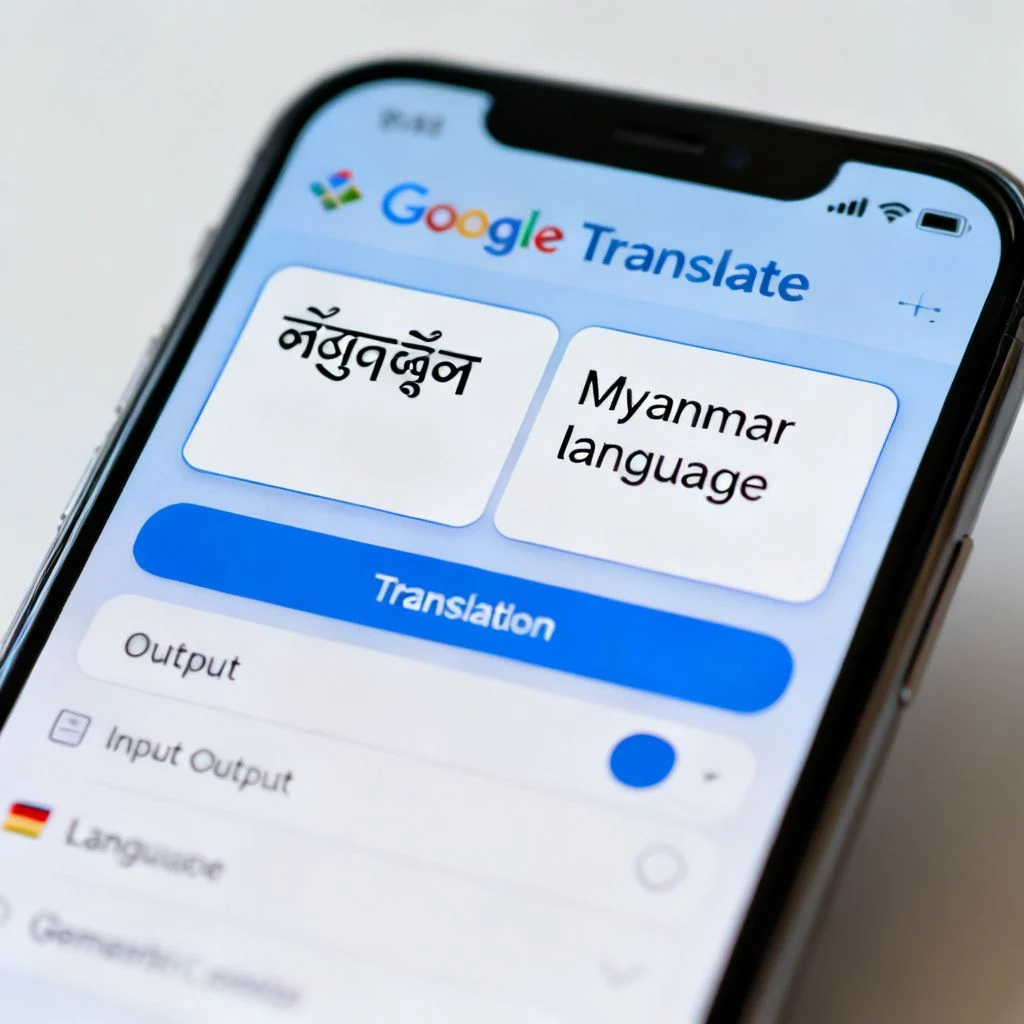
Google Translate with offline language packs downloaded is the practical choice. Download both Burmese and Thai packs before you travel. The camera translation feature works adequately for menus and signs, especially in good lighting.
For Business and Professional Use
Microsoft Translator’s API is worth considering if you need to translate customer communications, product listings, or internal documents at scale. You can build custom workflows and maintain a terminology glossary.
For Healthcare and Social Services
This is the highest-stakes category. Organizations serving Burmese communities in Thailand (and there are over 2 million Burmese migrant workers in Thailand, according to the International Labour Organization) should invest in professional translation for patient-facing materials. Machine tools can help staff communicate basic information in emergencies, but they are not a replacement for trained medical interpreters.
For Content Creators and Publishers
If you are publishing content in both languages, consider a post-editing workflow: run machine translation, then have a native speaker review and correct the output. This is faster and cheaper than translation from scratch while maintaining quality.
Pro Tip: When hiring a human translator for Burmese-Thai work, ask specifically about their experience with migrant worker dialects or border region terminology if that is your context. A translator trained on literary Burmese may struggle with the colloquial language spoken in Mae Sot or Ranong.
Key Takeaways
- Burmese and Thai are structurally very different languages, which makes direct machine translation harder than most language pairs
- No single tool handles all Burmese-Thai translation needs; a combined workflow works best
- Google Translate and Microsoft Translator are the strongest general-purpose options, with SEAlang serving as a reliable dictionary backup
- Honorifics, politeness registers, and loanwords are the most common failure points for machine translation
- For legal, medical, or financial documents, human review is non-negotiable regardless of which tools you use
- Building a terminology glossary dramatically improves consistency for recurring business translation needs
Frequently Asked Questions
Q: Can Google Translate handle Burmese to Thai directly?
A: Yes, Google Translate supports direct Burmese-Thai translation. Quality is adequate for simple phrases and everyday communication, but it struggles with formal documents, honorifics, and idiomatic expressions. For anything important, verify the output with a second tool or a human speaker.
Q: Is there a dedicated Burmese Thai translation assistant app?
A: There is no widely used app dedicated exclusively to Burmese-Thai translation. The practical approach is to use general translation apps like Google Translate or Microsoft Translator, supplemented by dictionary resources like SEAlang or Ornagai for word-level verification.
Q: How accurate is machine translation between Burmese and Thai?
A: Accuracy varies significantly by content type. Simple declarative sentences often translate well. Formal documents, legal text, medical terminology, and colloquial speech are much less reliable. A dual-engine comparison approach catches many errors that a single tool would miss.
Q: What is the best dictionary for Burmese to Thai word lookup?
A: The SEAlang Library hosts a Burmese-Thai dictionary project that is the most comprehensive freely available resource. For Burmese-English lookup, Ornagai is widely used. Neither is a full sentence translator, but both are valuable for verifying individual terms.
Q: Do I need a human translator for Burmese-Thai business documents?
A: Yes, for contracts, agreements, financial statements, and any document with legal or financial consequences, professional human translation is essential. Machine translation can speed up a first draft, but it should never be the final version for high-stakes documents.
Q: Can I use a Burmese Thai translation assistant offline?
A: Google Translate allows you to download offline language packs for both Burmese and Thai. This works for text translation without an internet connection. Camera translation and some advanced features may require connectivity.
Q: What are the most common mistakes in Burmese-Thai machine translation?
A: The most common mistakes involve honorifics and politeness particles, loanwords from Pali that have diverged in meaning, regional dialect differences, and proper nouns. Thai honorific particles like ครับ and ค่ะ are frequently dropped or misapplied.
Q: How do I handle Burmese names when translating into Thai?
A: Burmese names do not follow Western naming conventions and often have no surname. When translating into Thai, names should typically be transliterated phonetically rather than translated. Work with a native speaker to establish consistent transliterations for key names in your documents.
References & Further Reading
- Google Translate Help: Download languages to use offline
- SEAlang Library Burmese Dictionary Resources
- International Labour Organization: Labour Migration in Thailand
- Microsoft Translator Documentation: Language Support
—
About This Article: This guide draws on practical experience working with translation workflows across Southeast Asian language pairs, combined with research into the linguistic structures of Burmese and Thai. The recommendations reflect current tool capabilities as of early 2025. Tool quality changes over time, so verify current performance before committing to a workflow.


Pingback: English to Myanmar Words: A Practical Guide to Everyday…
Pingback: How to Explain in Burmese: A Practical Guide for Clear…