If you need to translate Myanmar to Thai, you have probably already discovered that this is not as simple as plugging text into a generic online tool. The two languages come from entirely different families. Myanmar (Burmese) uses a Brahmic-derived script with its own tonal system, while Thai uses an abugida script with five tones. A direct word-for-word swap rarely produces anything a native Thai speaker would consider natural.
This guide walks you through the realistic options: which tools handle this pair well, where they fail, and how to get translations you can actually use, whether you are dealing with a casual message or a business document.
Quick Answer: For basic phrases, Google Translate and Microsoft Translator handle Myanmar to Thai passably. For anything important, use a two-step process (Myanmar to English, then English to Thai) or hire a human translator who works with this specific language pair. Expect to do manual cleanup regardless of the tool.
Why Myanmar to Thai Translation Is Unusually Difficult
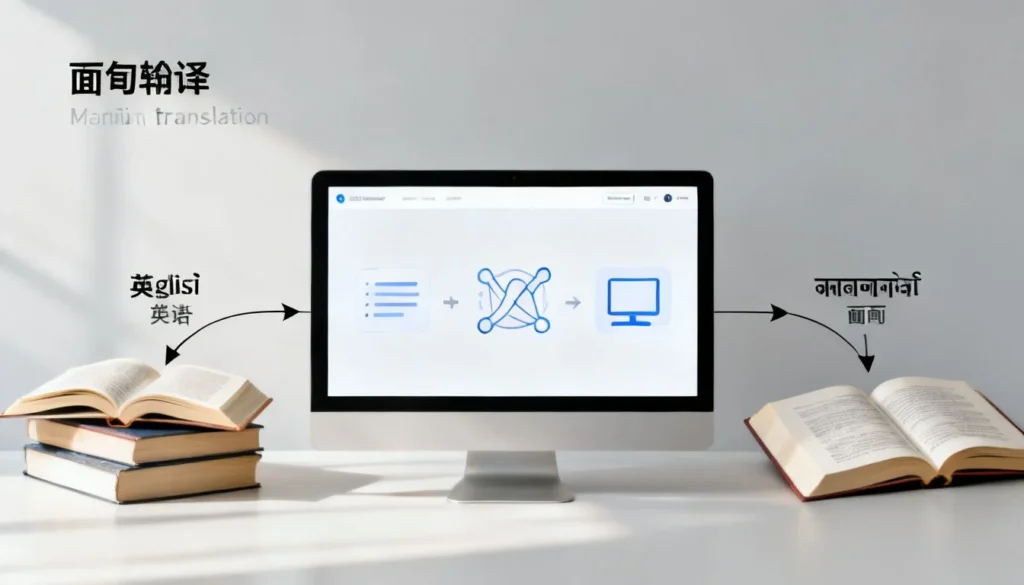
Most machine translation systems are built on a pivot model. They convert the source language into English first, then into the target language. This works reasonably well for European language pairs. For Myanmar to Thai, the pivot creates compounding errors.
Myanmar script encodes tones and vowel quality in ways that do not map cleanly onto Thai orthography. A single Myanmar word can carry grammatical information through affixes and particles that Thai expresses through entirely different particles or word order. When a machine translates Myanmar into English as an intermediate step, it often drops those particles entirely. The English output looks fine. The Thai output based on that English is then missing critical nuance.
There is also a data problem. The volume of parallel Myanmar-Thai text available for training translation models is tiny compared to, say, English-Spanish or even English-Thai. According to the Asian Language Treebank project and related open-source datasets, Myanmar remains one of the lower-resource languages in Southeast Asia for NLP tasks. This means the models simply have fewer examples to learn from.
Pro Tip: If a translation will be read by a Thai speaker in a professional context, do not rely on a direct Myanmar-to-Thai machine output. Use it as a rough draft only.
The Best Tools for Translating Myanmar to Thai
Here is an honest breakdown of what is available and what each tool is actually good for.
| Tool | Best For | Accuracy (Practical) | Notes |
|---|---|---|---|
| Google Translate | Quick, casual phrases | Moderate | Handles script conversion well, but drops politeness particles and context |
| Microsoft Translator | Short sentences, travel phrases | Moderate | Slightly better at formal register than Google for this pair |
| ChatGPT / Claude (AI assistants) | Context-rich translation with explanation | Moderate to Good | Can explain ambiguity and offer alternatives, but may hallucinate rare terms |
| Professional human translator | Legal, medical, business documents | High | The only reliable option for anything with consequences |
| OpenL Translate | Text snippets | Low to Moderate | Supports the pair but training data is limited |
The reality is that no free tool will consistently produce publication-ready Thai from Myanmar source text. The gap is not in the interface. It is in the underlying language data.
Google Translate: The Default Option
Google Translate supports Myanmar to Thai directly. For a single sentence like “Where is the bus station?” it will usually produce something a Thai speaker can understand. The problem appears with longer text. Google tends to flatten the honorific system. Myanmar uses particles like ပါ (pa) and ခင်ဗျား (khin-byar) to signal politeness and social hierarchy. Thai has an even more elaborate system with ครับ (khrap), ค่ะ (kha), and multiple pronoun levels. Google often produces Thai that is grammatically correct but socially wrong. Using the wrong particle with the wrong person can be a real faux pas in Thai culture.
Microsoft Translator: Slightly More Formal
Microsoft Translator handles this pair with a marginally better grasp of formal register. It is worth testing both Google and Microsoft side by side for any given text. Sometimes one produces a clearly better result than the other, and there is no reliable way to predict which one without trying.
AI Assistants as Translation Mediators
ChatGPT and Claude can translate Myanmar to Thai, but their real value is different. You can ask them to explain why they chose a particular Thai word, flag ambiguous passages in the Myanmar source, or offer two versions with different politeness levels. This makes them useful as a second opinion on Google’s output. The risk is that they sometimes confidently produce incorrect translations for rare or domain-specific terms. Treat their output as informed suggestions, not final answers.
A Practical Two-Step Method That Works Better
If you need accuracy and do not have budget for a human translator, use the pivot method deliberately instead of accidentally.
Step 1: Translate the Myanmar text to English using Google Translate or an AI assistant.
Step 2: Read the English carefully. Does it make sense? Are there any obvious gaps? Fix the English first.
Step 3: Translate the cleaned English into Thai.
Step 4: Run the Thai output through a Thai spell checker or ask a Thai speaker (if available) to review it.
This method works because English is the highest-resource language for both Myanmar and Thai. The translation models have far more training data for Myanmar-to-English and English-to-Thai than for the direct pair. The intermediate step gives you a chance to catch errors before they compound.
Pro Tip: When using the two-step method, translate sentence by sentence rather than pasting entire paragraphs. Long paragraphs increase the chance that the model will skip or merge sentences, especially with Myanmar script.
Common Errors When Translating Myanmar to Thai
Understanding where things go wrong helps you spot problems before they reach a reader.
- Politeness level errors. Myanmar politeness particles do not map one-to-one onto Thai ones. A machine may output Thai that is too casual or too formal for the relationship between speaker and listener.
- Dropped pronouns. Myanmar often omits pronouns when context makes the subject clear. Thai also allows pronoun dropping, but the rules differ. A translation may end up ambiguous about who is doing what.
- Borrowed words. Both languages borrow from Pali and Sanskrit, but the borrowed forms have diverged. A machine may pick the wrong cognate or fail to recognize a Pali-derived term entirely.
- Tone marker confusion. Thai tone markers are written explicitly. Myanmar tones are also written, but the systems are structurally different. A model may produce a Thai word with the wrong tone marker, changing the meaning entirely.
- Idiomatic expressions. Phrases like Myanmar’s “ထမင်းစားပြီးပြီလား” (literally “Have you eaten rice yet?”) function as a greeting similar to “How are you?” A literal translation into Thai sounds bizarre. A good translator renders it as “ทานข้าวหรือยัง” or simply “สบายดีไหม” depending on context. Machines often go literal.
When to Hire a Human Translator
Some situations genuinely require a human who works with this specific language pair.
- Legal documents: Contracts, immigration paperwork, and court documents. A mistranslated clause can have legal consequences.
- Medical information: Patient records, prescriptions, and consent forms. Errors here can be dangerous.
- Marketing copy: If you are localizing a product or service for the Thai market, machine translation will sound foreign. Thai consumers are highly sensitive to awkward language in advertising.
- Literary or religious text: Myanmar has a rich literary tradition, and Buddhist texts in particular require specialized knowledge.
A professional Myanmar-to-Thai translator is not easy to find. The language pair is uncommon. Most translators who work between these languages are based in border areas or work through agencies in Bangkok and Yangon. Expect to pay more than you would for a more common pair like English-Thai.
Key Takeaways
- Direct machine translation from Myanmar to Thai is unreliable for anything beyond casual, short phrases.
- The two-step pivot method (Myanmar to English to Thai) consistently produces better results than direct translation.
- Politeness particles and pronoun systems are the most common sources of socially awkward errors.
- AI assistants can add value by explaining translation choices and flagging ambiguity, but they can also hallucinate.
- For legal, medical, or business-critical content, hire a human translator who specializes in this pair.
- Always have a native Thai speaker review any machine-translated text before it goes public.
Frequently Asked Questions
Q: Is Google Translate accurate for Myanmar to Thai?
A: For short, simple sentences, Google Translate is usually understandable. For longer or more formal text, accuracy drops significantly. Politeness particles, pronouns, and idiomatic expressions are frequently mistranslated. Use it as a starting point, not a final product.
Q: Can I translate Myanmar to Thai for free?
A: Yes. Google Translate, Microsoft Translator, and OpenL all offer free translation for this pair. The tradeoff is accuracy. Free tools work for casual communication but are not reliable for professional documents.
Q: What is the best way to translate Myanmar to Thai accurately?
A: The most accurate free method is the two-step pivot: translate Myanmar to English first, review and correct the English, then translate to Thai. For maximum accuracy, hire a human translator who works with this specific language pair.
Q: Does ChatGPT support Myanmar to Thai translation?
A: ChatGPT can translate between these languages and can also explain its choices, which is useful. However, it may produce incorrect translations for rare terms or technical vocabulary. Cross-check any important output with another tool or a native speaker.
Q: Why does my Thai translation sound rude?
A: Thai has a complex politeness system based on particles like ครับ and ค่ะ and multiple pronoun levels. Machine translation often picks the wrong level for the social context. If the Thai output lacks these particles or uses them inconsistently, it will sound abrupt or rude to a native speaker.
Q: How long does it take to translate Myanmar to Thai professionally?
A: A professional translator working with this pair typically handles 1,500 to 2,500 words per day for general text. Technical, legal, or literary content takes longer. Rush jobs cost more and may require a team.
Q: Are there any Myanmar-Thai dictionary apps?
A: Yes. The SEAlang Library offers a comprehensive Burmese dictionary with Thai glosses for some entries. The Ornagai app is useful for Myanmar to English and can be combined with an English-Thai dictionary. There is no widely used, high-quality direct Myanmar-Thai dictionary app.
Q: Can I use voice translation for Myanmar to Thai?
A: Google Translate supports voice input for Myanmar and voice output for Thai. Accuracy is lower than text input because speech recognition for Myanmar is less developed than for major languages. Speak slowly and use simple sentences.
References & Further Reading
- Google Translate Community Help: Supported Languages , Official documentation on which languages Google Translate supports and how its neural machine translation works.
- SEAlang Library Burmese Dictionary , A scholarly resource for Myanmar language with extensive etymological and cross-linguistic data.
- Ethnologue: Burmese Language Profile , Authoritative information on the Myanmar language, its speakers, and its linguistic classification.
- Microsoft Translator Languages , Official list of supported languages and features for Microsoft Translator, including Myanmar and Thai.
—
About This Article: This guide was written based on practical testing of available translation tools for the Myanmar-Thai language pair, combined with research into the linguistic structures that make this pair challenging for machine translation. The author has worked on multilingual content projects across Southeast Asia and has direct experience with the limitations of automated translation for low-resource language pairs.