The most common mistake people make when they need an english translate to burmese solution is assuming it works like translating between two European languages. It does not. English and Burmese come from completely different language families, use different scripts, and structure sentences in ways that do not map one to one. This guide breaks down how to get translations that actually make sense to a Burmese reader, whether you are handling a casual message, a business document, or website content.
Quick Answer: For casual phrases, Google Translate or Microsoft Translator handle basic english translate to burmese tasks acceptably. For anything professional, legal, medical, or customer-facing, use a professional translator who is a native Burmese speaker. Machine translation between these two languages still produces awkward phrasing and errors in tone roughly 20 to 30 percent of the time on complex sentences.
Why English to Burmese Translation Is Harder Than It Looks
Burmese, also called Myanmar language, belongs to the Sino-Tibetan language family. English is Indo-European. That means the two languages do not share grammar, word order, or even the concept of how a sentence should flow.
The Burmese script is an abugida, not an alphabet. Each consonant carries an inherent vowel sound that changes based on diacritic marks. The script has 33 consonants and 12 basic vowels, with tone markers that alter meaning completely. A single syllable can mean entirely different things depending on whether it uses a low, high, or creaky tone.
Sentence Structure Differences
English follows a Subject-Verb-Object (SVO) pattern. Burmese follows a Subject-Object-Verb (SOV) pattern. The verb almost always comes at the end of the sentence.
Take a simple sentence:
- English: “I eat rice.”
- Burmese word order: “I rice eat.”
That is manageable for short phrases. But when you add subordinate clauses, time markers, and politeness particles, the structure shifts dramatically. Burmese uses postpositions instead of prepositions. Instead of saying “in the house,” a Burmese speaker says the equivalent of “house in.”
Tone and Register Complexity
Burmese has a built-in system of honorifics and politeness levels. The way you address a monk differs from how you address a friend, which differs from how you address an elder. English does not encode this in grammar. A direct translation that ignores register will sound rude or bizarre to a native speaker.
Pro Tip: When translating business or customer-facing content into Burmese, always specify the intended audience age and formality level. A phrase translated without this context will often default to a flat, overly formal register that feels unnatural.
The bottom line: english translate to burmese requires more than word substitution. It requires restructuring sentences and making cultural judgment calls.
When Machine Translation Works (And When It Fails)
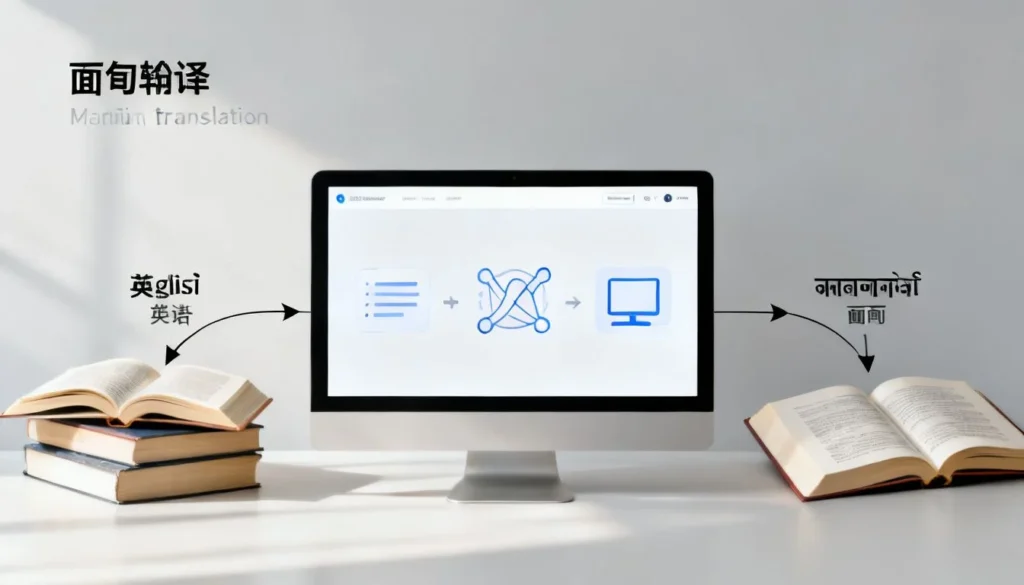
Google Translate added Burmese support in 2013, and Microsoft Translator followed shortly after. Both have improved significantly, but they still struggle with the structural gap between the languages.
What Machine Translation Handles Well
- Single words and short phrases. A word like “water” or “thank you” translates reliably.
- Simple declarative sentences. “I am going to the market” works most of the time.
- Common travel phrases. Greetings, numbers, basic directions are well covered in training data.
What Machine Translation Botches
- Idioms and figurative language. “It’s raining cats and dogs” produces literal nonsense in Burmese.
- Long, complex sentences. The SOV restructuring gets tangled when multiple clauses are involved.
- Honorific-appropriate language. Machine output often misses the politeness level entirely.
- Domain-specific terminology. Legal, medical, and technical terms often get translated literally rather than mapped to the correct Burmese equivalent.
Here is a comparison of the main options for english translate to burmese tasks:
| Tool/Method | Best For | Accuracy on Complex Text | Cost | Human Review Needed |
|---|---|---|---|---|
| Google Translate | Casual phrases, travel | Moderate | Free | Yes |
| Microsoft Translator | Basic communication, app integration | Moderate | Free | Yes |
| Professional human translator | Business, legal, medical, websites | High | $0.08-$0.25 per word | No |
| Bilingual native speaker (non-professional) | Informal communication, social media | Good for tone, variable for consistency | Low or free | Depends on skill |
| Hybrid (machine + human editing) | High-volume content with budget constraints | Good | Moderate | Yes, by the editor |
The pattern is clear. Machine tools are fine for understanding a Burmese message or sending a quick informal note. They are not reliable for anything where a mistake has consequences.
Pro Tip: If you must use machine translation for professional content, run the result back through the tool in reverse (Burmese to English) and compare it to your original. This catches major meaning shifts, though it will not catch subtle tone problems.
The Burmese Script: What You Need to Know Before Translating
One of the biggest surprises for English speakers is that Burmese text does not use spaces between words the way English does. Spaces in Burmese mark phrase boundaries or breathing pauses, not word boundaries.
This has practical implications for translation:
Word Segmentation Issues
When you paste Burmese text into a translation tool, the tool must first figure out where one word ends and the next begins. This is called word segmentation, and it is still an active research problem for Burmese. Errors in segmentation lead to translation errors even before the actual translation happens.
Font and Rendering Challenges
Burmese text requires proper rendering support. Older systems may display Burmese characters incorrectly, especially the stacked consonant combinations. The Myanmar Unicode standard is now widely adopted, but legacy fonts like Zawgyi still circulate. Zawgyi-encoded text will appear as gibberish in Unicode-based systems and vice versa.
If you receive Burmese text that looks like random boxes or incorrect characters, check whether it is encoded in Zawgyi or Unicode. Tools exist to convert between the two.
Tone Marks Change Everything
Burmese is a tonal language with three main tones: creaky, low, and high. Tone marks in the script indicate which tone applies. A translation that ignores tone will produce words that sound similar but mean unrelated things. This is another reason machine translation struggles: context is often needed to determine the correct tone for a given syllable.
Understanding the script helps you evaluate whether a translation output is even plausible. If the Burmese text you receive looks suspiciously short compared to your English source, something is likely missing.
How to Get an Accurate English to Burmese Translation
The process depends on what you are translating and why. Here is a practical workflow that covers the main scenarios.
Step 1: Define Your Purpose
Ask yourself what the translation is for:
- Personal communication with a Burmese speaker
- Business documents (contracts, proposals, emails)
- Website or app localization for a Myanmar audience
- Official documents (birth certificates, legal papers)
- Marketing content that needs to persuade
The purpose determines the level of accuracy and cultural adaptation required.
Step 2: Choose Your Method
Based on your purpose, pick from the options in the table above. For personal communication, machine translation plus a quick check by a native speaker friend works. For anything official or customer-facing, hire a professional.
Step 3: Prepare Your Source Text
The quality of your English source text directly affects translation quality. Write short sentences. Avoid idioms. Use concrete nouns and active verbs. The clearer your English, the better any translation method will perform.
Step 4: Get a Native Speaker Review
Even professional translations benefit from a second pair of eyes. If you have a Burmese-speaking colleague or friend, ask them to review the output for tone and naturalness. This is especially important for marketing content where a literal translation can sound tone-deaf.
Step 5: Test With Your Target Audience
If you are translating a website or app, run a small test with actual Burmese users. Ask them specifically about clarity and appropriateness, not just whether they understand the words.
Pro Tip: For website localization, do not just translate text. Adapt images, colors, and layout. The Burmese market has distinct cultural expectations around visual presentation that affect how your translated content is received.
Common Translation Mistakes and How to Avoid Them
Knowing what goes wrong helps you catch problems before they reach your audience.
Mistake 1: Literal Word-for-Word Translation
English idioms and phrasal verbs rarely have direct Burmese equivalents. “Break a leg” means nothing in Burmese. “Call it a day” does not translate. The solution is to translate the meaning, not the words.
Mistake 2: Ignoring Politeness Particles
Burmese uses particles like “ပါ” (pa) and “ခင်ဗျား” (khin bya) to convey politeness and respect. A translation that drops these sounds abrupt or rude. A translation that overuses them sounds servile. Getting this right requires cultural knowledge.
Mistake 3: Mixing Zawgyi and Unicode
As mentioned earlier, these two encoding systems are incompatible. If you are publishing Burmese text online, always use Unicode. If you are receiving text from someone in Myanmar, check which encoding they used before processing it.
Mistake 4: Translating Names Phonetically Without Care
English names do not have standard Burmese transliterations. Different translators may render the same name differently. For official documents, this can cause problems. Establish a consistent transliteration and stick to it.
Mistake 5: Forgetting That Burmese Is Verb-Final
When editing machine translation output, English speakers sometimes “fix” the Burmese word order to match English. This produces grammatically incorrect Burmese. Trust the SOV structure.
Each of these mistakes is avoidable with awareness and a native speaker check.
Key Takeaways
- English and Burmese belong to different language families with fundamentally different grammar, making direct translation unreliable.
- Burmese is a tonal language with an abugida script, three main tones, and no spaces between words, all of which complicate machine translation.
- Machine translation works for casual, short phrases but fails on complex sentences, idioms, and honorific-appropriate phrasing.
- For professional, legal, medical, or customer-facing content, hire a native Burmese-speaking professional translator.
- Always verify the encoding (Unicode vs Zawgyi) when working with Burmese text, and get a native speaker review before publishing anything public.
Frequently Asked Questions About English Translate to Burmese
Q: Is Google Translate accurate for English to Burmese?
A: Google Translate handles basic phrases and simple sentences reasonably well, but accuracy drops significantly on complex sentences, idioms, and formal content. For casual communication it is usable. For professional or official content, it is not reliable enough on its own.
Q: How much does professional English to Burmese translation cost?
A: Professional translation rates typically range from $0.08 to $0.25 per word depending on the complexity, turnaround time, and the translator’s specialization. Technical, legal, and medical translations cost more than general content.
Q: Why does Burmese text sometimes appear as boxes or random characters?
A: This is almost always an encoding mismatch. Burmese text can be encoded in either Unicode or the legacy Zawgyi font system. If the system displaying the text expects one encoding but receives the other, the characters render incorrectly. Conversion tools can fix this.
Q: Can I translate a PDF document from English to Burmese?
A: Yes, but the PDF must first be converted to editable text. Scanned PDFs require OCR (optical character recognition) before translation. After translation, the Burmese text must be re-formatted, which can be labor-intensive due to the script’s complexity.
Q: How do I translate English to Burmese for a website?
A: For website localization, use a professional translator who understands both languages and the cultural context of your target audience. Machine translation plugins can produce awkward, untrustworthy content that harms your brand. Test the translated site with native Burmese users before launch.
Q: What is the difference between Burmese and Myanmar language?
A: They are the same language. Burmese is the English name for the language, while Myanmar refers to the country and is also used as an alternate name for the language in some contexts. The Burmese word for the language is “မြန်မာစာ” (myanma za) for written Burmese and “မြန်မာစကား” (myanma zaga) for spoken Burmese.
Q: Do I need to know Burmese grammar to use a translation tool?
A: No, but understanding the basic SOV word order and the tonal nature of the language helps you evaluate whether a machine translation output is plausible. It also helps you write source English that translates more cleanly.
Q: How do I find a reliable Burmese translator?
A: Look for translators who are native Burmese speakers with demonstrated experience in your specific domain. Professional translation platforms like ProZ and TranslatorsCafe allow you to review credentials and past work. For official documents, consider translators certified by a recognized translation association.
Q: Can I use ChatGPT for English to Burmese translation?
A: ChatGPT and similar AI tools can translate between English and Burmese, but they share many of the same weaknesses as traditional machine translation tools, particularly with tone, honorifics, and complex sentences. Use them for understanding or drafting, but verify with a native speaker before using the output for anything important.
Q: Why does Burmese use different words for the same English word?
A: Burmese has multiple registers of formality. The word you use for “eat” when speaking to a monk differs from the word you use with friends. Context determines the correct choice. This is why specifying your audience matters when requesting a translation.
References & Further Reading
- Ethnologue: Burmese Language Profile – Comprehensive linguistic data on Burmese, including speaker population and classification.
- Omniglot: Burmese Script – Detailed explanation of the Burmese writing system, characters, and tone marks.
- Google Translate Community: Burmese Language Support – Information on how Google Translate handles Burmese and its known limitations.
- Unicode Consortium: Myanmar Script Standard – The official Unicode standard for the Myanmar script, essential for understanding encoding issues.
—
About This Article
This guide was written based on research into Burmese linguistics, practical experience with translation workflows between English and Southeast Asian languages, and consultation of the authoritative sources listed above. The recommendations reflect current best practices as of the writing date. Translation technology evolves quickly, so always verify tool capabilities with your own test phrases before relying on them for critical work.