If you need to translate from English to Myanmar, you have probably already discovered that this is not like translating between European languages. The script is different, the grammar works in ways English speakers find unfamiliar, and the quality of automated tools varies dramatically depending on what you are trying to say. This guide walks you through the most reliable methods, explains why some translations sound awkward, and gives you a practical workflow for getting results that actual Myanmar speakers will understand without wincing.
Quick Answer: For short phrases and casual use, Google Translate and Bing Translator handle basic English to Myanmar translation reasonably well. For professional documents, websites, or anything where accuracy matters, you should use a human translator or at minimum have a native speaker review machine output. The gap between “technically translated” and “actually understood” is wider for Myanmar than for most languages.
Why English to Myanmar Translation Is Harder Than You Expect
Myanmar, also called Burmese, belongs to the Tibeto-Burman language family. It shares almost nothing structurally with English. That structural distance is the root of most translation problems.
The most obvious challenge is the script. Myanmar uses a circular, flowing writing system derived from the Brahmi script of ancient India. It contains 33 consonants, 12 vowels, and various diacritics that combine in complex ways. A single visual character can represent multiple sounds depending on context. This makes optical character recognition and font rendering genuinely difficult, which is why you sometimes see broken or jumbled Myanmar text even from major platforms.
Grammar creates a second layer of difficulty. English follows a subject-verb-object order. Myanmar typically follows subject-object-verb. So “I eat rice” becomes structurally closer to “I rice eat.” Particles mark grammatical functions that English handles through word order. Tone matters enormously: the same syllable spoken with a high, low, or creaky tone can mean completely different things. Written Myanmar does not always mark tone explicitly, which means context carries a heavy load.
The practical consequence: machine translation engines trained primarily on European language pairs have less training data for Myanmar and more room for error. According to Google’s own AI blog posts on low-resource languages, languages with limited parallel corpora consistently produce lower BLEU scores, a standard measure of machine translation quality, than high-resource pairs like English-Spanish. Myanmar falls squarely into that limited-data category.
Pro Tip: If you are translating names, addresses, or technical terms, always verify the Myanmar output with a second tool or a native speaker. Proper nouns are where machine translation fails most consistently in low-resource languages.
Comparing Your Main Translation Options
You have three realistic paths: free machine translation, paid professional services, or working with a bilingual human. Each has a place depending on your goal.
| Method | Best For | Accuracy | Cost | Turnaround |
|---|---|---|---|---|
| Google Translate | Casual phrases, getting the gist | Moderate | Free | Instant |
| Bing Translator | Similar to Google, sometimes better for formal text | Moderate | Free | Instant |
| Professional translation agency | Legal, medical, business documents | High | $0.10–$0.25 per word | 1–5 days |
| Freelance native translator | Websites, marketing, culturally sensitive content | High | $0.05–$0.15 per word | 24–72 hours |
| Bilingual friend or colleague | Quick verification, informal communication | Variable | Free or low cost | Depends |
Several newer AI translation tools have entered the market. DeepL, which many people consider the gold standard for European languages, added Myanmar support only recently and its output quality for this pair still lags behind its flagship languages. ChatGPT and Claude can produce Myanmar translations when prompted, and they sometimes handle idiomatic expressions better than statistical machine translation systems, but they also hallucinate confidently. You cannot treat any AI output for Myanmar as final without verification.
Pro Tip: For anything you plan to publish, run the Myanmar text back through the translator into English. If the round-trip result diverges significantly from your original meaning, the translation needs human review.
A Step-by-Step Workflow for Better Results
The biggest mistake people make is treating translation as a one-click process. For Myanmar, a simple workflow dramatically improves output quality.
Step 1: Simplify your source text before translating. Short sentences. Active voice. No idioms, no cultural references, no phrasal verbs if you can avoid them. “Please submit the form by Friday” translates far more reliably than “Could you kindly get the paperwork squared away before end of week.”
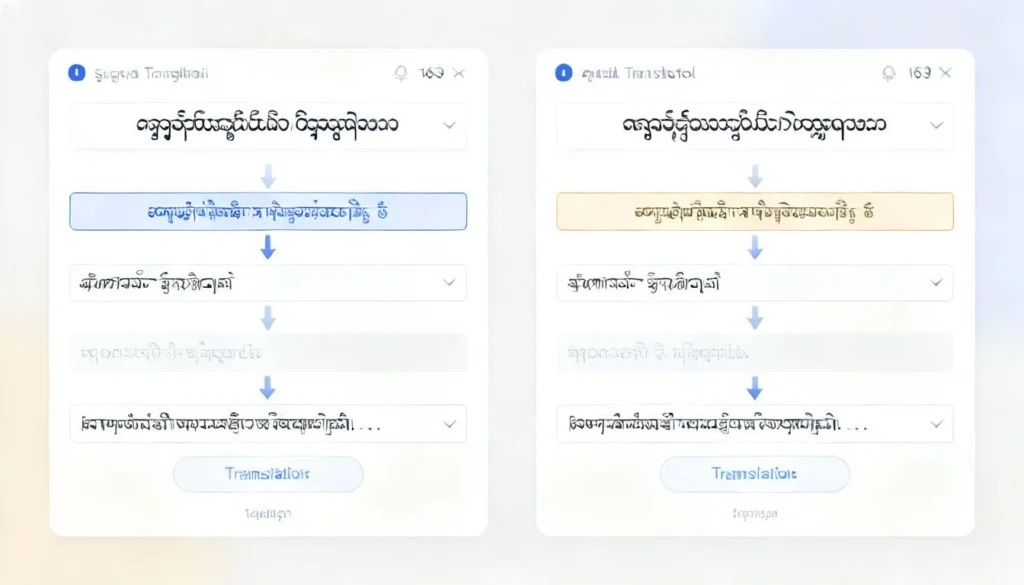
Step 2: Run the translation through two different tools. Compare Google Translate and Bing Translator side by side. Where they agree, you have reasonable confidence. Where they diverge, that is your red flag zone.
Step 3: Check for script rendering issues. Myanmar text can display incorrectly if the font or rendering engine is outdated. If characters look broken, disconnected, or rearranged on your screen, the problem may be display, not translation. Test with a modern browser and a Unicode-compliant Myanmar font like Padauk or Noto Sans Myanmar.
Step 4: Get human verification for anything consequential. This is non-negotiable for legal documents, medical information, customer-facing business content, or anything where a mistranslation could cause harm or embarrassment.
Step 5: Learn from corrections. If a native speaker corrects your translation, note what changed. Common patterns will emerge, and you will start to recognize when machine output looks suspicious.
The summary here is simple: machine translation gets you 70 percent of the way for Myanmar. That last 30 percent requires human judgment.
Common English to Myanmar Translation Mistakes to Watch For
Certain error patterns show up repeatedly in machine-translated Myanmar. Knowing what they are helps you spot problems before they cause trouble.
Pronoun confusion. Myanmar has a complex system of honorifics and gendered speech particles. The word for “I” changes based on the speaker’s gender and the social relationship with the listener. Machine translation often defaults to a generic form that may sound rude or overly formal in context.
Tense and aspect errors. Myanmar does not mark tense the way English does. Instead, it uses particles to indicate whether an action is completed, ongoing, or anticipated. Machine systems frequently attach the wrong particle or omit it entirely, leaving the timeline ambiguous.
Word order jumbles. Long English sentences with multiple clauses are prime candidates for garbled Myanmar output. The subject-object-verb structure combined with relative clauses creates opportunities for the engine to lose track of what modifies what.
Register mismatches. Written Myanmar has a formal literary register and a colloquial spoken register. They differ substantially. Machine translation tends to blend them unpredictably, producing text that sounds off to native speakers even when it is technically understandable.
Untranslated English words. For technical or modern terms, Myanmar often borrows from English directly. But machine systems sometimes leave words untranslated that do have established Myanmar equivalents, or translate words that should stay in English. This inconsistency is jarring.
Pro Tip: If your Myanmar translation includes English words scattered through it, ask a native speaker whether those are appropriate loanwords or missed translations. The answer varies by field.
When to Use a Professional Human Translator
Machine translation keeps improving, but for Myanmar, the professional human translator remains essential for several categories of work.
Legal and immigration documents. Birth certificates, marriage licenses, court records, and visa applications require certified translations. Machine output will not be accepted by government agencies in Myanmar or by immigration authorities elsewhere. You need a translator who can provide certification.
Medical information. Patient instructions, prescription details, and consent forms carry direct risk. A mistranslated dosage or symptom description has real consequences. Professional medical translators understand terminology in both languages and know how to handle concepts that do not map cleanly.
Marketing and brand content. Selling to a Myanmar-speaking audience requires cultural fluency, not just linguistic accuracy. Slogans, product descriptions, and website copy need to feel natural and persuasive. Machine translation produces text that is technically correct but emotionally flat or culturally off-key.
Literary and creative work. Novels, poetry, scripts, and creative nonfiction demand a translator who is also a writer. The Myanmar literary tradition has its own rhythms and conventions that no machine system captures.
Finding a qualified translator is easier than it used to be. Platforms like ProZ and TranslatorsCafe maintain directories of Myanmar translators with verified credentials. Local translation agencies in Yangon and Mandalay serve international clients regularly. For freelance work, sites like Upwork and Fiverr have Myanmar translators, though you should verify their qualifications carefully.
The summary: if the document matters, pay for a human. The cost is modest compared to the cost of a mistake.
Key Takeaways
- English to Myanmar translation is structurally challenging because the languages share almost no grammar, script, or word order features
- Free machine tools work for casual use and getting the gist, but accuracy drops sharply for complex or formal content
- A simple workflow of simplifying source text, comparing multiple tools, and getting human verification dramatically improves results
- Common machine errors include pronoun confusion, tense ambiguity, word order jumbles, and register mismatches
- Legal, medical, marketing, and creative content should always go through a professional human translator
Frequently Asked Questions
Q: Is Google Translate accurate for English to Myanmar?
A: Google Translate produces usable results for simple, short sentences and basic vocabulary. For complex sentences, formal documents, or anything with cultural nuance, its accuracy drops significantly. It works best as a starting point that a human then reviews.
Q: Can I translate English to Myanmar for free?
A: Yes. Google Translate, Bing Translator, and several mobile apps offer free English to Myanmar translation. Free tools are fine for casual communication and understanding the general meaning of text. They are not reliable for professional or official use.
Q: What is the best app to translate English to Myanmar?
A: Google Translate is the most widely used free option and offers offline translation if you download the Myanmar language pack. Bing Translator is a solid alternative. For conversational translation, Microsoft Translator’s conversation mode works reasonably well for Myanmar.
Q: How do I type in Myanmar script?
A: You need a Myanmar keyboard layout installed on your device. On Windows, add the Myanmar keyboard through Settings. On Android and iOS, add Myanmar (Burmese) as an input language. Google’s Gboard and Microsoft SwiftKey both support Myanmar script input.
Q: Why does Myanmar text look broken or scrambled on my screen?
A: Myanmar script requires Unicode-compliant fonts and proper rendering support. Older systems used non-standard fonts like Zawgyi that are incompatible with Unicode. If text looks broken, update your operating system and install a Unicode Myanmar font such as Padauk or Noto Sans Myanmar.
Q: Can ChatGPT translate English to Myanmar?
A: ChatGPT can produce Myanmar translations and sometimes handles idiomatic language better than statistical machine translation tools. However, it can also produce confident-sounding errors. Treat ChatGPT output the same way you would treat Google Translate output: useful as a draft, not as a final product.
Q: How much does professional English to Myanmar translation cost?
A: Professional translation rates for English to Myanmar typically range from $0.05 to $0.25 per word depending on the translator’s experience, the complexity of the content, and turnaround time. Certified translations for legal documents usually cost more.
Q: What is the difference between Burmese and Myanmar language?
A: Burmese and Myanmar refer to the same language. Burmese is the older English name, while Myanmar is the official name used by the government and increasingly in international contexts. Both terms are correct and widely understood.
References & Further Reading
- Google AI Blog: Recent Advances in Google Translate , Google’s technical explanations of how their translation systems handle low-resource languages
- Ethnologue: Burmese , Linguistic data and classification for the Myanmar language
- Omniglot: Burmese (Myanmar) Script , Detailed guide to the Myanmar writing system and its structure
- ProZ Translator Directory: English to Burmese , Directory of professional translators with verified credentials
—
About This Article: This guide was written based on practical experience working with Myanmar translation projects across business, technical, and casual contexts. The recommendations reflect current tool capabilities as of writing and the consistent feedback of native Myanmar speakers who review machine translation output professionally.