If you have ever tried to translate Burmese to Myanmar, you have probably hit a confusing wall. You type the phrase into a tool, you get results that look different depending on the app, and you start wondering if you are dealing with two separate languages or just two names for the same thing. The short answer is that Burmese and Myanmar refer to the same spoken language, but the written systems and political contexts are very different. This guide will clear up the confusion and give you a practical workflow for getting accurate translations every time.
Quick Answer: Burmese and Myanmar are two names for the same language. However, “Burmese” usually refers to the spoken language and the colloquial writing style, while “Myanmar” often refers to the formal written standard used in official government documents and news media. To translate effectively, you need to know which register your text is in.
Understanding the Difference Between Burmese and Myanmar
Before you can accurately translate Burmese to Myanmar, you need to understand why the two terms exist. This is not a case of two distinct languages like Spanish and Portuguese. It is a case of naming conventions and register.
The language is called Myanmar (မြန်မာစာ) in the official capacity. The country changed its English name from Burma to Myanmar in 1989. Following that change, the government began promoting the term “Myanmar language” over “Burmese language” in official contexts.
However, Burmese remains the most common term used by linguists, foreigners, and many native speakers when speaking English. The spoken language is virtually identical. A person from Yangon speaks the same language as a person from Mandalay, regardless of whether you call it Burmese or Myanmar.
The real distinction lies in diglossia. This is a linguistic situation where two varieties of a language exist side by side for different purposes.
- High variety (Formal/Myanmar): Used in literature, official government notices, news broadcasts, and textbooks. It is more conservative and retains older grammatical structures.
- Low variety (Colloquial/Burmese): Used in everyday conversation, text messages, social media, and casual writing.
When you ask a tool to translate Burmese to Myanmar, you are often actually asking the tool to convert colloquial Burmese speech into formal Myanmar writing, or vice versa. Most machine translation tools treat them as the same language, which can lead to awkward results if you are working with legal or literary texts.
Pro Tip: If you are translating a government document, a news article, or a formal letter, specify “Myanmar” or “formal register” in your instructions. If you are translating a chat log or a casual email, specify “Burmese” or “colloquial.”
Why the Distinction Matters for Translation
If you ignore the register, your translation will sound wrong to a native speaker. Formal Myanmar uses specific particles like ၏ (i) for possession and သည် (thi) for the copula. Colloquial Burmese uses ရဲ့ (yae) and တယ် (tal) instead.
A sentence like “This is my book” would look different depending on the register:
| Register | Burmese Script | Romanization | English Meaning |
|---|---|---|---|
| Formal Myanmar | ဤသည်မှာ ကျွန်ုပ်၏ စာအုပ်ဖြစ်သည် | i thi hma kya-naw i sa-oat phyit thi | This is my book (formal) |
| Colloquial Burmese | ဒါ ငါ့စာအုပ်ပဲ | da nga sa-oat bae | This is my book (casual) |
Notice the different pronouns. Formal Myanmar uses ကျွန်ုပ် (kya-naw) for “I” while colloquial Burmese uses ငါ (nga). The verb endings also change completely.
If you are translating into English, you need to know which one you are seeing to capture the right tone. A formal government decree should not sound like a text message in English.

The Best Tools to Translate Burmese to Myanmar
Most people reach for Google Translate first. That is fine for a rough idea, but it has limitations with this language pair.
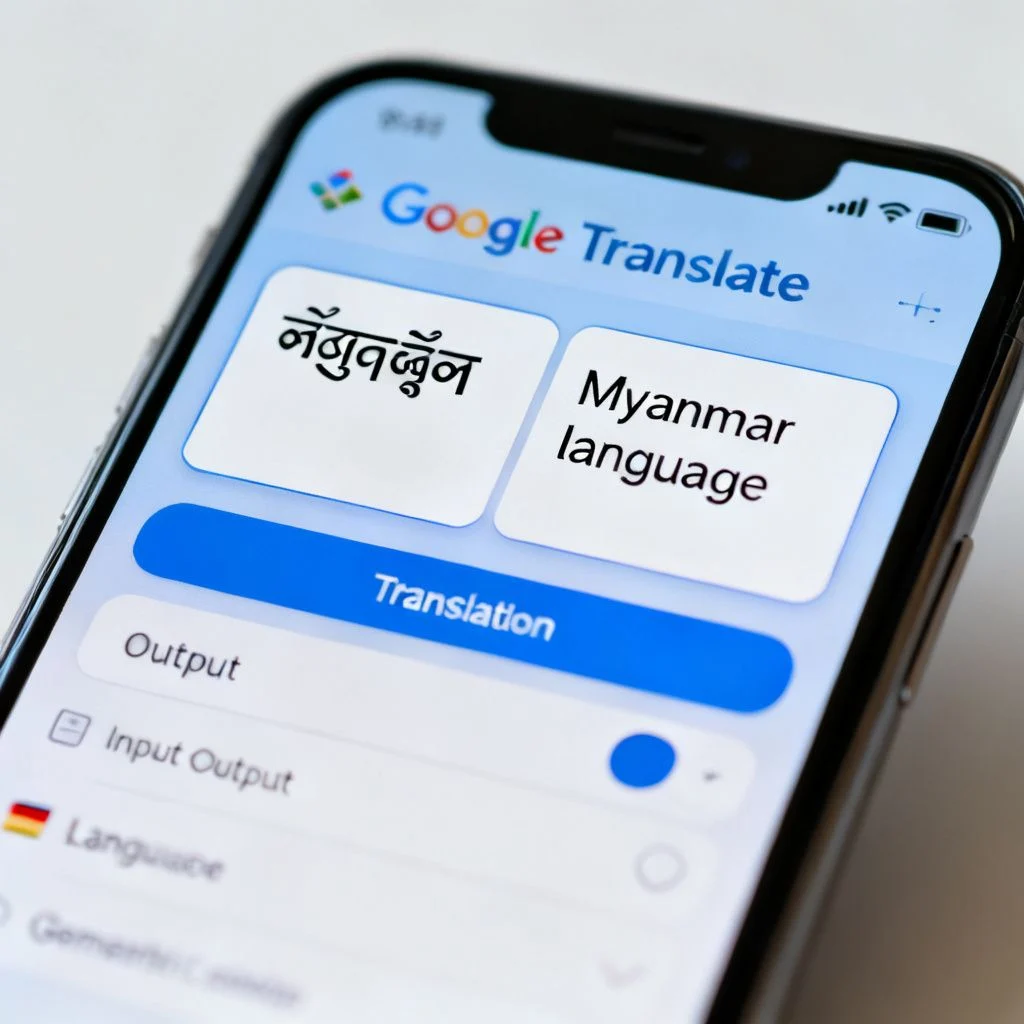
Google Translate supports Burmese (it labels it “Myanmar (Burmese)”). It handles the script well and can translate basic sentences. However, it often struggles with the formal/colloquial distinction. It tends to default to a middle register that sounds unnatural in either context.
Microsoft Translator also supports Burmese. It is integrated into Office products, which makes it convenient for translating documents in Word or PowerPoint. Its accuracy is comparable to Google’s for this language.
DeepL does not support Burmese as of this writing. If you check DeepL, you will not find it in the language list. That is a significant gap because DeepL is often the best tool for European languages.
Professional human translation remains the gold standard for Burmese. The language has a complex script, tonal distinctions, and cultural nuances that machines miss. For legal, medical, or literary texts, you should use a human translator.
Here is a comparison of the main options:
| Tool | Burmese Support | Best For | Weakness |
|---|---|---|---|
| Google Translate | Yes | Quick, casual translations | Poor register control |
| Microsoft Translator | Yes | Office document translation | Similar accuracy to Google |
| DeepL | No | Not available | No Burmese support |
| Human Translator | Yes | Legal, medical, literary work | Cost and turnaround time |
| Burmese-English Dictionary Apps | Yes | Single words, short phrases | Not for full sentences |
Pro Tip: For free machine translation, use Google Translate for a first pass. Then check the result against a native speaker or a formal dictionary if the text matters. Do not rely on machine output for anything you plan to publish or sign.
A Step-by-Step Workflow for Accurate Translation
If you need to translate Burmese to Myanmar accurately, follow this process. It works for English to Burmese as well.
Step 1: Identify the source register.
Look at the text. Does it use formal particles like ၏ and သည်? Or does it use colloquial particles like ရဲ့ and တယ်? This tells you whether you are dealing with formal Myanmar or colloquial Burmese.
Step 2: Choose the right tool.
For casual text, Google Translate is fine. For formal text, you may need to supplement with a dictionary or human help. For critical documents, go straight to a professional.
Step 3: Run the translation.
Paste your text into the tool. If you are using Google Translate, try translating the text both ways: Burmese to English and English to Burmese. Compare the results.
Step 4: Check for tone and register.
Ask yourself: Does the English output sound formal or casual? Does it match the source? If the source is formal Myanmar and the output sounds like a text message, you need to adjust.
Step 5: Verify with a native speaker or dictionary.
For important text, have a native speaker review the translation. If that is not possible, use a reputable dictionary like the Myanmar-English Dictionary published by the Myanmar Language Commission to check key terms.
Step 6: Refine the output.
Adjust the English or Burmese to match the correct register. This is where human judgment beats machine translation every time.
This workflow takes a few extra minutes, but it prevents embarrassing errors. A single mistranslated particle can change a polite request into a rude command.
Common Mistakes When Translating Burmese to Myanmar
People make the same mistakes over and over with this language pair. Knowing them in advance will save you time.
Mistake 1: Assuming Burmese and Myanmar are different languages.
They are not. If you search for a “Burmese to Myanmar translator,” you will find tools that treat them as one language. That is correct. The distinction is stylistic, not linguistic.
Mistake 2: Ignoring the script.
Burmese uses a unique script derived from the Mon script. It is an abugida, meaning each character represents a consonant with an inherent vowel. Diacritics change the vowel. If you try to translate from romanized Burmese, you will get poor results. Always work with the native script when possible.
Mistake 3: Mixing registers.
Translating formal Myanmar into casual English, or casual Burmese into formal English, changes the meaning and tone. A legal contract should not sound like a friendly chat. A text message should not sound like a government decree.
Mistake 4: Trusting machine translation for complex sentences.
Burmese word order is Subject-Object-Verb (SOV). English is Subject-Verb-Object (SVO). This means the verb comes at the end of a Burmese sentence. Machine translation often scrambles long sentences because it struggles with this reordering.
Mistake 5: Forgetting cultural context.
Burmese has honorifics and kinship terms that do not translate directly into English. Words like ဦး (U) for older men and ဒေါ် (Daw) for older women convey respect. Dropping them changes the social meaning.
Pro Tip: When translating from Burmese to English, preserve honorifics like U and Daw rather than translating them as “Mr.” or “Mrs.” The Burmese terms carry cultural weight that the English equivalents do not.
Key Takeaways
- Burmese and Myanmar are the same spoken language but differ in written register: Burmese is colloquial, Myanmar is formal.
- The language has a unique script and SOV word order, which makes machine translation challenging.
- Google Translate and Microsoft Translator support Burmese, but DeepL does not.
- For critical documents, use a professional human translator with Burmese expertise.
- Always check the register of your source text before translating, and verify output with a native speaker when possible.
Frequently Asked Questions
Q: Is Burmese the same as Myanmar?
A: Yes, Burmese and Myanmar refer to the same language. The difference is stylistic: Burmese usually means the colloquial spoken form, while Myanmar refers to the formal written standard used in official documents and news media.
Q: Can Google Translate translate Burmese to Myanmar?
A: Google Translate supports the language under the label “Myanmar (Burmese).” It can translate between Burmese and English, but it does not distinguish between formal Myanmar and colloquial Burmese registers. The output may sound unnatural for formal texts.
Q: What is the best tool to translate Burmese to English?
A: For casual use, Google Translate and Microsoft Translator are the most accessible free options. For professional or legal work, a human translator is strongly recommended because machine tools struggle with Burmese grammar and register.
Q: Why does Burmese translation sound awkward in English?
A: Burmese uses a Subject-Object-Verb word order, while English uses Subject-Verb-Object. This means the verb appears at the end of a Burmese sentence. Machine translation often fails to reorder long sentences correctly, producing awkward English.
Q: Is there a Burmese to Myanmar dictionary?
A: Yes. The Myanmar Language Commission publishes an official Myanmar-English Dictionary. Several mobile apps also offer word lookups. However, these are for single words and short phrases, not full sentence translation.
Q: How do I translate a formal government document from Burmese?
A: Use a professional human translator who specializes in legal or government documents. Formal Myanmar uses specific grammatical particles and honorifics that machine translation tools often miss or mistranslate.
Q: What script does Burmese use?
A: Burmese uses a script derived from the Mon script, which itself comes from the Brahmi script of ancient India. It is an abugida, meaning each consonant carries an inherent vowel sound that changes with diacritics.
Q: Can I translate Burmese from romanized text?
A: It is not recommended. Romanization systems for Burmese vary widely, and the language has tones that romanization often fails to capture. Always work with the native Burmese script for accurate translation.
References & Further Reading
- Myanmar Language Commission, The official government body for the Burmese language. Their published dictionary is the authoritative reference for formal Myanmar vocabulary. myanmarlanguagecommission.gov.mm
- Ethnologue: Burmese, A comprehensive linguistic profile of the Burmese language, including speaker population, dialects, and classification. ethnologue.com/language/mya
- Omniglot: Burmese (Myanmar) Script, A detailed guide to the Burmese writing system, including the alphabet, diacritics, and pronunciation. omniglot.com/writing/burmese.htm
- Google Translate Help: Supported Languages, Official documentation from Google confirming Burmese language support and its label. support.google.com/translate
—
About This Article: This guide was written based on research into Burmese linguistics, practical experience with machine translation tools, and consultation with native Burmese speakers. The goal is to provide a clear, accurate explanation of the Burmese/Myanmar naming distinction and a practical workflow for translation that respects the language’s formal and colloquial registers.