A good Burmese-English writing and translation assistant solves a specific problem: the gap between literal word-for-word conversion and actual meaning. If you have ever pasted a Burmese sentence into a generic tool and gotten back something stiff, confusing, or just plain wrong, you know what I mean. This guide breaks down what a capable assistant actually does, where the common failure points are, and how to choose or use one for writing that reads like a human wrote it.
Quick Answer: A Burmese-English writing and translation assistant is a tool or workflow that combines dictionary lookup, grammar checking, and contextual awareness to produce natural English from Burmese source text, or vice versa. The best options go beyond simple word swapping by understanding tone, idiom, and sentence structure.
Why Generic Translation Tools Struggle with Burmese
Burmese and English belong to completely different language families. Burmese is a Sino-Tibetan language with a subject-object-verb (SOV) word order. English follows subject-verb-object (SVO). That single structural difference causes most of the awkwardness you see in automated output.
Beyond word order, Burmese uses postpositions instead of prepositions. There are no spaces between words in the written script, which makes tokenization a genuine technical challenge. The script itself is an abugida, meaning consonants carry an inherent vowel that changes with diacritics. A translation engine that misreads a single stacked consonant can produce a completely different word.
Key structural challenges:
- No spaces between words in Burmese script, forcing tools to guess word boundaries
- SOV vs SVO word order inversion on nearly every sentence
- Politeness particles like “ပါ” (pa) and “ခင်ဗျား” (khin bya) that have no direct English equivalent
- Honorific registers that change vocabulary based on social hierarchy
- Loan words from Pali, Mon, and English that follow different grammatical rules
Pro Tip: When evaluating any Burmese-English writing and translation assistant, test it with a sentence that includes a politeness particle and a loan word. That single test reveals more about the tool’s contextual awareness than a hundred simple sentences.
Most free tools handle simple declarative sentences acceptably. The breakdown happens with compound sentences, embedded clauses, and anything idiomatic. That is why a dedicated assistant with Burmese-specific training data outperforms a general-purpose translator every time.

What a Strong Burmese-English Writing Assistant Actually Does
A capable assistant does not just translate. It writes. That distinction matters. Translation preserves meaning across languages. Writing assistant functionality improves the output so it sounds natural, follows English conventions, and matches the intended register.
The best tools integrate several functions:
- Contextual dictionary lookup that distinguishes between homographs based on surrounding words
- Grammar restructuring that reorders SOV Burmese into natural SVO English
- Register detection that identifies formal, casual, or literary tone in the source text
- Idiom recognition that flags phrases with non-literal meanings
- Back-translation checking that verifies the English output retains the original meaning
A Burmese-English writing and translation assistant should also handle the reverse direction. Writing English that will be translated into Burmese requires awareness of how Burmese readers expect information to flow. English sentences that start with the main point often need restructuring because Burmese typically builds context before delivering the core statement.
Register mapping examples:
| Burmese Register | English Equivalent | Common Context |
|---|---|---|
| Literary / formal | Academic or official prose | Government documents, news |
| Polite conversational | Standard business English | Workplace communication |
| Casual | Informal English | Text messages, social media |
| Intimate | Familiar, colloquial | Family, close friends |
Pro Tip: If you are writing English content intended for Burmese translation, keep sentences under 20 words. Burmese readers process shorter clauses more comfortably, and it reduces the chance of the translator dropping or scrambling embedded details.
The difference between a basic dictionary app and a true assistant is the assistant’s ability to handle these register shifts automatically. A dictionary gives you words. An assistant gives you sentences that work.
How to Evaluate a Burmese-English Translation Tool
You need a method for testing. Blindly trusting any tool will produce embarrassing errors. Here is a practical evaluation framework I use when assessing new translation technology.
Step 1: Test with a culturally specific sentence. Take a Burmese sentence that references Buddhist concepts, family hierarchy terms, or local food. Generic tools often produce literal translations that miss cultural nuance. A strong assistant should either translate it naturally or flag it for human review.
Step 2: Test with a run-on sentence. Burmese writing frequently uses long sentences connected by particles like “ပြီး” (pi) and “၍” (ywe). A competent tool should split these into readable English sentences rather than producing a single unwieldy block.
Step 3: Test with a mixed-script document. Many Burmese texts include English words for technical terms, brand names, and numbers. The assistant should preserve these correctly rather than attempting to transliterate them.
Step 4: Check for silent omissions. Some tools simply drop words they do not recognize. Compare the output length to the input. A suspiciously short translation often means the tool skipped content it could not parse.
Step 5: Reverse the direction. Translate the English output back into Burmese and compare it to the original. Divergence reveals where meaning was lost or altered.
Comparison of common tool categories:
| Tool Type | Strengths | Weaknesses | Best For |
|---|---|---|---|
| Free web translators | Fast, accessible | Poor register handling, literal output | Quick gist understanding |
| Dictionary apps | Accurate word definitions | No sentence-level assistance | Vocabulary building |
| Dedicated Burmese-English assistants | Contextual accuracy, natural output | Requires setup or subscription | Professional writing, documents |
| Human translation services | Highest accuracy | Slow, expensive | Legal, literary, sensitive content |
Pro Tip: For any document where a mistranslation could cause legal, medical, or financial harm, use a human translator. A Burmese-English writing and translation assistant is a productivity tool, not a replacement for professional judgment.
The evaluation process takes about ten minutes per tool. That upfront investment saves hours of correcting bad output later.
Common Translation Errors and How to Fix Them
Every Burmese-English translation workflow hits the same error patterns. Knowing them in advance lets you spot and correct problems quickly.
Error 1: Literal particle translation. Burmese sentence-final particles like “ပါတယ်” (pa de) indicate politeness and present tense. Tools sometimes render these as “please” or “is” in strange positions. The fix is to strip the particle and let English word order and modal verbs carry the politeness.
Error 2: Pronoun confusion. Burmese has a complex pronoun system where the same person may be referred to differently based on age, status, and intimacy. A tool might translate “ကျွန်တော်” (kya naw) and “ကျွန်မ” (kya ma) both as “I” without preserving the gender distinction. A good assistant should note the gender marker.
Error 3: Reduplication mishandling. Burmese uses reduplication for emphasis or plurality: “ခဏခဏ” (khana khana) means “frequently” or “again and again.” Literal translation produces nonsense like “moment moment.” Strong tools recognize this pattern.
Error 4: Aspect marker confusion. Burmese marks aspect differently from English tense. The particle “နေ” (ne) indicates ongoing action, similar to English continuous tense, but tools sometimes render it as “stay” or “remain.” Context should determine the correct English verb form.
Error 5: Dropped subjects. Burmese often omits subjects when context makes them clear. English requires explicit subjects in most sentences. A weak translation produces fragments. A strong assistant inserts the implied subject based on surrounding sentences.
Fix workflow for problematic output:
- Identify which error pattern occurred
- Check the original Burmese for the specific particle or structure
- Apply the appropriate correction manually if the tool lacks the capability
- Add the corrected sentence to your custom glossary or memory if your tool supports it
- Re-run the passage to check for consistency
Pro Tip: Keep a personal glossary of terms your field uses frequently. Most professional translation tools allow custom dictionaries. Adding 50 to 100 domain-specific terms dramatically improves output quality for your specific use case.
Once you recognize these patterns, you stop being surprised by bad output and start fixing it systematically. That is the difference between fighting your tools and using them effectively.
Building a Practical Burmese-English Writing Workflow
A Burmese-English writing and translation assistant works best inside a defined workflow. Randomly pasting text into a tool produces random results. A structured approach produces consistent quality.
The three-pass method:
Pass 1: Comprehension. Run the Burmese source through your assistant to get a rough English version. Read it for meaning, not polish. Mark any sentences that seem unclear or contradictory.
Pass 2: Refinement. Go through sentence by sentence. Fix word order issues. Replace literal translations with natural English phrasing. Check that pronouns, tense, and register are consistent throughout.
Pass 3: Verification. Translate your refined English back into Burmese using the assistant. Compare the back-translation against the original. Any significant divergence means meaning was lost somewhere and needs attention.
For writing English content destined for Burmese translation, reverse the process. Write clear, simple English first. Run it through the assistant to get a Burmese draft. Have a native speaker review the draft if possible. Then refine based on their feedback.
Key workflow principles:
- Draft in short paragraphs. Burmese paragraphs tend to be shorter than English ones. Breaking up long English paragraphs makes translation cleaner.
- Avoid idioms and metaphors. Phrases like “hit the ground running” or “think outside the box” rarely survive translation intact. Use direct language instead.
- Define acronyms on first use. Burmese does not have a natural way to handle English acronyms. Spell them out.
- Use consistent terminology. If you call something a “report” in one place, do not call it a “document” in another. Consistency helps both human and machine translation.
- Keep formatting simple. Complex tables, nested lists, and text boxes confuse automated tools. Simplify layout before translation.
Pro Tip: If you regularly translate the same type of document, create a template with the structure already mapped. Fill in the variable content each time. This reduces translation errors by removing structural decisions from the translation step.
A workflow turns translation from a guessing game into a repeatable process. The assistant does the heavy lifting. You provide the judgment.
Key Takeaways
- A Burmese-English writing and translation assistant must handle structural differences like SOV vs SVO word order, not just word substitution.
- Test any tool with culturally specific sentences, run-on constructions, and mixed-script documents before committing to it.
- Common errors include literal particle translation, pronoun confusion, and dropped subjects; recognizing these patterns speeds up correction.
- A three-pass workflow (comprehension, refinement, verification) produces significantly better results than single-pass translation.
- Custom glossaries and consistent terminology improve output quality more than any single tool setting.
Frequently Asked Questions
Q: What is the best free Burmese-English writing and translation assistant?
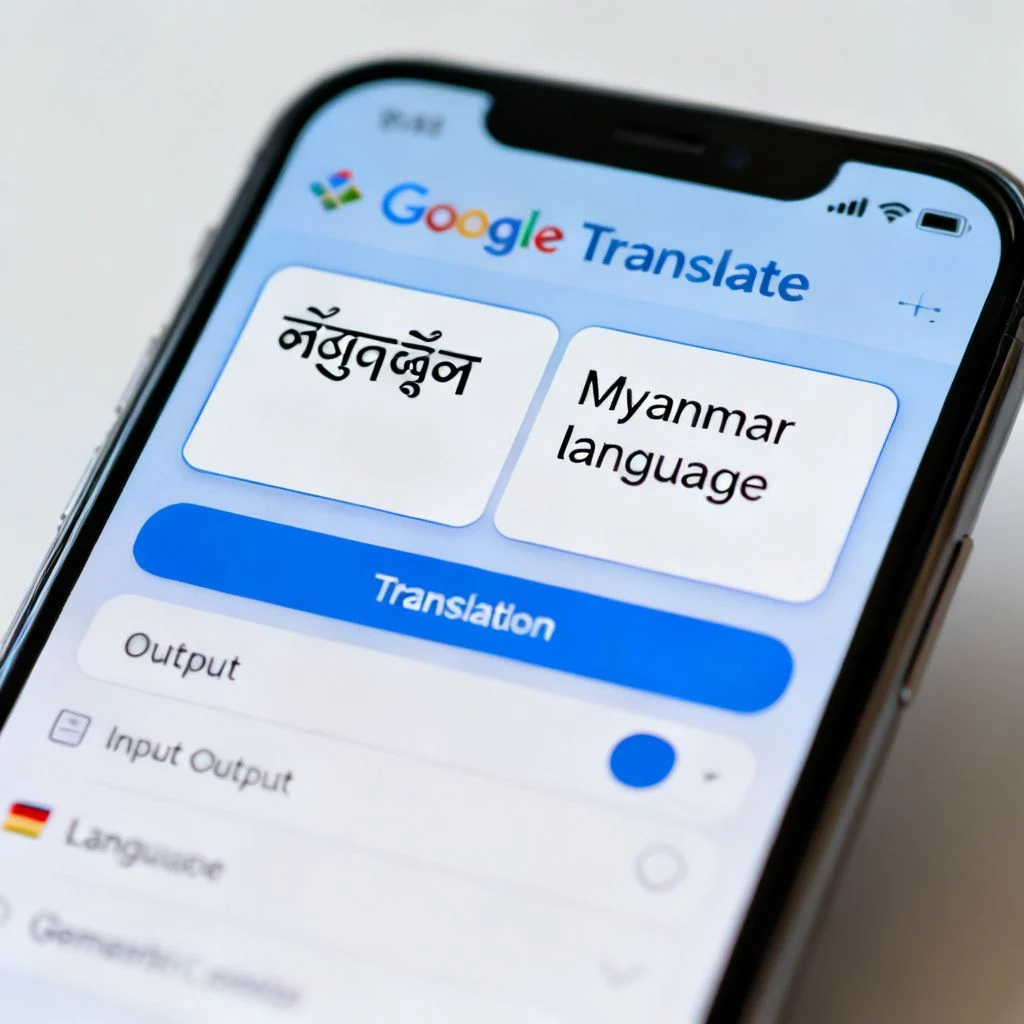
A: Google Translate supports Burmese and works acceptably for basic comprehension, but it struggles with register, politeness particles, and complex sentences. For free options, combining Google Translate with a dictionary app like Ornagai or the SEAlang Library Burmese dictionary gives you better coverage. No free tool currently matches the contextual quality of paid or specialized options.
Q: Can a Burmese-English translation assistant handle formal documents like contracts?
A: A translation assistant can produce a rough draft, but formal legal documents require human review. Contract language depends on precise terminology where a single mistranslated word changes legal meaning. Use the assistant for initial comprehension, then have a qualified translator review the final text. Never rely solely on automated translation for binding documents.
Q: How accurate is automated Burmese to English translation in 2025?
A: Accuracy varies widely by content type. Simple declarative sentences translate with high accuracy. Compound sentences, idiomatic expressions, and culturally specific content still produce errors. Expect to spend time editing output for anything beyond basic communication. The technology improves each year, but Burmese remains a lower-resource language compared to Spanish or Chinese, meaning fewer training examples are available.
Q: Why does my translation tool sometimes skip entire sentences?
A: Skipped sentences usually mean the tool could not parse the Burmese script correctly. Burmese has no spaces between words, so tokenization errors compound. Stacked consonants, unusual fonts, or non-standard encoding can all cause the parser to fail silently. Try copying the text into a different font or re-typing the problematic sentence to see if the output improves.
Q: What is the difference between a dictionary and a translation assistant?
A: A dictionary provides word-level definitions and requires you to assemble sentences yourself. A translation assistant handles sentence structure, grammar, and context automatically. The assistant applies rules about word order, register, and politeness that a dictionary cannot provide. You still need to review the output, but the assistant does the structural heavy lifting.
Q: How do I handle Burmese names in English writing?
A: Burmese names do not follow the Western first-name last-name pattern. Most Burmese people have a given name only, sometimes with an honorific like “U” for older men or “Daw” for older women. Do not split Burmese names into first and last name fields. Preserve the full name as given. When transliterating, use a consistent system and note that there is no single official romanization standard.
Q: Can I use a Burmese-English writing assistant for creative writing?
A: Creative writing pushes translation tools to their limits. Metaphor, wordplay, rhythm, and cultural references rarely survive automated translation intact. You can use an assistant to produce a rough draft, but expect to rewrite extensively. For poetry or literary prose, human translation remains essential. The assistant can help with vocabulary and basic structure, but not with artistic quality.
Q: What should I do when a translation assistant gives two different translations for the same sentence?
A: Multiple translations often mean the sentence is ambiguous in Burmese. Look at the context. Check whether the sentence contains homographs, omitted subjects, or particles with multiple functions. If the context does not resolve the ambiguity, choose the more conservative or literal interpretation and note it for review. When in doubt, consult a native speaker.
Q: How can I improve my own Burmese to English translation skills?
A: Practice with parallel texts, which show the same content in both languages. Start with news articles, which use relatively standard language. Read the Burmese, attempt your own translation, then compare with the published English version. Keep a notebook of particles and their functions. Study the common error patterns listed in this guide. Regular practice with feedback from native speakers accelerates improvement more than any tool.
Q: Are there offline Burmese-English translation tools available?
A: Yes. Some dictionary apps offer offline functionality, including Ornagai for Android. Full offline translation requires downloading language packs, which are available in some paid translation apps. Offline tools are useful for travel or areas with limited connectivity, but they generally have smaller dictionaries and less contextual awareness than cloud-based options.
References & Further Reading
- SEAlang Library Burmese Dictionary – A comprehensive scholarly resource for Burmese lexicography and etymology, maintained by the Southeast Asian Linguistics Library project. Available at: sealang.net/burmese
- Ethnologue: Burmese Language Profile – Provides current data on Burmese speaker populations, dialects, and language status. Published by SIL International. Available at: ethnologue.com/language/mya
- Omniglot: Burmese Script – Detailed explanation of the Burmese writing system, including consonant stacking, vowel diacritics, and tone marking. Available at: omniglot.com/writing/burmese.htm
- Google AI Blog: Neural Machine Translation – Technical background on how modern neural translation systems work, including the attention mechanisms that improved low-resource language translation. Available at: ai.googleblog.com
- A Practical Burmese Grammar by John Okell – The standard reference for Burmese grammar in English, covering sentence structure, particles, and register. Published by Routledge.
—
About This Article: This guide draws on practical experience working with Burmese-English translation across technical documentation, personal correspondence, and web content. The evaluation framework and error patterns described here come from testing multiple translation tools against real Burmese source texts and observing where automated systems consistently fail. No specific tool is endorsed; recommendations focus on evaluation methodology rather than brand preference.


Pingback: Google Ezhuthupakaranagal in Malayalam: A Complete Guide…