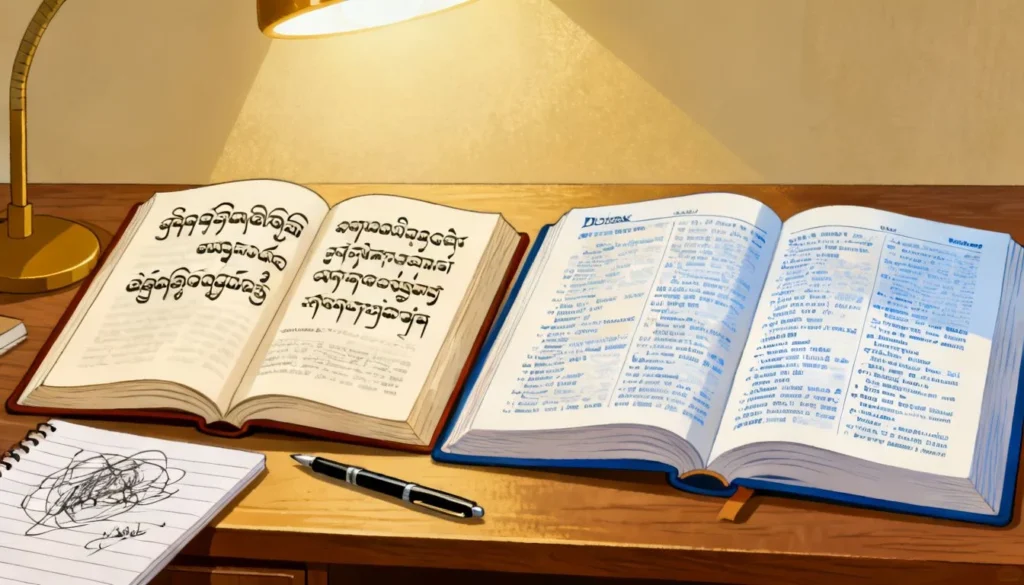
Translation Myanmar to English is a challenge that trips up everyone from tourists to business owners. The two languages share almost nothing in common. Different scripts. Different grammar. Different ways of thinking about time and politeness. But getting a decent translation is absolutely doable once you understand how the tools work and where they fail.
Quick Answer: For casual phrases and menus, Google Translate or Microsoft Translator handle basic translation Myanmar to English adequately. For legal documents, medical records, or business contracts, hire a professional Burmese translator. Machine tools still make serious errors with formal Burmese.
Why Burmese Is Harder to Translate Than You Think
Burmese belongs to the Sino-Tibetan language family, which puts it in a completely different branch from English. The written form uses a circular, flowing script derived from the Brahmi writing system of ancient India. There are 33 consonants and 12 basic vowels, but the real complexity comes from how they combine.
Here is what makes translation Myanmar to English uniquely difficult:
- No spaces between words. Burmese script runs words together, with spaces only marking phrase boundaries. A machine has to guess where one word ends and another begins.
- Tonal distinctions. Burmese is a tonal language. The same syllable can mean three different things depending on pitch. Written Burmese marks tone, but context still matters enormously.
- Politeness registers. Burmese has distinct vocabulary for speaking to monks, elders, and royalty. English has nothing equivalent, so translators must decide how formal to be.
- Particles everywhere. Small grammatical particles attach to words to show subject, object, tense, and mood. These particles have no direct English equivalent.
Most people assume the hard part is the unfamiliar script. It is not. The hard part is that Burmese packs a lot of grammatical information into structures English simply does not have.
Pro Tip: If you are testing a translation tool, start with a simple sentence you already know the answer to, like “I eat rice.” Then try a complex sentence with a subordinate clause. The difference in output quality tells you a lot about the tool’s real capability.
Machine Translation: What Works and What Falls Apart
Google Translate added Burmese support in 2014, and the quality has improved steadily since. For everyday phrases, directions, and simple written text, it gets the job done. Microsoft Translator and Yandex Translate also support Burmese, though their accuracy lags slightly behind Google for this language pair.
Here is a quick comparison of the main options:
| Tool | Best For | Weaknesses |
|---|---|---|
| Google Translate | Everyday phrases, menus, signs | Struggles with formal and literary Burmese |
| Microsoft Translator | Business documents, email | Inconsistent with idiomatic expressions |
| Yandex Translate | Short text snippets | Limited context awareness |
| Human translator | Legal, medical, literary work | Slower and costs money |
The pattern is consistent. Machine tools handle simple declarative sentences well. They fall apart on anything with cultural nuance, indirect speech, or specialized vocabulary. A Burmese legal contract run through Google Translate will produce something readable but potentially dangerous. Terms like “consideration” in contract law have no direct Burmese equivalent, and the reverse translation often misses the legal meaning entirely.
Pro Tip: Always run a reverse translation check. Take the English output, translate it back to Burmese, and see if the meaning holds. If the reverse translation looks strange, the original output is probably unreliable.
When to Use a Professional Human Translator
There is a point where free tools stop being helpful and start being risky. If the document matters, hire a person. That includes birth certificates, marriage licenses, medical records, court documents, and anything involving money.
Professional Burmese translation services charge anywhere from $0.10 to $0.25 per word depending on complexity and turnaround time. Certified translations for immigration or legal purposes cost more because they require a translator’s affidavit and sometimes notarization.
Here is when you should definitely skip the free tools:
- Immigration paperwork. USCIS and similar agencies reject machine translations. They require certified human translators with credentials.
- Medical communication. A mistranslated dosage or symptom description can cause real harm. No machine tool is reliable enough here.
- Business contracts. The stakes are financial. A single mistranslated clause can void an agreement or create unintended obligations.
- Literary or marketing content. Tone, voice, and cultural resonance matter. Machines produce flat, literal text that reads awkwardly to native English speakers.
The good news is that professional Burmese translators are not hard to find. Platforms like ProZ and TranslatorsCafe list qualified professionals with verified credentials. Many specialize in specific fields like legal, medical, or technical translation.
Free Tools That Actually Help
You do not need to pay for everything. Several free resources make translation Myanmar to English much easier, especially for casual use.
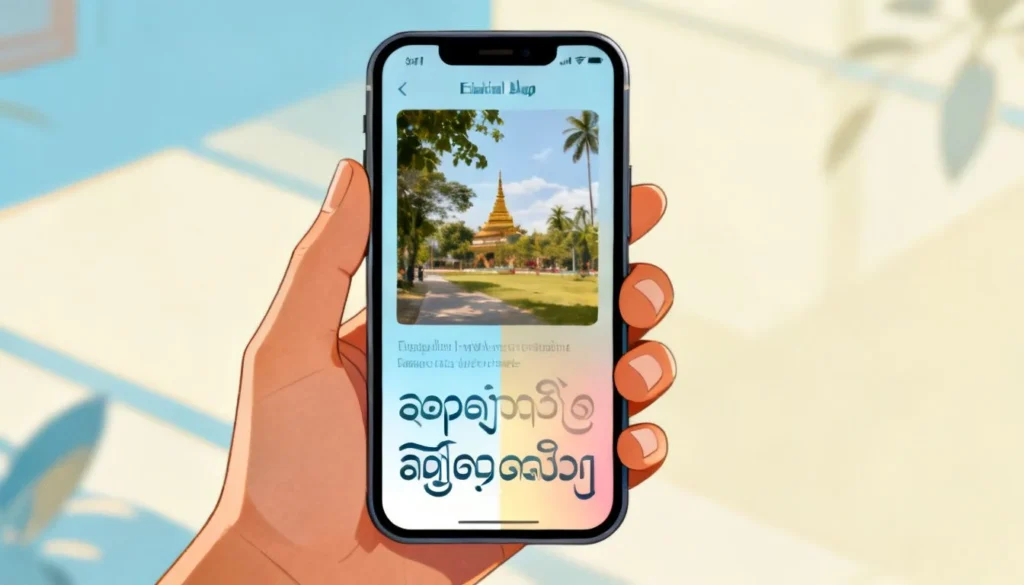
Google Lens deserves special mention. Point your phone camera at a Burmese sign, menu, or document, and it overlays a live English translation. It is not perfect, but it is remarkably good for getting the gist of written text in real time. This is invaluable for travelers.
The Ornagai dictionary app is widely used by Burmese language learners. It provides detailed definitions with usage examples, which helps you understand nuance that simple translation tools miss. Available for both iOS and Android.
Myanmar-English online dictionaries like the one maintained by the Myanmar Language Commission offer authoritative definitions. These are useful for cross-checking machine output when something looks suspicious.
The key is using multiple tools together. No single free resource is reliable enough on its own for translation Myanmar to English. Cross-referencing catches errors.
Common Translation Mistakes and How to Avoid Them
Certain errors show up repeatedly when translating from Burmese to English. Knowing what they are helps you spot them before they cause problems.
Pronoun confusion. Burmese often drops pronouns entirely when context makes them clear. English requires them. A machine translator will sometimes guess wrong about who is doing what in a sentence. This is especially dangerous in legal or medical contexts.
Tense ambiguity. Burmese verbs do not conjugate for tense the way English verbs do. Time is shown through particles and context. A machine might render a past-tense Burmese sentence as present-tense English because the particle was ambiguous.
Formal vs. casual register. Burmese has multiple levels of formality built into the vocabulary. A sentence using royal or monastic vocabulary will translate literally into something that sounds bizarre in English. “The venerable one partakes of morning sustenance” is not how you say “the monk ate breakfast.”
To catch these errors, always read the English output critically. If a sentence sounds unnatural or confusing, the translation is probably wrong somewhere. Trust your native-speaker intuition about what English should sound like.
Key Takeaways
- Machine translation works for casual Burmese text but fails on formal, legal, or medical content.
- The Burmese script has no spaces between words, which creates unique challenges for automated translation.
- Professional human translation costs $0.10 to $0.25 per word and is essential for official documents.
- Google Lens provides real-time camera translation that is genuinely useful for travelers.
- Always cross-reference machine output with a dictionary or a second tool before relying on it.
- Reverse translation is a quick way to spot errors in machine-generated English.
Frequently Asked Questions
Q: Is Google Translate accurate for Burmese to English?
A: Google Translate is reasonably accurate for simple, everyday Burmese phrases and sentences. It struggles with formal Burmese, literary language, and specialized vocabulary. For casual use it works fine. For anything important, verify with a human translator.
Q: How much does professional Myanmar to English translation cost?
A: Professional translation typically costs between $0.10 and $0.25 per word, depending on the translator’s experience, the document’s complexity, and turnaround time. Certified translations for legal or immigration purposes usually cost more due to additional documentation requirements.
Q: Can I use Google Lens to translate Burmese text?
A: Yes. Google Lens supports Burmese text recognition and can overlay English translations on your phone’s camera view. It works well for signs, menus, and short documents. Longer documents with dense text may produce less reliable results.
Q: Why does Burmese have no spaces between words?
A: Burmese script traditionally uses spaces only to mark phrase or clause boundaries, not individual words. This is common in several Southeast Asian writing systems. It creates challenges for machine translation because algorithms must determine where words begin and end.
Q: What is the best free Myanmar to English dictionary?
A: Ornagai is widely considered one of the best free Myanmar-English dictionaries. It offers detailed definitions, usage examples, and works offline. The SEAlang Library also maintains a comprehensive online Burmese dictionary with linguistic annotations.
Q: Do I need a certified translator for immigration documents?
A: Yes. Government immigration agencies generally require certified translations from qualified human translators. Machine translations are not accepted. The translator must provide a signed statement attesting to their competence and the accuracy of the translation.
Q: How long does it take to translate a document from Myanmar to English?
A: A professional translator can typically handle 2,000 to 3,000 words per day for standard documents. Complex legal or technical documents take longer. Rush jobs are available but usually cost 50 to 100 percent more than standard turnaround.
Q: Can I learn to read Burmese script quickly?
A: Learning the basic Burmese script takes most people several weeks of consistent study. The 33 consonants and vowel combinations are learnable, but reading fluency requires months of practice. For quick needs, translation tools are more practical.
References & Further Reading
- Myanmar Language Commission – Official government body for Burmese language standards and dictionary development
- SEAlang Library Burmese Resources – Comprehensive linguistic database with dictionary and corpus tools
- Google Translate Burmese Support Documentation – Official information on supported languages and features
- ProZ Burmese Translator Directory – Professional translator marketplace with verified credentials and specialization filters
—
About This Article: This guide draws on practical experience with Burmese language tools and professional translation workflows. The recommendations reflect current tool capabilities as of early 2025. Machine translation quality changes quickly, so test tools with your own sample text before relying on them for anything important.