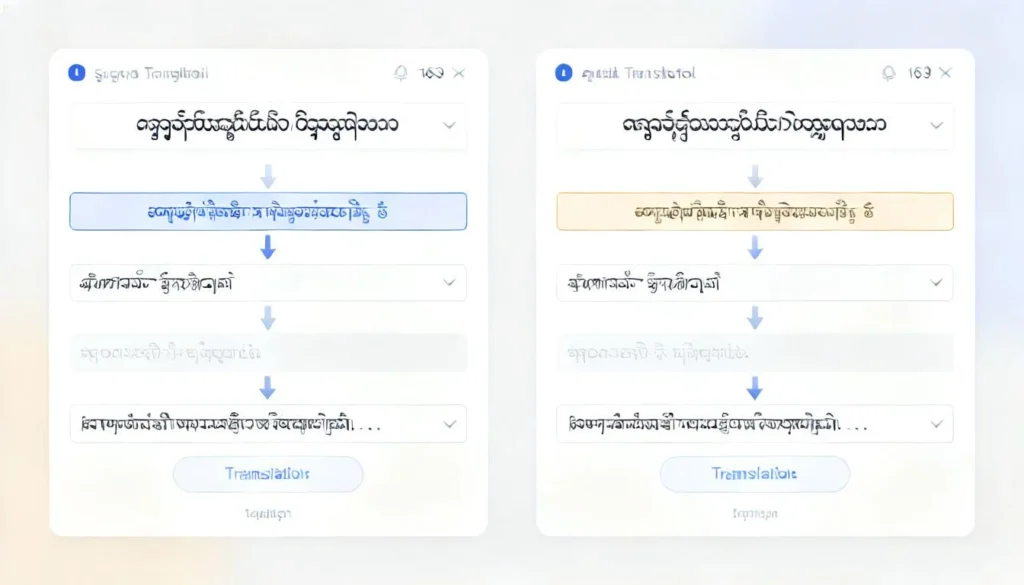
English Burmese translation is tricky, and if you have ever tried it, you know that a direct word-for-word swap rarely works. The two languages come from completely different families, which means the grammar, sentence structure, and even the script itself behave in ways that can trip up even experienced translators. This guide breaks down the real challenges, the best tools available, and the strategies that produce translations that actually make sense to a native Burmese speaker.
Quick Answer: For casual or quick needs, Google Translate and Microsoft Translator handle basic English Burmese translation. For professional, legal, or medical documents, you need a human translator who understands the cultural context, because machine translation often fails with Burmese syntax and honorifics.
Why English Burmese Translation Is So Difficult
The gap between English and Burmese is massive. English is an Indo-European language with a subject-verb-object (SVO) structure. Burmese is a Sino-Tibetan language that typically follows a subject-object-verb (SOV) structure. That single difference forces a complete mental reordering of every sentence.
Beyond word order, Burmese uses a tonal system. A word like “sa” can mean “eat,” “letter,” “start,” or “star” depending on the tone. Machine translation systems that do not properly model tone will produce errors that a native speaker would catch immediately.
The Burmese script, derived from the Mon script, is also a barrier. It uses circular letters and complex stacking rules for consonant clusters. When you type English text and translate it into Burmese, the rendering of these characters depends heavily on proper Unicode support. Many older systems produce broken or misaligned text.
The Tone Problem in Practice
Consider the English word “rice.” In Burmese, there are multiple words for rice depending on its state. “Hsin” means uncooked rice, “htamin” means cooked rice, and “san” also refers to rice in certain contexts. A machine translator without context will often pick the wrong one.
This is why context matters more in Burmese than in many European languages. A single English word can map to three or four Burmese words, and the right choice depends on the situation, the level of formality, and even the region of Myanmar the reader comes from.
Pro Tip: If you are translating content for a specific region in Myanmar, tell your translator. Dialects and word preferences vary between Yangon, Mandalay, and rural areas. A translator in Yangon may use different terms than one in Mandalay.

Machine Translation Tools: What Actually Works
Let’s be honest about the current state of machine translation for Burmese. It has improved dramatically in the last few years, but it still lags behind languages like Spanish or French.
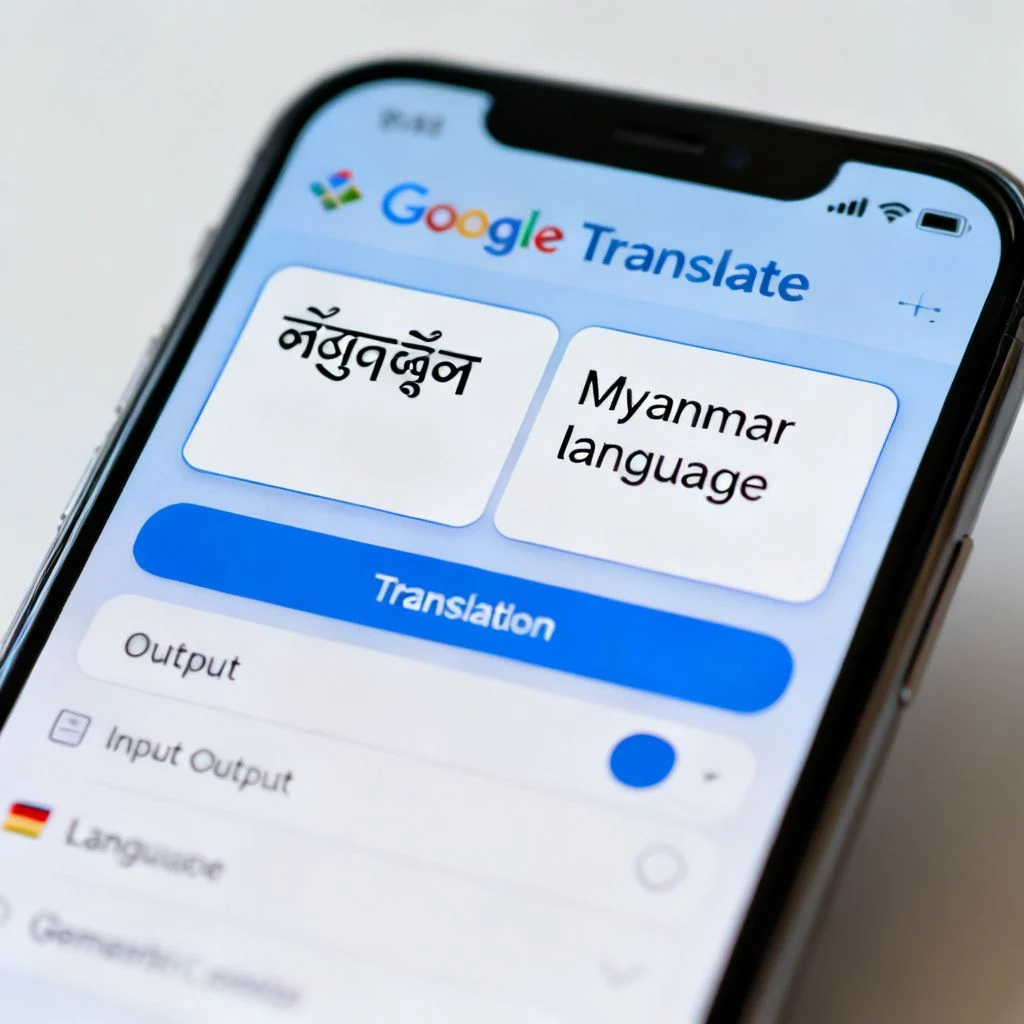
Google Translate added neural machine translation for Burmese in 2016, and the quality jumped significantly. Microsoft Translator also supports Burmese and is integrated into Bing, Office, and Skype. Both are usable for short, simple sentences.
Here is a comparison of the main options:
| Tool | Best For | Accuracy (General) | Offline Support | Cost |
|---|---|---|---|---|
| Google Translate | Casual text, travel phrases | Moderate | Yes (app) | Free |
| Microsoft Translator | Business docs, integration | Moderate | Yes (app) | Free |
| DeepL | Not available for Burmese | N/A | N/A | N/A |
| Human translator | Legal, medical, marketing | High | N/A | $0.08-$0.20 per word |
| Bilingual dictionary apps | Single word lookups | High for words | Yes | Free or low cost |
DeepL, which many people prefer for European languages, does not support Burmese as of now. That is a significant gap, because DeepL often outperforms Google for other language pairs. For Burmese, you are essentially choosing between Google and Microsoft for free machine translation.
Where Machine Translation Fails
Machine translation struggles most with:
- Honorifics and politeness levels – Burmese has a complex system of polite particles like “par,” “bar,” and “khin.” Getting these wrong can make you sound rude or overly formal.
- Long, complex sentences – The SOV structure means the verb comes at the end. Long English sentences with multiple clauses get scrambled.
- Legal and technical terminology – Burmese legal terms often derive from Pali and do not map cleanly to English legal concepts.
- Names and proper nouns – Transliteration of English names into Burmese script is inconsistent across tools.
Pro Tip: If you use Google Translate for English Burmese translation, break your text into short, simple sentences before translating. Avoid idioms, metaphors, and passive voice. The output will be noticeably better.
When to Hire a Human Translator
There is a clear line where machine translation stops being acceptable. If the document has legal, medical, or financial consequences, you need a human.
A professional English Burmese translator does more than convert words. They understand that Burmese culture values indirectness in certain situations. They know when to use formal versus informal address. They catch ambiguities that a machine will miss.
For example, the English word “you” has multiple Burmese equivalents. “Ngar” is intimate or rude depending on context. “Khinbyar” is polite. “Ashin” is used for monks. A machine translator will often default to one form without considering the relationship between the speakers.
Human translators also handle localization. A marketing slogan that works in English might be meaningless or even offensive when translated literally into Burmese. A human translator can adapt the message to resonate with Burmese cultural values, which often center on family, community, and Buddhism.
What Human Translation Costs
Rates for English Burmese translation vary. Freelance translators on platforms like ProZ or Upwork typically charge between $0.08 and $0.20 per word. Translation agencies charge more, often $0.15 to $0.35 per word, but they include proofreading and quality assurance.
For a 1,000-word document, expect to pay between $80 and $350 depending on the provider and the complexity of the subject matter.
The turnaround time for a professional translator is usually 300 to 500 words per hour for standard text. Technical or legal text takes longer.
Common Mistakes in English Burmese Translation
Even well-intentioned translations go wrong. Here are the mistakes I see most often.
Direct translation of idioms. “It’s raining cats and dogs” means nothing in Burmese. The equivalent expression is “Moe ywa yin de” which roughly means “rain is falling heavily.” A literal translation would confuse readers.
Ignoring the lack of articles. Burmese does not use “a,” “an,” or “the” the way English does. Translators must decide when to add or remove these based on context.
Forgetting about gender. Burmese pronouns do not distinguish gender the way English does. “He” and “she” are both “thu” in colloquial Burmese. Context is required to know which is meant.
Mixing formal and informal registers. Burmese has distinct registers for spoken and written language. Written Burmese, especially in official documents, uses more Pali-derived vocabulary. Using spoken forms in a legal document looks unprofessional.
Poor Unicode handling. This is a technical issue, but it matters. Burmese text requires proper Unicode rendering. Some older fonts use non-standard encoding that looks fine on one device but breaks on another. Always use Unicode-compliant fonts.
Pro Tip: Before publishing any Burmese translation, have a native speaker read it aloud or review it. Even if you used a professional translator, a second set of eyes catches errors that slip through.
Practical Workflow for English Burmese Translation Projects
Here is a process that works whether you are translating a website, a legal document, or a simple email.
Step 1: Define your audience. Are you writing for Burmese speakers in Myanmar, or for the diaspora in the US, UK, or Australia? The diaspora may be more comfortable with English loanwords, while readers in Myanmar may prefer pure Burmese terms.
Step 2: Choose your method. For internal communication or casual reading, machine translation with human review is acceptable. For anything public-facing or legally binding, use a human translator from the start.
Step 3: Prepare the source text. Write in clear, simple English. Avoid passive voice, idioms, and culturally specific references. The cleaner your source text, the better any translation will be.
Step 4: Translate and review. If using a machine, translate in chunks and review each chunk. If using a human, ask them to flag any ambiguous passages rather than guessing.
Step 5: Validate with a native speaker. This is the step most people skip. A native speaker can tell you if the translation sounds natural or if it reads like a translation. The difference matters.
Step 6: Format for Burmese script. Burmese characters are taller and more complex than Latin letters. You may need to adjust font sizes, line heights, and button sizes in your design to accommodate the script.
Each of these steps addresses a specific failure point in the translation process. Skipping any one of them increases the risk of a translation that confuses or offends your reader.
Key Takeaways
- English Burmese translation is structurally hard because the languages have different word orders, tones, and scripts.
- Machine translation works for simple, casual text but fails with honorifics, idioms, and complex sentences.
- Human translators are essential for legal, medical, and marketing content where accuracy and cultural nuance matter.
- Rates for professional translation range from $0.08 to $0.35 per word depending on the provider.
- Always have a native speaker review the final translation before publishing or sending it.
Frequently Asked Questions
Q: Is Google Translate accurate for English Burmese translation?
A: Google Translate is reasonably accurate for short, simple sentences and everyday phrases. It struggles with complex grammar, honorifics, and technical terminology. For anything important, use a human translator or at least have a native speaker review the machine output.
Q: How much does professional English Burmese translation cost?
A: Professional translation typically costs between $0.08 and $0.35 per word, depending on the translator’s experience, the complexity of the text, and whether you use a freelancer or an agency. A 1,000-word document usually costs between $80 and $350.
Q: Can I translate English to Burmese for free?
A: Yes, Google Translate and Microsoft Translator both offer free English Burmese translation. These tools are fine for casual use, travel phrases, and understanding the general meaning of a text. They are not recommended for official documents or professional content.
Q: What is the difference between Burmese and Myanmar language?
A: Burmese and Myanmar language refer to the same language. “Burmese” is the English name, while “Myanmar” is the official name used by the government and in many international contexts. The language itself is called “Myanma bhasa” in Burmese.
Q: Why does Burmese text look broken or misaligned on some websites?
A: Burmese text requires proper Unicode rendering. Older fonts and systems use non-standard encoding that breaks on modern browsers. Always use Unicode-compliant fonts and test your text on multiple devices to ensure it displays correctly.
Q: How long does it take to translate a document from English to Burmese?
A: A professional translator works at roughly 300 to 500 words per hour for standard text. A 1,000-word document takes about 2 to 3 hours of translation time, plus additional time for proofreading and formatting.
Q: Are there different dialects of Burmese I should know about?
A: Yes, there are regional variations. The standard dialect is based on Yangon and Mandalay speech. Other regions like Rakhine State and the Irrawaddy Delta have distinct accents and some vocabulary differences. For most purposes, standard Burmese is understood everywhere.
Q: Can I use English Burmese translation for legal documents?
A: You should not rely on machine translation for legal documents. Legal translation requires a certified translator who understands both legal systems and can accurately convey obligations, rights, and conditions. Errors in legal translation can have serious consequences.
Q: What is the best app for English Burmese translation on a phone?
A: Google Translate is the most widely used app for English Burmese translation on mobile devices. It offers offline translation, camera translation for text in images, and voice input. Microsoft Translator is a solid alternative, especially if you use Microsoft products.
Q: How do I find a reliable English Burmese translator?
A: Look for translators on professional platforms like ProZ, TranslatorsCafe, or Upwork. Check their credentials, read reviews, and ask for a sample translation. For certified translations, look for translators accredited by organizations like the American Translators Association or the Myanmar Translators Association.
References & Further Reading
- Google Translate Burmese Language Support – Official Google Translate page with Burmese language support information.
- Ethnologue: Burmese Language Profile – Comprehensive linguistic data on the Burmese language, including speaker counts and dialect information.
- Omniglot: Burmese Script and Pronunciation Guide – Detailed guide to the Burmese alphabet, tone system, and pronunciation.
- American Translators Association – Professional organization with resources for finding certified translators and understanding translation standards.
- Microsoft Translator Burmese Language Support – Official Microsoft Translator language list with Burmese support details.
About This Article
This article was written based on practical experience with English Burmese translation projects, including website localization, document translation, and coordination with native Burmese translators. The information reflects current tool capabilities and market rates, which may change over time. For high-stakes translation needs, always consult a professional translator directly.