Learning how to translate English to Burmese language effectively is about more than swapping words. It is about understanding context, tone, and the specific challenges that come with a language like Burmese, which has its own script, grammar rules, and cultural nuances. Whether you need to translate a business document, a website, or a simple text message, the approach you take will determine whether your message lands clearly or gets lost in confusion.
Quick Answer: For casual or quick translations, Google Translate and Microsoft Translator work well for basic phrases. For accurate, culturally appropriate results in business or official contexts, a professional human translator or a specialized service like Gengo or Translated.net is the better choice.
This guide breaks down the tools, techniques, and common pitfalls so you can choose the right method for your specific situation.
Understanding the Challenge of English to Burmese Translation
Burmese, also known as Myanmar language, is spoken by over 33 million people as a first language, primarily in Myanmar. It belongs to the Sino-Tibetan language family, which means its grammar and sentence structure differ significantly from English.
English follows a Subject-Verb-Object (SVO) order. Burmese typically follows a Subject-Object-Verb (SOV) order. This single difference means a direct word-for-word translation produces awkward, sometimes incomprehensible results. For example, the English sentence “I eat rice” becomes something closer to “I rice eat” in Burmese word order.
Another major hurdle is the Burmese script. Unlike English, which uses the Latin alphabet, Burmese uses a circular, flowing script derived from the Brahmi writing system. The script contains 33 consonants and 12 vowels, with tone markers that change the meaning of words entirely. A single syllable can mean several different things depending on the tone used.
These structural differences mean that machine translation tools have historically struggled with Burmese more than with European language pairs. The good news is that the technology has improved significantly in recent years.
Pro Tip: When using any translation tool for Burmese, always translate from English to Burmese rather than the reverse if you need to verify accuracy. Back-translation (translating the Burmese result back to English) can reveal where meaning has been lost or distorted.

The Best Tools to Translate English to Burmese Language
Not all translation tools are created equal when it comes to Burmese. Here is a comparison of the most commonly used options:
| Tool | Best For | Accuracy Level | Cost | Offline Support |
|---|---|---|---|---|
| Google Translate | Casual text, quick phrases | Moderate | Free | Yes (downloadable) |
| Microsoft Translator | Conversations, travel | Moderate | Free | Yes |
| DeepL | European languages, not Burmese | N/A (no Burmese support) | Free/Paid | No |
| Gengo | Professional documents | High | Paid per word | No |
| Translated.net | Business, legal, medical | High | Paid per word | No |
| Local Burmese translators | Cultural nuance, marketing | Highest | Varies | N/A |
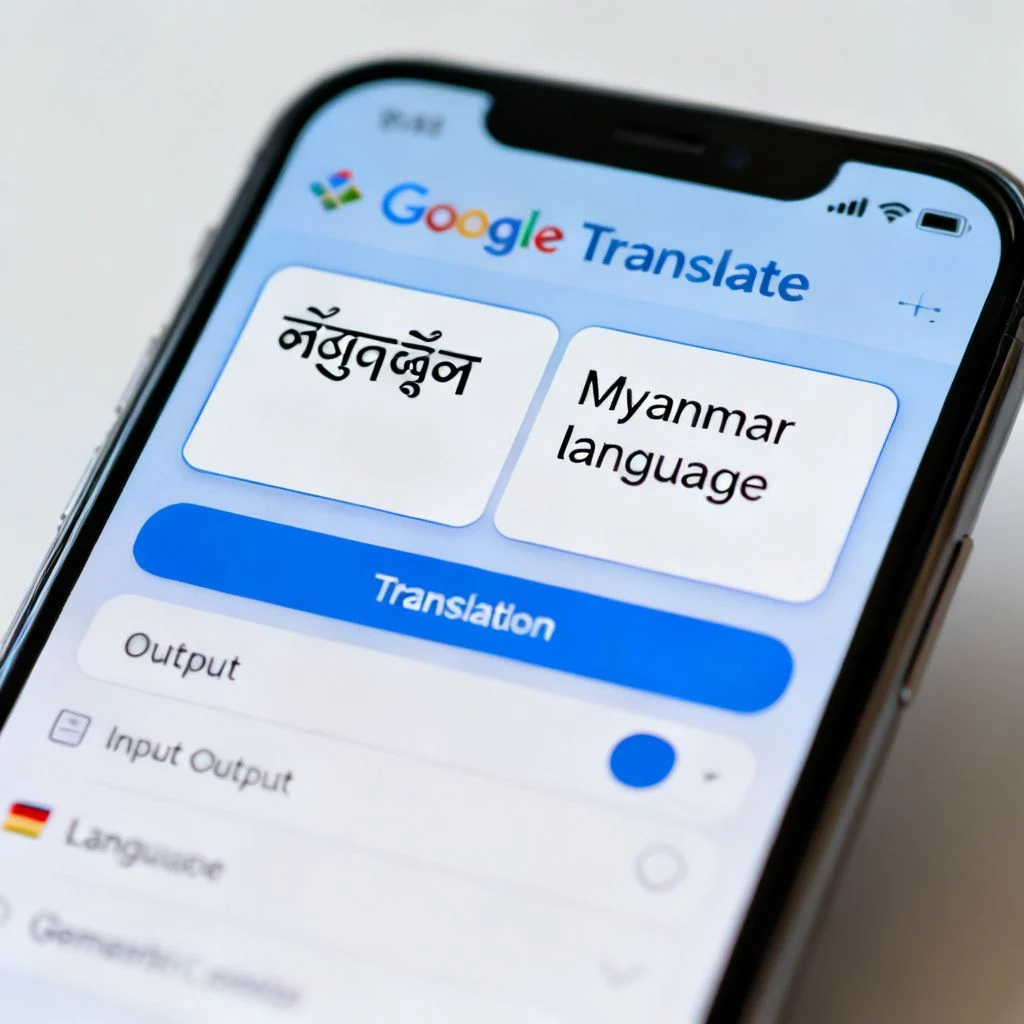
Google Translate added Burmese support in 2014, and its accuracy has improved steadily since. It handles common phrases, simple sentences, and everyday vocabulary reasonably well. However, it still struggles with complex grammar, idioms, and formal or technical language.
Microsoft Translator also supports Burmese and offers a conversation feature that can be useful for real-time communication. Its accuracy is comparable to Google Translate for basic content.
DeepL, often praised for its quality with European languages, does not currently support Burmese. If you have been relying on DeepL for other language pairs, you will need a different tool for Burmese.
Pro Tip: For Google Translate, enable the “Tap to Translate” feature on mobile. This lets you copy text in any app and get an instant Burmese translation without switching between applications.
When Machine Translation Works and When It Fails
Machine translation has come a long way, but it has clear limitations with Burmese. Understanding these limits will save you from embarrassing mistakes.
Where machine translation works well
- Simple, everyday phrases: Greetings, basic questions, and short statements translate reasonably well.
- Single words and short phrases: Dictionary-style lookups are generally accurate.
- Travel-related vocabulary: Directions, food items, and common tourist phrases are well-represented in training data.
- Social media posts: Informal, short messages often translate acceptably.
Where machine translation fails
- Formal documents: Contracts, legal texts, and official correspondence require precision that current machine translation cannot guarantee for Burmese.
- Marketing and creative content: Slogans, brand names, and persuasive copy need cultural adaptation, not literal translation.
- Technical or medical terminology: Specialized vocabulary is often missing or mistranslated.
- Honorifics and politeness levels: Burmese has complex systems for showing respect based on social hierarchy. Machine translation typically flattens these distinctions.
- Idioms and figurative language: Expressions like “it’s raining cats and dogs” make no sense when translated literally into Burmese.
A real example: the English phrase “I’m sorry for your loss” translates through machine tools into Burmese in a way that sounds overly formal and slightly awkward to native speakers. A human translator would know to use a more natural condolence expression that matches Burmese cultural expectations around grief and respect.
The takeaway: machine translation is a useful starting point for personal, casual communication. It is not yet reliable enough for anything where accuracy carries real consequences.
How to Get Professional-Quality Burmese Translations
When you need accuracy, you have several options for professional translation. The right choice depends on your budget, timeline, and the nature of your content.
Option 1: Professional translation agencies
Companies like Gengo, Translated.net, and Stepes offer Burmese translation services with human translators. These platforms vet their translators and often provide quality guarantees. Expect to pay between $0.10 and $0.25 per word for professional Burmese translation, depending on turnaround time and subject matter complexity.
Agencies are the safest choice for business documents, legal materials, and anything that will be published or distributed publicly.
Option 2: Freelance translators
Platforms like Upwork, Fiverr, and ProZ connect you directly with freelance Burmese translators. Rates vary widely, from $0.03 per word for basic translation to $0.15 per word or more for specialized work. When hiring a freelancer, look for:
- Native Burmese speakers with verified credentials
- Experience in your specific industry or content type
- Positive reviews from previous clients
- Willingness to provide a sample translation
Option 3: Local community resources
If you live in an area with a Burmese community, local translation services may be available through community organizations, religious institutions, or cultural centers. These resources can be especially valuable for translating content that needs deep cultural understanding, such as community announcements, educational materials, or healthcare information.
Pro Tip: Always ask for a back-translation when working with a new translator. Have a different translator convert the Burmese text back to English so you can compare it against your original. This catches errors and reveals where meaning has shifted.
Practical Tips for Better English to Burmese Translations
Whether you are using a free tool or working with a professional, these strategies will improve your results.
Write for translation from the start
The best translations start with source text that is clear and unambiguous. Before translating anything into Burmese:
- Use short, complete sentences. Long, complex sentences with multiple clauses are harder to translate accurately.
- Avoid idioms and slang. Phrases like “think outside the box” or “hit the ground running” do not translate well.
- Be specific about names and places. Use official names rather than nicknames or abbreviations.
- Define technical terms upfront. If your document uses specialized vocabulary, provide a glossary for your translator.
- Use active voice. Passive constructions create ambiguity that compounds during translation.
Verify with native speakers
If you are using machine translation for anything important, have a native Burmese speaker review the output. Even a quick review can catch errors that would be embarrassing or costly.
This is especially important for:
- Medical instructions
- Legal notices
- Safety information
- Product descriptions
- Website content
Consider the dialect
Burmese has regional variations. The standard form taught in schools and used in media is based on the Yangon dialect. However, speakers from Mandalay, Rakhine State, or ethnic minority regions may use different vocabulary and pronunciation. If your audience is concentrated in a specific region, mention this to your translator.
Formatting matters
Burmese script renders differently than English. It is generally more compact vertically but can be wider horizontally. When translating content for websites or printed materials:
- Allow extra space for text expansion (Burmese translations are often 10-20% longer than the English original)
- Use fonts that support Burmese Unicode properly (Zawgyi, the older non-standard encoding, causes display problems)
- Test on multiple devices and browsers if publishing digitally
The effort you put into preparing your source text pays off in translation quality. A clear, well-structured English document produces a clear, well-structured Burmese translation.
Key Takeaways
- Machine translation tools like Google Translate and Microsoft Translator work for casual, everyday Burmese translation but struggle with formal, technical, or culturally nuanced content.
- Burmese grammar follows Subject-Object-Verb order, which makes direct word-for-word translation from English ineffective.
- Professional human translation is essential for business documents, legal materials, marketing content, and anything with real consequences if mistranslated.
- Professional Burmese translation typically costs between $0.03 and $0.25 per word depending on the provider and complexity.
- Always verify machine-translated Burmese with a native speaker before using it for anything important.
Frequently Asked Questions About English to Burmese Translation
Q: Is Google Translate accurate for English to Burmese?
A: Google Translate provides moderate accuracy for simple phrases and everyday vocabulary in Burmese. It handles basic communication reasonably well but struggles with complex grammar, idioms, formal language, and technical terminology. For casual use, it is acceptable. For professional or official purposes, a human translator is recommended.
Q: Does DeepL support Burmese translation?
A: No, DeepL does not currently support Burmese. DeepL focuses primarily on European languages and a limited set of Asian languages like Japanese and Chinese. For Burmese, Google Translate and Microsoft Translator are the main free machine translation options.
Q: How much does professional English to Burmese translation cost?
A: Professional Burmese translation typically costs between $0.03 and $0.25 per word. Freelance translators on platforms like Upwork and Fiverr often charge at the lower end, while established agencies like Gengo and Translated.net charge more for quality assurance and faster turnaround times.
Q: Why does Burmese translation sometimes look longer than the English original?
A: Burmese script packs a lot of information into each character, but translated Burmese text is often 10 to 20 percent longer than the English source when measured by physical space. This happens because Burmese grammar requires additional particles and markers that English does not use, and the script’s visual characteristics require more horizontal space for legibility.
Q: Can I translate English to Burmese offline?
A: Yes. Both Google Translate and Microsoft Translator offer offline translation for Burmese. You need to download the Burmese language pack in advance while connected to the internet. Offline translations are generally less accurate than online translations because they use smaller language models, but they work for basic communication.
Q: What is the difference between Burmese and Myanmar language?
A: Burmese and Myanmar language refer to the same spoken language. “Burmese” is the English name for the language, while “Myanmar” is the official name of the country. In formal contexts, you may see the language referred to as “Myanmar language” or “Myanmar (Burmese).” They are interchangeable in practice.
Q: How do I type in Burmese script?
A: You can type in Burmese using a Burmese keyboard layout on your computer or mobile device. Google’s Gboard keyboard for Android and iOS includes Burmese support. On desktop, you can enable the Burmese keyboard in your operating system’s language settings. Some users also use online Burmese keyboard tools that let you click characters on screen.
Q: Is Zawgyi or Unicode better for Burmese text?
A: Unicode is the international standard and is now the recommended encoding for Burmese text. Zawgyi was a widely used non-standard font that caused compatibility problems. Myanmar officially adopted Unicode in 2019, and most modern platforms now support it properly. If you encounter Burmese text that displays incorrectly, it is likely encoded in Zawgyi and needs conversion.
References & Further Reading
- Google Translate Help: Translate text in other apps – Official documentation on using Google Translate features including Burmese support.
- Ethnologue: Burmese – Comprehensive linguistic data on the Burmese language including speaker population and classification.
- Myanmar Unicode Standard – The official Unicode character chart for the Myanmar script block.
- Microsoft Translator Languages – List of supported languages for Microsoft Translator including Burmese.
—
About This Article: This guide was written based on practical experience with Burmese translation tools and research into the linguistic structure of the Myanmar language. The recommendations reflect current tool capabilities as of the publication date. For high-stakes translations, always consult a qualified human translator with expertise in your specific subject matter.