If you need to translate Burmese to English, you have probably already discovered that this language pair is harder than it looks. Maybe you pasted a Facebook post into Google Translate and got back something that made no sense. Or you received a document from a colleague in Yangon and need a reliable translation for work.
The good news is that with the right combination of tools, techniques, and a basic understanding of how Burmese works, you can get much better results. This guide walks you through everything you need to know, from free tools to professional services, and explains why Burmese presents unique challenges for machine translation.
Quick Answer: For casual text, Google Translate and Bing Translator work reasonably well. For anything important, use a combination of tools, verify with native speakers, or hire a professional translator through services like Translated.net or Gengo.
Why Burmese Is Difficult for Machine Translation
Burmese, also called Myanmar language, belongs to the Tibeto-Burman language family. It uses a circular, flowing script that looks nothing like Latin characters. But the script is only part of the challenge.
The grammar structure is fundamentally different from English. Burmese follows a subject-object-verb (SOV) word order, while English uses subject-verb-object (SVO). This means a sentence like “I eat rice” becomes “I rice eat” in Burmese. Machine translation engines have improved dramatically, but this structural gap still causes errors.
Another major issue is register and politeness levels. Burmese has different verb endings and vocabulary depending on whether you are speaking to a monk, an elder, a peer, or a child. A single English word like “eat” has multiple Burmese equivalents. Machine translation often defaults to the formal or literary register, which can sound awkward or even disrespectful in casual conversation.
There is also a significant gap between written Burmese and spoken Burmese. Written Burmese is formal and literary. Spoken Burmese is more casual and drops many grammatical particles. Most translation tools are trained primarily on written texts, so they struggle with social media posts, text messages, and other informal content.
Pro Tip: If you are translating social media content or casual messages, expect machine translation errors around sentence boundaries. Burmese does not always use spaces or punctuation the way English does, so the tool may merge or split sentences incorrectly.

Free Tools to Translate Burmese to English
Several free tools can handle basic Burmese to English translation. Each has strengths and weaknesses, and the best choice depends on your specific text.
Google Translate
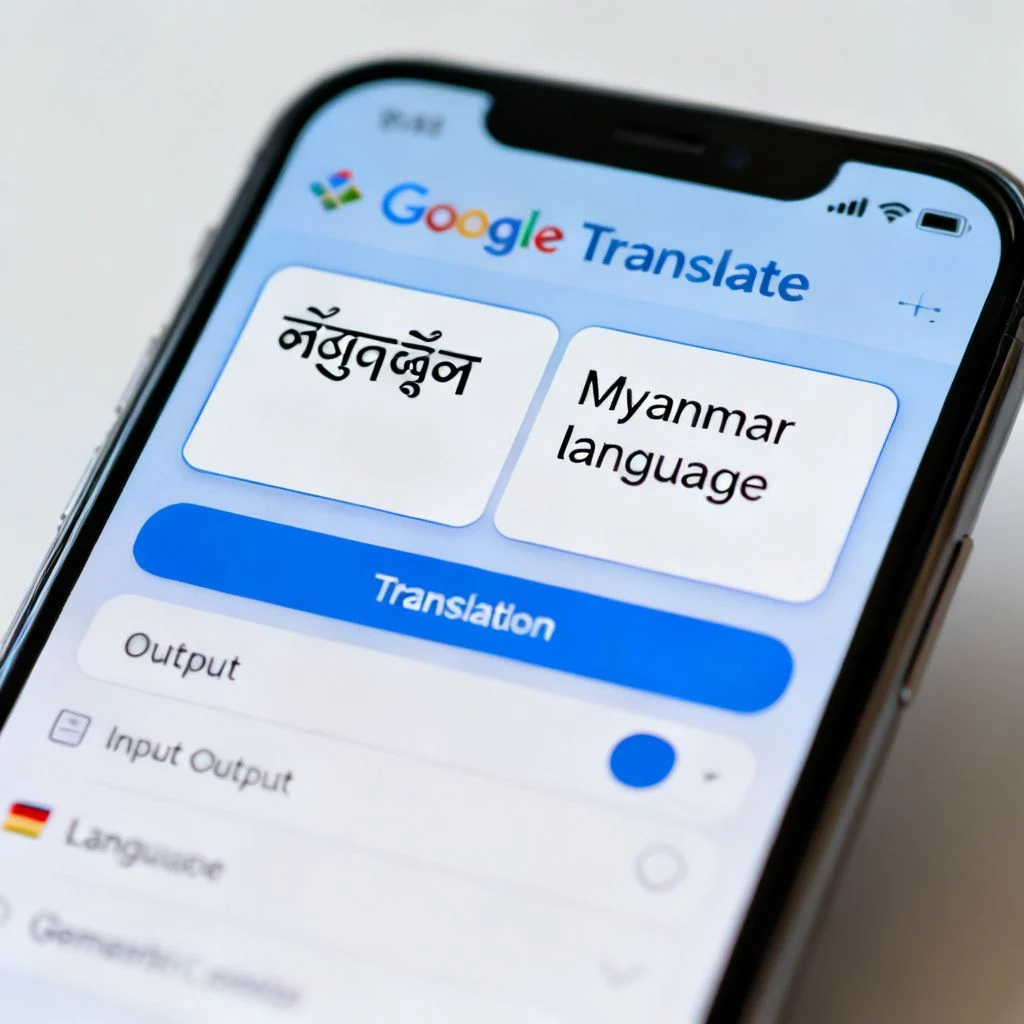
Google Translate supports Burmese and has improved significantly since the language was added in 2013. It is the most accessible option and works well for short phrases, individual words, and simple sentences. The mobile app also supports camera translation, which lets you point your phone at a Burmese sign or menu and see an English overlay in real time.
However, Google Translate struggles with longer passages, idiomatic expressions, and anything with cultural nuance. It also tends to produce overly literal translations of Burmese idioms, which can be confusing.
Bing Microsoft Translator
Bing Translator also supports Burmese and sometimes produces slightly different results than Google. It is worth checking both tools for the same text, especially if the Google output seems off. Bing tends to handle formal or news-style Burmese a bit better, though the difference is not dramatic.
Yandex Translate
Yandex Translate added Burmese support more recently. It is less commonly used for this language pair, but it can be a useful third opinion. Yandex sometimes handles certain grammatical structures differently, and cross-checking three tools can help you spot potential errors.
Comparison of Free Tools
| Tool | Best For | Weaknesses | Camera Translation | Offline Mode |
|---|---|---|---|---|
| Google Translate | Short phrases, everyday text | Idioms, long passages | Yes | Yes |
| Bing Translator | Formal text, news articles | Casual speech | Yes | No |
| Yandex Translate | Cross-checking results | Less trained data | No | No |
The bottom line: free tools are a good starting point, but they are not reliable enough for anything that matters legally, medically, or financially.
How to Get Better Results from Free Tools
You can improve machine translation output significantly by preparing your text before you translate it. Burmese text often lacks clear sentence boundaries, especially in informal writing. Here are some steps you can take.
Clean Up the Source Text
Before pasting Burmese text into a translation tool, check for these common issues:
- Add missing sentence breaks. If the original text is one long run-on, split it into logical sentences manually.
- Fix obvious typos. Burmese has many similar-looking characters. A single wrong character can change the meaning completely.
- Remove emojis and stickers. These confuse translation engines and can break sentence parsing.
- Identify proper nouns. Names of people, places, and organizations often get transliterated incorrectly. You may need to correct these manually after translation.
Use Back-Translation for Verification
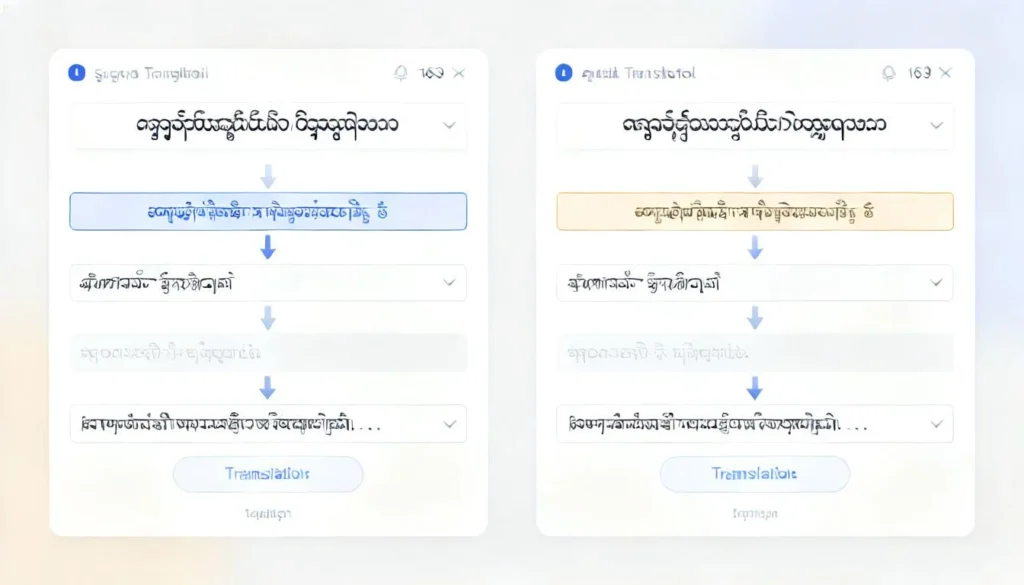
Back-translation means taking the English output, translating it back into Burmese, and comparing it to the original. If the back-translation looks very different from the source text, the translation probably missed something important.
For example, if you translate a Burmese sentence to English and then back to Burmese, and the result is completely different from what you started with, that is a red flag. This technique is especially useful for catching errors in tone, negation, and subject identification.
Pro Tip: For important documents, run the text through at least two different translation tools and compare the outputs. If the two English versions disagree significantly, that is a signal the original text is ambiguous or the tools are struggling.
Professional Translation Options for Burmese
When free tools are not enough, you have several professional options. The cost varies depending on the service, turnaround time, and complexity of the text.
Freelance Translators
Platforms like Upwork, Fiverr, and ProZ connect you with freelance Burmese translators. Rates typically range from $0.05 to $0.15 per word depending on the translator’s experience and the subject matter. For a 1,000-word document, expect to pay between $50 and $150.
The advantage of freelancers is flexibility and direct communication. The disadvantage is quality control. Always ask for samples, check reviews, and clarify whether the translator is a native Burmese speaker or a native English speaker. For Burmese to English translation, a translator with strong English skills is essential, regardless of their native language.
Translation Agencies
Agencies like Translated.net, Gengo, and Rev offer Burmese translation with built-in quality assurance. Gengo, for example, uses a two-step process where a translator and a proofreader both review the text. Agency rates are higher than freelance rates, often $0.10 to $0.25 per word, but you get more consistency and accountability.
Agencies are a better choice for legal documents, medical records, and business contracts where accuracy is critical.
Community and Volunteer Options
For non-critical content, you can try community translation forums. Reddit’s r/translator has a large community of volunteers, including Burmese speakers who help with short texts for free. The Myanmar Language Facebook groups also have members willing to help.
These options are fine for understanding a text message or a short social media post, but do not rely on them for anything official.
Pro Tip: If you need a certified translation for immigration, legal, or academic purposes, check the specific requirements first. Many institutions require a certified translator with specific credentials, and a freelance or community translation will not be accepted.
Understanding Burmese Script and Romanization
If you want to translate Burmese to English more effectively, it helps to understand how the script works. Burmese is an abugida, meaning each consonant letter carries an inherent vowel sound that can be modified with diacritics.
The Burmese alphabet has 33 consonants and 12 basic vowels, but the actual number of possible syllable combinations is much larger. The script is written from left to right with no spaces between words. Spaces are used to mark phrase or clause boundaries, which is one reason machine translation struggles with sentence segmentation.
Romanization Systems
Several romanization systems exist for writing Burmese in Latin characters. The most common are:
- MLC Transcription System (Myanmar Language Commission): The official standard used in Myanmar for transliterating Burmese into Latin script.
- BGN/PCGN romanization: Used by the US and UK governments for geographic names.
- Informal romanization: What you see on social media, where Burmese speakers write their language using English letters and numbers (for example, “min gala ba” for “hello”).
Understanding these systems helps when you need to search for a Burmese word or verify a translation. If you see a romanized Burmese word, you can often find its meaning by searching for the term plus “meaning” or by using a Burmese-English dictionary.
Common Burmese Words and Phrases
Here is a quick reference for some of the most common Burmese phrases you might encounter:
| Burmese (Romanized) | English Meaning | Context |
|---|---|---|
| Mingalaba | Hello | Formal greeting |
| Ne kaun la? | How are you? | Casual greeting |
| Kyei zu tin ba deh | Thank you | Formal |
| Kyei zu beh | Thanks | Casual |
| Ho deh | Yes / That’s right | Affirmation |
| Ma ho bu | No / Not correct | Negation |
| Na meh beh lo kaw deh leh? | What is your name? | Question |
Common Mistakes When Translating Burmese to English
Even experienced translators make mistakes with this language pair. Here are the most frequent errors to watch for.
Literal Translation of Idioms
Burmese has many idioms that make no sense when translated word for word. For example, the Burmese expression “sit hta min” literally means “war food” but actually refers to a rushed meal eaten during a busy time. A machine translation will render this literally, producing nonsense.
Ignoring Politeness Particles
Burmese uses sentence-final particles like “ba” (for males) and “shin” (for females) to indicate politeness. Machine translation often drops these entirely, losing the tone of the original. In English, this politeness may need to be conveyed through word choice or phrasing rather than a direct equivalent.
Mishandling Honorifics
Burmese has a complex system of honorifics. The word “U” before a name indicates an older man or a man of higher status. “Daw” is the equivalent for women. “Maung” is for younger men, and “Ma” is for younger women. These honorifics are often dropped in translation, which can change the social dynamics of a conversation.
Confusing Homonyms
Burmese has many homonyms, words that sound the same but have different meanings depending on tone. The word “sa” can mean “eat,” “letter,” “start,” or “salt” depending on the tone. Machine translation tools often pick the wrong meaning when context is ambiguous.
Pro Tip: When translating Burmese text that contains names, always verify the honorifics. A name like “U Thant” should not be translated as “Mr. Thant” in all contexts. The honorific carries cultural meaning that English equivalents do not fully capture.
Key Takeaways
- Burmese to English translation is challenging due to different grammar structure, script, and cultural context
- Free tools like Google Translate and Bing work for casual text but fail on idioms, informal language, and long passages
- Back-translation is a simple technique to verify the accuracy of machine translations
- Professional translation costs range from $0.05 to $0.25 per word depending on the service and complexity
- Understanding Burmese honorifics, politeness particles, and common idioms helps you spot translation errors
- For legal, medical, or official documents, always use a professional translator or agency
Frequently Asked Questions
Q: Is Google Translate accurate for Burmese to English?
A: Google Translate is reasonably accurate for short, simple phrases and individual words. However, it struggles with longer passages, idiomatic expressions, and informal or spoken Burmese. For anything important, verify the translation with a second tool or a native speaker.
Q: What is the best free tool to translate Burmese to English?
A: Google Translate is the most popular and accessible free tool. Bing Microsoft Translator is a good alternative and sometimes produces better results for formal text. Using both tools and comparing outputs is the best free approach.
Q: How much does professional Burmese to English translation cost?
A: Freelance translators typically charge between $0.05 and $0.15 per word. Translation agencies charge between $0.10 and $0.25 per word. A 1,000-word document would cost roughly $50 to $250 depending on the service.
Q: Can I translate Burmese text from an image?
A: Yes. Google Translate’s mobile app has a camera feature that can detect Burmese text in images and overlay an English translation. This works well for signs, menus, and printed documents, though the accuracy depends on image quality and text clarity.
Q: Why does Burmese to English translation often sound awkward?
A: Burmese has a subject-object-verb word order, while English uses subject-verb-object. This structural difference means translated sentences often need reordering to sound natural in English. Machine translation tools sometimes preserve the Burmese word order, producing awkward results.
Q: What is the difference between Burmese and Myanmar language?
A: Burmese and Myanmar language refer to the same language. “Burmese” is the English name, while “Myanmar” is the official name of the country and is often used for the language in official contexts. Both terms are correct and interchangeable.
Q: Are there any offline Burmese to English translation apps?
A: Google Translate offers offline translation for Burmese, but you need to download the language pack in advance. The offline mode is less accurate than the online version and works best for short phrases.
Q: How can I verify a Burmese to English translation is correct?
A: Use back-translation by taking the English output and translating it back to Burmese. Compare the result with the original text. You can also cross-check with multiple translation tools or ask a native Burmese speaker to review the translation for accuracy and tone.
References & Further Reading
- Google Translate Help: Translate text in other apps – Official documentation on Google Translate features including camera translation
- Ethnologue: Burmese Language – Comprehensive linguistic data on the Burmese language
- Myanmar Language Commission – Official government body for Burmese language standards and romanization
- Omniglot: Burmese Script – Detailed guide to the Burmese writing system and alphabet
—
About This Article
This guide was researched and written by a content strategist specializing in language learning and translation topics. The information draws on publicly available documentation from translation tool providers, linguistic resources, and widely accepted practices in the translation industry. Cost ranges reflect current market rates observed across major freelance platforms and translation agencies as of the publication date.




Pingback: Burmese to English Translation Keyboard: How to Type and…