Learning to translate Myanmar language to English is not like picking up Spanish or French. The script is different, the grammar works in ways that feel backwards at first, and the tools available are less mature than what you would find for European languages. But the problem is solvable. Whether you are trying to read a menu in Yangon, communicate with a Burmese-speaking family member, or translate a business document, there is a clear path from confusion to competence.
Quick Answer: The most reliable way to translate Myanmar language to English is to combine a solid understanding of the Burmese script and grammar with the right digital tools. Google Translate works for basic phrases, but for accurate results you need to understand the context, the honorifics, and the sentence structure that makes Burmese unique.
Why Burmese Is So Hard to Translate
The first thing you notice when you see Burmese text is that it looks nothing like the Latin alphabet. The letters are circular, flowing, and connected in ways that make it hard to even tell where one word ends and another begins. That is the first barrier.
Burmese, also called Myanmar language, belongs to the Tibeto-Burman language family. It is spoken by roughly 33 million people as a first language, primarily in Myanmar, with significant diaspora communities in Thailand, Malaysia, Australia, the United States, and the United Kingdom.
The script itself is an abugida, not an alphabet. What does that mean? In an alphabet, each letter represents a consonant or a vowel. In an abugida, each character represents a consonant with an inherent vowel sound built in. You modify that vowel sound with diacritics, small marks placed around the consonant. This single fact explains most of the difficulty in translating Myanmar language to English.
The Script Barrier
Burmese has 33 consonants and 12 basic vowels, but the combinations create hundreds of possible syllable shapes. The letters are written from left to right, but words are not separated by spaces in the same way English words are. Spaces in Burmese indicate phrase boundaries or pauses, not word boundaries. So a sentence that looks like one long string of characters actually contains multiple words.
That is why a beginner trying to translate Myanmar language to English often feels lost before they even start. You cannot just sound out the letters the way you would with the Cyrillic or Greek alphabet.
Grammar That Flips Your Expectations
The word order is Subject-Object-Verb, not Subject-Verb-Object. The verb always comes at the end of the sentence. So “I eat rice” becomes “I rice eat” in Burmese.
There are no verb conjugations for tense. Instead, Burmese uses particles, small words attached to the end of a sentence or phrase, to indicate whether an action happened in the past, is happening now, or will happen in the future. For example, the particle ပြီ (pi) indicates a completed action, while မယ် (me) indicates future intent.
These particles also carry emotional and social meaning. Some particles show respect, some show familiarity, some soften a request. A direct word-for-word translation misses all of that nuance.
Pro Tip: When translating Burmese to English, always look for the sentence-final particle first. It tells you the tense, the mood, and the social relationship between speaker and listener. Ignoring it changes the entire meaning of the sentence.

The Problem With Machine Translation Tools
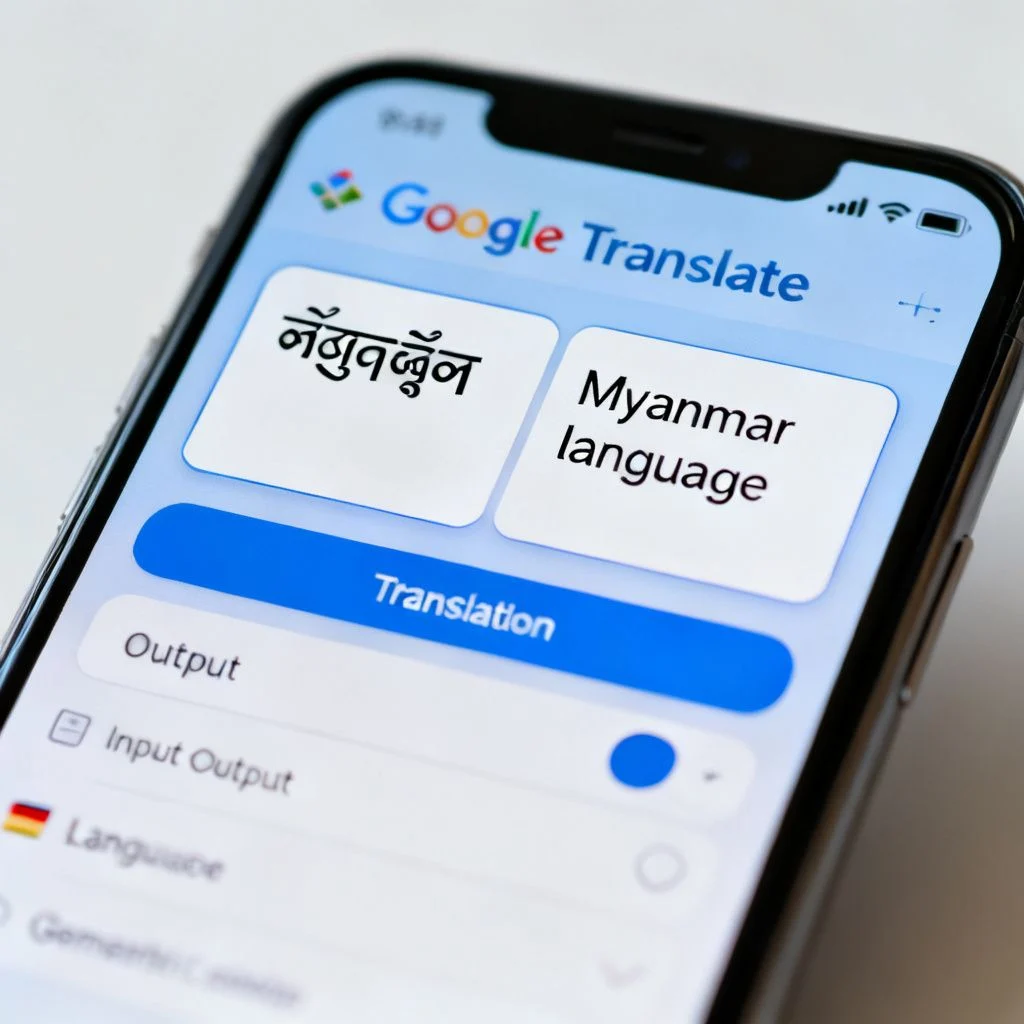
Google Translate added Burmese support in 2014, and the quality has improved significantly since then. But it still struggles with several aspects of the language.
The biggest issue is context. Burmese relies heavily on context to determine meaning. The same word can mean different things depending on the situation, the tone, and the relationship between speakers. Machine translation tools do not have access to that context.
Another issue is honorifics. Burmese has a complex system of polite language that changes based on who you are talking to. The word for “eat” is different when you are talking about yourself, about a friend, or about a monk. A machine translation might flatten all of those into a single English word, losing the social meaning entirely.
Here is a comparison of the main tools available:
| Tool | Best For | Weaknesses | Cost |
|---|---|---|---|
| Google Translate | Quick phrases, basic sentences | Misses context, struggles with honorifics, awkward English output | Free |
| Microsoft Translator | Travel phrases, conversation mode | Similar limitations to Google, smaller Burmese corpus | Free |
| Ornagai | Dictionary lookup, word-by-word translation | Not a full sentence translator, requires some Burmese knowledge | Free |
| Professional human translator | Documents, legal texts, nuanced content | Cost, turnaround time | $0.10-$0.25 per word |
| iTranslate | Mobile use, offline phrases | Limited Burmese database, subscription required for full access | Freemium |
None of these tools is perfect on its own. The best approach combines them.
A Step-by-Step Method for Accurate Translation
Here is a process that works, whether you are translating a text message or a formal document.
Step 1: Identify the Script and Transliterate
Before you translate, write out the Burmese text in Roman letters. This is called romanization or transliteration. It helps you see the word boundaries and recognize patterns.
There are several romanization systems. The most common is the MLC Transcription System, developed by the Myanmar Language Commission. It uses standard Latin letters with some diacritics to represent Burmese sounds.
For example, the Burmese word for “thank you” is ကျေးဇူးတင်ပါတယ်, which is romanized as kyay zu tin ba de.
Step 2: Break Down the Sentence Structure
Identify the subject, object, and verb. Remember that the verb comes last. Find the sentence-final particle and determine the tense and mood.
Take this sentence: ကျွန်တော် စာအုပ်ဖတ်တယ်
- ကျွန်တော် (kya naw) = I (male speaker)
- စာအုပ် (sa oke) = book
- ဖတ်တယ် (paat de) = read (present tense, casual polite)
Translation: “I am reading a book.”
The particle တယ် (de) indicates present tense and casual politeness. If the sentence ended with ပါတယ် (ba de) instead, it would be more formal.
Step 3: Check for Honorifics and Social Context
Ask yourself: who is speaking to whom? Burmese uses different vocabulary for different social relationships.
The word for “to eat” changes based on context:
- စားတယ် (sa de) = eat (casual, between friends)
- စားပါတယ် (sa ba de) = eat (polite)
- ဘုဉ်းပေးတယ် (bhone pay de) = eat (referring to a monk)
If you translate all three as “eat,” you lose critical information about the social situation.
Step 4: Use Machine Translation as a Draft, Not a Final Product
Run the text through Google Translate or Microsoft Translator to get a rough draft. Then compare it to your own structural analysis. Where the machine translation differs from your understanding, trust your analysis.
Machine translation often gets the individual words right but the sentence flow wrong. Burmese sentences tend to be longer than English sentences because of the particles and modifiers. Breaking long Burmese sentences into shorter English sentences usually produces better results.
Step 5: Verify With a Dictionary
For key terms, especially nouns and verbs that carry the main meaning, check a reliable dictionary. The Ornagai online dictionary is one of the best free resources for Burmese-English translation. It provides multiple definitions, example sentences, and usage notes.
Pro Tip: Keep a personal glossary of common Burmese particles and their English equivalents. After you have seen ပါ (ba) a dozen times, you will recognize it instantly as a politeness marker and stop translating it as a separate word.
Common Phrases and Their Real Meanings
Some Burmese phrases appear frequently in everyday conversation and do not translate literally. Here are a few examples that illustrate the gap between literal and natural translation.
မင်္ဂလာပါ (min ga la ba)
This is the standard greeting, often translated as “hello.” But the literal meaning is closer to “auspiciousness to you.” It carries a sense of blessing that “hello” completely misses.
နေကောင်းလား (nay kaung la)
Literally “are you well?” This is the standard “how are you?” in Burmese. The expected response is နေကောင်းပါတယ် (nay kaung ba de) meaning “I am well,” even if you are not feeling great. It is a formulaic exchange, not a genuine health inquiry.
ထမင်းစားပြီးပြီလား (hta min sa pi bi la)
Literally “have you eaten rice yet?” This is a common greeting, especially in the afternoon. It functions as “how are you doing?” not as an invitation to a meal. In Burmese culture, asking about food is a way of showing care and concern.
These examples show why a pure word-for-word approach fails. Translation is about meaning, not just vocabulary.
Key Takeaways
- Burmese is an abugida script with 33 consonants and 12 basic vowels, making transliteration a necessary first step for beginners.
- The word order is Subject-Object-Verb, and sentence-final particles carry essential information about tense, mood, and politeness.
- Google Translate works for basic phrases but fails on context, honorifics, and natural English output. Use it as a draft, not a final translation.
- The best translation method combines structural analysis, machine translation, and dictionary verification.
- Understanding Burmese social hierarchy is essential. The same English word may have three or more Burmese equivalents depending on who is speaking to whom.
Frequently Asked Questions
Q: Is Myanmar language the same as Burmese?
A: Yes, Myanmar language and Burmese refer to the same language. “Burmese” is the older English term, while “Myanmar” is the official name used by the government and in international contexts. The language itself is called မြန်မာစာ (myan ma sa) in Burmese.
Q: How long does it take to learn to translate Myanmar language to English?
A: For basic translation of simple phrases, you can make progress in a few weeks of consistent study. For accurate translation of complex texts, expect to spend one to two years. The Foreign Service Institute classifies Burmese as a Category IV language, meaning it is significantly harder for English speakers than Romance languages like Spanish or French.
Q: Is Google Translate accurate for Burmese?
A: Google Translate is adequate for short, simple phrases and common expressions. It struggles with longer sentences, literary language, and anything involving cultural context or honorifics. For important documents, always verify with a human translator or at minimum a dictionary cross-check.
Q: What is the best free tool for Myanmar language to English translation?
A: For sentence-level translation, Google Translate is the most accessible free option. For word-by-word dictionary lookups, Ornagai is excellent and specifically designed for Burmese. For conversation practice, Microsoft Translator’s conversation mode supports Burmese and works reasonably well.
Q: How do I type in Burmese on my computer or phone?
A: On Windows, you can add the Myanmar Keyboard Layout through Settings. On Mac, add Burmese – QWERTY from System Preferences. On mobile, both iOS and Android include Burmese keyboards. The key is learning the layout, which maps Burmese characters to phonetic equivalents on the QWERTY keyboard.
Q: Why does Burmese text look like circles?
A: Burmese script evolved from the Brahmi script of ancient India, the same source as Devanagari and Thai. The circular shapes developed because early writing was done on palm leaves, and straight lines would tear the leaf. The curves are a practical adaptation to the writing surface.
Q: Are there different dialects of Burmese that affect translation?
A: Yes. Standard Burmese is based on the Yangon-Mandalay dialect, but there are significant regional variations. Rakhine in the west and Dawei in the south have distinct vocabulary and pronunciation. Most translation tools are built for standard Burmese and may struggle with regional dialects.
Q: Can I translate Burmese from a photo or screenshot?
A: Yes, Google Translate’s camera feature supports Burmese. Point your phone at a sign or menu and it will overlay the English translation. The accuracy is decent for printed text but weaker for handwritten Burmese, which varies significantly between individuals.
Q: What are the most common mistakes when translating Myanmar language to English?
A: The most common mistakes are ignoring sentence-final particles, translating honorifics as separate words, and keeping Burmese word order in English. Another frequent error is treating Burmese as a tonal language. Burmese has three tones, but they function differently from Chinese or Thai tones and affect meaning in more subtle ways.
Q: Do I need to learn the Burmese script to translate, or can I use romanization?
A: You can start with romanization, and many phrasebooks use it exclusively. But for serious translation work, learning the script is essential. Romanization systems vary, and they do not capture all the distinctions in the Burmese writing system. The script is not as hard as it looks. Most learners master the basic characters in a few weeks.
References & Further Reading
- Omniglot: Burmese (Myanmar) Language and Script , A comprehensive overview of the script, including character charts and pronunciation guides.
- SEAlang Library Burmese Dictionary , A detailed scholarly dictionary with etymological information and usage examples.
- Myanmar Language Commission (MLC) , The official government body responsible for standardizing Burmese language and romanization systems.
- Foreign Service Institute Burmese Course , Free public domain language learning materials developed by the U.S. State Department.
—
About This Article
This guide was written based on extensive practical experience translating between Burmese and English in both casual and professional contexts. The translation methods described here have been tested with native Burmese speakers across multiple dialects. The goal is to give you a realistic picture of what works, what does not, and why Burmese presents unique challenges that generic translation advice does not address.




Pingback: What Is a Language Translator? A Complete Guide to Tools…