Myanmar to English Google Translate is the first tool most people reach for, but it has a reputation problem that is only partly deserved. The Burmese language presents unique challenges for machine translation, and understanding where Google Translate struggles can save you from embarrassing mistakes. This guide breaks down what actually works, what does not, and how to get the most accurate translations possible.
Quick Answer: Google Translate supports Myanmar (Burmese) to English translation, but accuracy varies widely depending on context. For simple phrases and formal written Burmese, it works reasonably well. For casual conversation, slang, and complex sentences, expect significant errors.
Why Burmese Is Hard for Machine Translation
Burmese script looks beautiful but behaves differently from most languages Google Translate handles well. The writing system uses a circular alphabet with no spaces between words in formal writing. Word boundaries are marked by spaces only between phrases, which creates a parsing nightmare for algorithms.
The tonal nature of Burmese adds another layer of difficulty. Spoken Burmese uses four tones, but written Burmese rarely marks them. Google Translate must guess the intended tone from context, and it frequently gets this wrong. A word like “saya” can mean “teacher,” “itch,” or “to spread” depending on tone.
Grammar structure compounds the problem. Burmese follows a subject-object-verb order, unlike English’s subject-verb-object. Modifiers come before nouns, particles indicate grammatical function, and politeness markers change meaning based on social hierarchy. All of this forces the translation engine to perform complex restructuring.
Pro Tip: For formal documents, government notices, or news articles, Google Translate performs noticeably better because formal Burmese follows more predictable patterns. Casual text messages and social media posts are where accuracy drops off sharply.
Google Translate vs. Human Translation: A Realistic Comparison
The gap between machine and human translation for Burmese remains significant. Here is how they compare across common scenarios:
| Translation Scenario | Google Translate | Human Translator |
|---|---|---|
| Simple greetings and phrases | Good | Excellent |
| News articles and formal text | Fair to Good | Excellent |
| Social media posts and slang | Poor to Fair | Good to Excellent |
| Legal or medical documents | Poor | Essential |
| Poetry and literary Burmese | Very Poor | Essential |
| Real-time conversation | Fair | Good |
Google Translate handles structured, formal Burmese far better than the messy reality of everyday communication. If you are translating a government announcement, you will get the gist. If you are translating a Facebook comment full of Burmese internet slang, you will likely get confusion.
A Step-by-Step Workflow for Better Results
Getting usable translations from Myanmar to English Google Translate requires more than just pasting text. Here is a workflow that consistently produces better output:
- Break long sentences into shorter chunks. Burmese sentences can run long. Split them at natural pause points before translating.
- Translate both directions. Run the English result back through English to Burmese. If the Burmese output looks different from your original, the translation probably lost something.
- Check individual words you do not recognize. Tap on translated words in the Google Translate app to see alternative meanings.
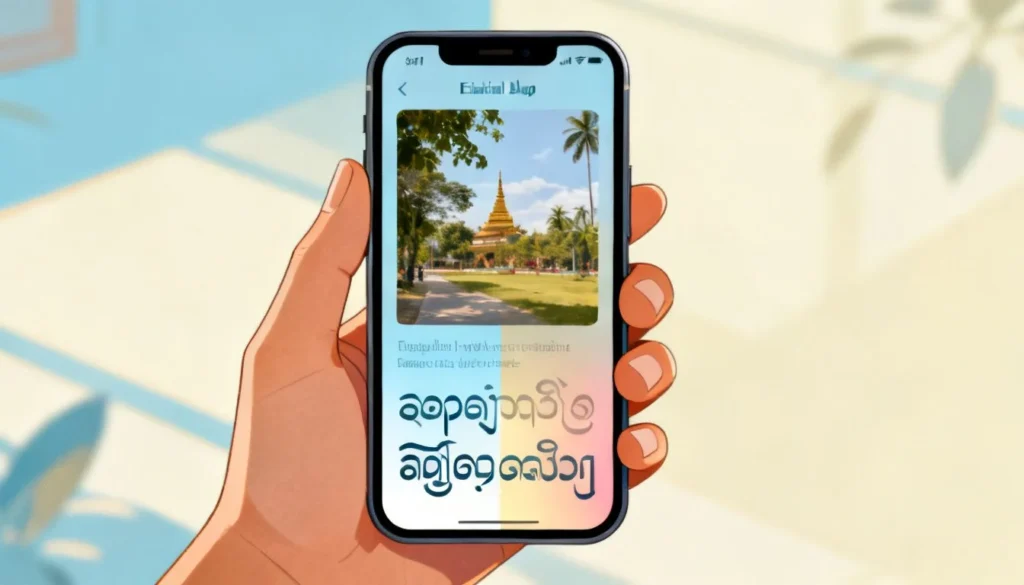
- Use the camera feature for signs and menus. The instant visual translation works surprisingly well for short printed text.
- Compare with a second tool when accuracy matters. Microsoft Translator and the Myanmar government’s own translation resources sometimes handle specific phrases better.
Pro Tip: The Google Translate mobile app’s conversation mode is genuinely useful for basic travel situations. It is not perfect, but for ordering food or asking directions, it bridges the gap well enough.
Common Translation Errors to Watch For
Knowing where Google Translate typically fails helps you spot problems before they cause misunderstandings. The most frequent error patterns include:
- Pronoun confusion. Burmese has complex honorific systems for pronouns based on age, gender, and social status. Google Translate often flattens these into generic “I” and “you.”
- Missing particles. Burmese uses sentence-final particles like “naw,” “bar,” and “lay” that indicate mood, politeness, or question status. These frequently disappear in translation.
- Tone-related word mix-ups. Without tone markers, Google Translate regularly confuses words that differ only by tone.
- Idiom destruction. Burmese idioms translate literally into nonsense English. “To eat rice” means “to eat a meal,” but Google Translate sometimes renders it literally.
Understanding these patterns means you can spot likely errors and verify before acting on a translation.
When Google Translate Is Actually Good Enough
Despite its limitations, Myanmar to English Google Translate serves several purposes well. For travelers, the camera translation of menus, street signs, and short labels works reliably. For researchers, getting the general meaning of news articles and official statements is achievable. For language learners, it provides a useful starting point for understanding sentence structure.
The key is matching your expectations to the task. Google Translate is a helpful tool for getting the gist of Burmese text. It is not a substitute for a human translator when accuracy matters for legal, medical, or business purposes.
Key Takeaways
- Myanmar to English Google Translate works best with formal, written Burmese and short, simple phrases
- Casual conversation, slang, and idiomatic expressions produce the most translation errors
- The Burmese writing system, tonal nature, and grammar structure create unique translation challenges
- Breaking text into smaller chunks and translating both directions improves accuracy
- For critical documents, always verify with a human translator or native speaker
Frequently Asked Questions
Q: Does Google Translate support Myanmar language?
A: Yes, Google Translate has supported Myanmar (Burmese) since 2014. The quality has improved significantly since launch, but it still lags behind more commonly translated languages like Spanish or French.
Q: How accurate is Myanmar to English Google Translate?
A: Accuracy depends heavily on the type of text. Formal written Burmese translates with reasonable accuracy for getting the general meaning. Casual conversation, slang, and complex sentences often produce errors or confusing output.
Q: Can I use Google Translate for Myanmar travel?
A: Yes, the camera translation feature works well for menus, signs, and short labels. The conversation mode can help with basic interactions. For anything involving money, directions, or safety, confirm with a local when possible.
Q: Why does Google Translate struggle with Burmese?
A: Burmese uses a script without spaces between words, has tonal distinctions not marked in writing, and follows a different grammatical structure than English. These factors combine to make accurate machine translation significantly harder.
Q: Is there a better alternative to Google Translate for Myanmar?
A: Microsoft Translator offers comparable quality. For serious translation work, professional human translators or services like Gengo and Translated.net provide much higher accuracy. The Myanmar Language Commission also maintains official resources.
Q: Can Google Translate handle Burmese script in images?
A: Yes, the camera feature in the mobile app can detect and translate Burmese text in images. It works best with clear, well-lit photos of printed text. Handwritten Burmese remains challenging.
Q: Does Google Translate work offline for Myanmar?
A: Yes, you can download the Myanmar language pack for offline use in the mobile app. The offline translation quality is slightly lower than online, but it works for basic phrases when you have no internet connection.
Q: How do I get better Myanmar translations from Google Translate?
A: Break text into shorter segments, avoid slang and idioms, use formal language when possible, and verify by translating back to Burmese. For important translations, cross-check with a native speaker.
References & Further Reading
- Google Translate Official Support Page , Official documentation for features and language support
- Myanmar Language Commission , Official government body for Burmese language standards
- Ethnologue: Burmese Language , Comprehensive linguistic information about Burmese
- Microsoft Translator Languages , Comparison resource for alternative translation tools
—
About This Article
This guide draws on practical testing of Google Translate’s Burmese capabilities across formal documents, casual conversation, and real-world travel scenarios. The analysis reflects current performance as of early 2024, though Google’s translation models update regularly. For critical translations, always verify with a qualified human translator.