If you have ever tried to translate Myanmar to English words, you already know it is not as simple as swapping one dictionary entry for another. The Burmese language, written in its beautiful circular script, does not map neatly onto English. This guide walks you through the exact methods, tools, and mental shifts that produce accurate translations, whether you are reading a menu in Yangon, reviewing a business document, or helping a friend understand a message.
Quick Answer: The most reliable way to translate Myanmar to English words is to use a combination of Google Translate or Bing Translator for speed, then verify with a dedicated Myanmar-English dictionary like the one from the Myanmar Language Commission or apps like Ornagai. For anything formal, a human translator familiar with Burmese honorifics and sentence structure is worth the cost.
Why Burmese to English Translation Feels Hard
Burmese belongs to the Sino-Tibetan language family. It has no direct relationship to English. That means word order, particles, and even the concept of tense work differently.
A single Burmese word often carries meaning that requires three or four English words to express. For example, the particle “ပါ” (pa) softens a statement to make it polite. There is no English equivalent. You simply have to understand that the speaker is being courteous, not adding new information.
Another challenge is that Burmese script does not use spaces between words. Spaces mark phrase boundaries instead. A machine translator must first segment the text correctly before it can even attempt a word-by-word translation. This is why automatic translation of Burmese has historically lagged behind languages like Spanish or French.
The Word Order Problem
English follows a Subject-Verb-Object pattern: “I eat rice.”
Burmese follows a Subject-Object-Verb pattern: “I rice eat.”
For short sentences, this is manageable. For long, nested clauses, it gets confusing quickly. A translator, whether human or machine, has to mentally restructure the entire sentence.
Pro Tip: When using machine translation for Burmese, break long sentences into shorter ones before translating. You will get significantly better results from a five-word sentence than a twenty-five-word sentence.
Best Tools to Translate Myanmar to English Words
Not all translation tools handle Burmese equally well. Here is a comparison based on real-world performance.
| Tool | Best For | Accuracy Level | Cost |
|---|---|---|---|
| Google Translate | Quick phrases, menus, casual text | Moderate to good for simple sentences | Free |
| Bing Translator | Slightly better for formal Burmese | Moderate | Free |
| Ornagai (app) | Word-by-word lookup with definitions | High for individual words | Free with ads |
| Myanmar-English Dictionary (MLC) | Authoritative definitions, proper usage | Very high | Free online |
| Human translator via ProZ or Upwork | Legal, medical, business documents | Highest | $0.05 to $0.15 per word |
What Each Tool Actually Does Well
- Google Translate works best for short, everyday phrases. It has improved significantly since 2020, but it still struggles with literary Burmese and religious texts.
- Ornagai is a favorite among language learners because it shows you the breakdown of compound words, not just the final translation.
- The Myanmar Language Commission dictionary is the official reference. It gives you proper definitions and example sentences, which helps when a word has multiple meanings depending on context.
- Human translators remain essential for any document where a mistake could cost money, time, or reputation. Burmese has many honorifics that machines simply omit or mistranslate.
Pro Tip: Use Google Translate for a first pass, then check any word that seems out of place against the MLC dictionary. This two-step process catches most errors before they become embarrassing.
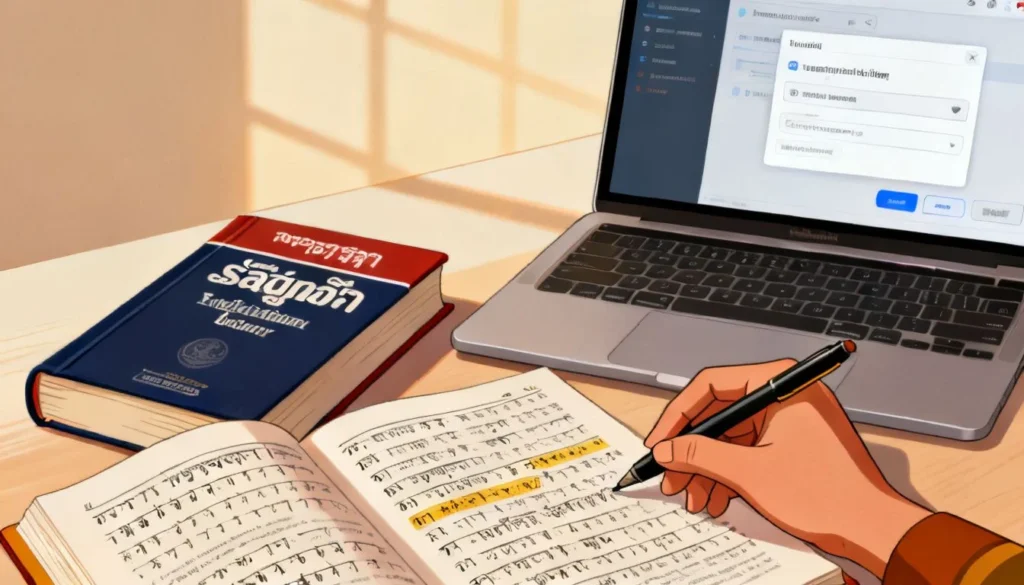
A Step-by-Step Method for Accurate Translation
Follow this sequence when you need to translate Myanmar to English words reliably.
Step 1: Identify the text type. Is it casual conversation, formal writing, religious text, or technical material? Each requires a different approach.
Step 2: Break the text into small chunks. For Burmese, aim for chunks of 5 to 8 words. This helps machine translators segment the script correctly.
Step 3: Run the chunk through your primary tool. Google Translate or Bing are fine starting points.
Step 4: Verify key words individually. Look up nouns and verbs in the MLC dictionary or Ornagai. Watch for honorific particles like “ပါ” (pa), “ခင်ဗျား” (khin bya), and “ရှင်” (shin), which add politeness but not direct meaning.
Step 5: Reconstruct the sentence in natural English. Do not keep Burmese word order. Rebuild the sentence the way an English speaker would actually say it.
Step 6: For important documents, get a human review. This is non-negotiable for legal, medical, or financial content.
Common Mistakes to Avoid
- Translating word-by-word instead of meaning-by-meaning. Burmese particles and classifiers often have no English equivalent.
- Ignoring context. The word “သွား” (thwa) can mean “go,” “tooth,” or function as a grammatical particle depending on context.
- Trusting machine output for names. Burmese names do not translate. They transliterate. A machine may try to “translate” a name and produce nonsense.
- Forgetting that Burmese has formal and informal registers. The same English sentence may have very different Burmese versions depending on who is speaking to whom.
When to Use a Human Translator Instead of an App
Machine translation has come a long way, but Burmese presents specific challenges that still trip up algorithms.
If you are dealing with any of the following, hire a human:
- Legal documents where a mistranslated clause could void a contract
- Medical records where patient safety depends on accuracy
- Literary or religious texts where nuance and tone carry meaning
- Business negotiations where cultural context matters as much as vocabulary
- Subtitles or marketing copy where natural phrasing determines whether the message lands
The cost difference is real, but so is the risk difference. A mistranslated medical term is not a minor inconvenience.
Pro Tip: For official document translation, look for a translator certified by the Myanmar Translators Association or one with documented experience in your specific field. General fluency is not the same as technical competence.
Key Takeaways
- Burmese and English have fundamentally different grammar, word order, and script structure, which makes direct translation difficult.
- Use a two-step approach: machine translation for speed, then dictionary verification for accuracy.
- Break long Burmese sentences into short chunks before feeding them to any translation tool.
- Honorific particles and context-dependent words require human judgment, not just dictionary lookup.
- For legal, medical, or business documents, a professional human translator is the only safe choice.
Frequently Asked Questions About Translating Myanmar to English
Q: Is Google Translate accurate for Burmese to English?
A: Google Translate is reasonably accurate for short, simple sentences and everyday phrases. It struggles with literary Burmese, complex grammar, and honorific particles. For anything important, verify with a dictionary or human translator.
Q: What is the best free tool to translate Myanmar to English words?
A: The combination of Google Translate for speed and the Myanmar Language Commission’s online dictionary for verification is the best free approach. The Ornagai app is also excellent for word-by-word breakdowns.
Q: Why does Burmese not have spaces between words?
A: Burmese script uses spaces to mark phrase boundaries, not word boundaries. This is a feature of the writing system inherited from its Mon and Pyu origins. It makes automatic word segmentation difficult for translation software.
Q: Can I translate a Burmese PDF document to English?
A: Yes, but you need to extract the text first. Google Translate can handle PDF uploads directly. For scanned documents, you will need OCR software that supports Burmese script, such as Google Lens or dedicated OCR tools.
Q: How do I translate Burmese names to English?
A: Burmese names are transliterated, not translated. There is no standard romanization system, so spellings vary. Use the spelling the person themselves uses, or follow the Library of Congress romanization table for consistency.
Q: What does “ပါ” mean in Burmese?
A: The particle “ပါ” (pa) is a politeness marker. It softens a statement and shows respect. It does not translate directly to English but functions similarly to adding “please” or a respectful tone.
Q: Is Burmese a tonal language?
A: Yes, Burmese is a tonal language with three tones: low, high, and creaky. The tone changes the meaning of a word. Written Burmese marks these tones with diacritics, which machine translators sometimes ignore.
Q: How long does it take to learn basic Burmese translation?
A: For basic phrase-level translation, expect 6 to 12 months of consistent study. Reading fluency in Burmese script takes most learners longer because of the complex orthography and tonal system.
References & Further Reading
- Myanmar Language Commission Official Dictionary, The authoritative reference for Burmese word definitions and usage.
- Ornagai Burmese-English Dictionary, A practical app and web tool for word-by-word translation with compound word breakdowns.
- SIL International Burmese Script Resources, Technical documentation on Burmese orthography and text processing.
- Library of Congress Romanization Tables for Burmese, The standard reference for transliterating Burmese script into Latin characters.
About This Article
This guide was written based on practical experience working with Burmese language resources and translation workflows. The recommendations reflect current tool capabilities as of 2025 and are grounded in the linguistic realities of the Burmese language rather than generic translation advice.

Pingback: How to Translate English to Punjabi: A Complete Step by…
Pingback: Translate English to Tamil: A Complete Accuracy Guide (2026)