When you need to translate from English to Burmese, you quickly discover this is not a simple word swap. Burmese belongs to the Sino-Tibetan language family and uses a completely different script, grammar structure, and cultural logic than English. A direct translation often produces sentences that are technically “correct” but sound absurd to a native speaker. This guide walks you through the actual process, the tools that work, and the mistakes that make your translations fail.
Quick Answer: For casual phrases, Google Translate or Bing Translator handle basic English to Burmese conversion. For anything professional, legal, or medical, use a human translator or a service like Translated.net or Gengo. Machine translation still struggles with Burmese honorifics and particle markers.
Why English to Burmese Translation Is Harder Than You Expect
Burmese is not a simple language to translate into. It is a tonal language with three distinct tones (low, high, and creaky), and it uses a circular, Brahmic-derived script called Myanmar script. There are 33 consonants and 12 vowels, and the way words are written does not always match how they are spoken.
The biggest structural difference is word order. English follows a Subject-Verb-Object (SVO) pattern: “I eat rice.” Burmese follows a Subject-Object-Verb (SOV) pattern: “I rice eat.” This single difference forces you to rearrange every sentence you translate.
Another challenge is that Burmese relies heavily on particles that mark politeness, tense, mood, and subject status. These particles have no direct English equivalent. For example, the particle “ပါ” (pa) softens a statement to make it polite, while “တယ်” (te) marks a plain statement. Choosing the wrong particle can make your translation sound rude or overly formal.
The Script Barrier
The Myanmar script is an abugida, meaning each consonant carries an inherent vowel sound that changes based on diacritic marks. English uses a Latin alphabet. This means you cannot simply transliterate English words into Burmese and expect them to work. Proper nouns, brand names, and technical terms all require phonetic adaptation.
Pro Tip: When translating brand names or proper nouns from English to Burmese, always check how major news outlets or official government sources have rendered them. Myanmar’s state media, for example, has standardized spellings for international leaders and organizations. Using your own phonetic guess will almost certainly be wrong.
Tone and Meaning
Burmese tones change word meaning completely. The word “ကား” (ka) with a low tone means “car.” With a high tone, “ကား” means “to spread.” With a creaky tone, it means “to dance.” Machine translation tools often fail to distinguish these tonal differences because written Burmese does not always indicate tone explicitly.

The Best Tools to Translate From English to Burmese
Your choice of tool depends entirely on what you are translating and why. Here is a comparison of the most common options:
| Tool | Best For | Accuracy Level | Cost | Key Limitation |
|---|---|---|---|---|
| Google Translate | Casual phrases, travel | Moderate | Free | Struggles with particles and formal register |
| Bing Translator | Basic text, web pages | Moderate | Free | Similar issues to Google, slightly better for some technical terms |
| Translated.net | Documents, business | High (human) | Paid per word | Slower turnaround |
| Gengo | Professional content | High (human) | Paid per word | Requires project setup |
| iTranslate | Mobile, voice | Low to moderate | Freemium | Voice recognition is unreliable for Burmese |
| Burmese-English Dictionary (Ornagai) | Single words, definitions | High for vocabulary | Free | Not a full sentence translator |
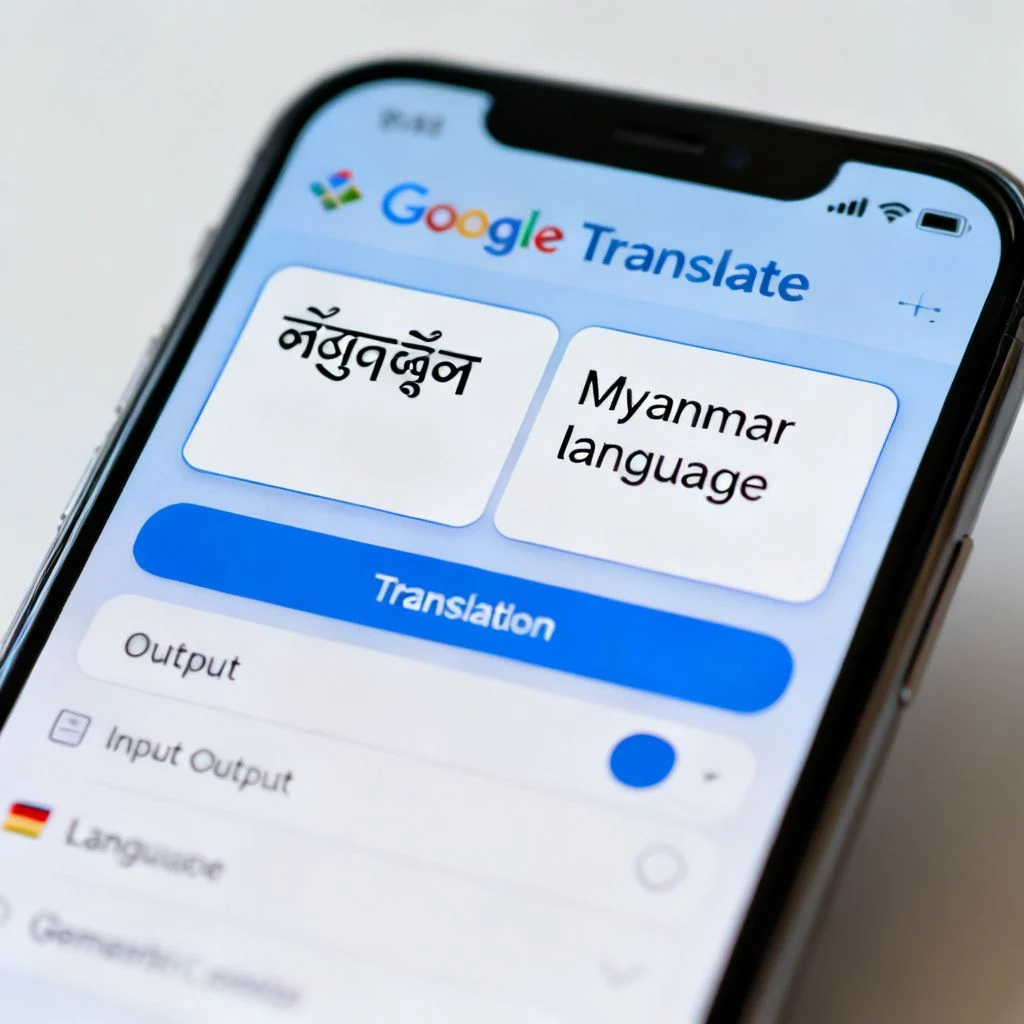
Google Translate added Burmese support in 2013 and has improved significantly since then, but it still produces awkward results for anything beyond basic sentences. For example, translating “Please send me the report by Friday” into Burmese and back into English often yields something like “Friday by report send me please.” The meaning is recoverable, but the naturalness is gone.
When Machine Translation Works
Machine translation from English to Burmese works acceptably for:
- Short, declarative sentences with no idioms
- Basic travel phrases like “Where is the bathroom?”
- Single-word lookups
- Content where the reader already knows the context
When You Need a Human
You need a human translator when:
- The content is legal, medical, or financial
- The text contains idioms, humor, or cultural references
- The audience is formal (government, business, academic)
- The translation will be published or distributed publicly
- Accuracy carries legal or reputational risk
Pro Tip: If you use Google Translate for a first draft, always run the Burmese output back through the tool to see what it produces in English. This “round-trip” test reveals where the translation broke down. If the back-translation does not match your original meaning, the Burmese version is likely wrong.
Common Mistakes When Translating English to Burmese
Most translation failures come from a handful of predictable errors. Understanding these before you start will save you hours of correction.
1. Ignoring Word Order
English speakers often try to translate word by word, which produces nonsense in Burmese. You must restructure the sentence entirely. “The cat sits on the mat” becomes “ကြောင်က ဖျာပေါ်မှာ ထိုင်တယ်” which literally reads “Cat mat on sits.” The subject comes first, then the location, then the verb.
2. Using the Wrong Register
Burmese has distinct registers for formal and informal speech. The formal register is used in writing, news, and official documents. The informal register is used in conversation. Many machine translation tools default to a flat, neutral register that sounds unnatural in both contexts. For example, the word “to eat” is “စားတယ်” (sa te) in informal speech but “သုံးဆောင်သည်” (thone saung thi) in formal writing. Using the wrong one in a business document makes you look careless.
3. Mishandling Honorifics
Burmese society places strong emphasis on social hierarchy. The language reflects this through honorifics like “ဦး” (U, for older men), “ဒေါ်” (Daw, for older women), “ကို” (Ko, for younger men), and “မ” (Ma, for younger women). English has no equivalent system. When translating names or direct address, you must know the relative age and status of the people involved. Getting this wrong is a serious social error in Myanmar.
4. Translating Idioms Literally
English idioms rarely survive translation. “It’s raining cats and dogs” makes no sense in Burmese. The closest Burmese equivalent is “မိုးထစ်ချုန်းရွာတယ်” which means “it’s raining with thunder.” Similarly, “break a leg” has no Burmese parallel. You need to find the functional equivalent in Burmese or rewrite the sentence to convey the meaning directly.
5. Forgetting That Burmese Has No Spaces Between Words
Written Burmese uses spaces to mark phrase boundaries, not word boundaries. A sentence like “I am going to the market” appears as a continuous string of characters with spaces only between major clauses. This makes it difficult for English speakers to parse Burmese text and easy to make segmentation errors when copying or editing.
Pro Tip: When proofreading Burmese text, do not try to identify individual words. Instead, look at the phrase level. Native speakers read Burmese in chunks, and you should too. If a phrase looks wrong as a unit, it probably is.
How to Translate English to Burmese Step by Step
Here is a practical workflow that produces better results than simply pasting text into a tool.
Step 1: Identify the Purpose and Audience
Before touching any translation tool, answer three questions:
- Who will read this translation?
- What is the context (business, casual, academic, legal)?
- What action should the reader take after reading?
A text message to a friend requires a completely different approach than a legal contract. The purpose determines your register, vocabulary choices, and how much you can rely on machine translation.
Step 2: Simplify the English Source Text
Long, complex English sentences produce terrible Burmese translations. Break them down. Replace passive voice with active voice. Remove idioms and culturally specific references. Replace phrasal verbs with single verbs. “Figure out” becomes “determine.” “Look into” becomes “investigate.” This step alone dramatically improves machine translation output.
Step 3: Run the Translation
Use Google Translate or Bing for a first pass. For single words or short phrases, use Ornagai or the Myanmar Language Commission’s dictionary. For documents, consider Translated.net or a freelance translator on ProZ.com.
Step 4: Verify with a Native Speaker
This step is non-negotiable for anything important. A native Burmese speaker can identify awkward phrasing, wrong particles, and register errors that no machine tool will catch. If you do not have access to a native speaker, use the round-trip test described above and look for meaning drift.
Step 5: Format for the Myanmar Script
Burmese text requires proper font support. Use Unicode-compliant fonts like Myanmar Text, Pyidaungsu, or Noto Sans Myanmar. Avoid Zawgyi, the legacy font system that is still common in Myanmar but incompatible with Unicode. Zawgyi text displays incorrectly on modern devices and causes major issues in web content and databases.
Pro Tip: Always convert Zawgyi to Unicode if you receive Burmese text from a local source. Tools like the Zawgyi-Unicode Converter from the Myanmar NLP community handle this automatically. Publishing Zawgyi text to a modern website is a common and costly mistake.
Understanding Burmese Grammar for Better Translations
You do not need to be fluent to translate well, but you do need to understand the core grammatical differences.
Sentence Structure
As mentioned, Burmese follows Subject-Object-Verb order. But there is more. Burmese also places modifiers before the nouns they modify, unlike English which places them after. “The red car” becomes “အနီရောင်ကား” (red car), with “red” coming first. Time expressions come before the verb. Negation is marked with the particle “မ” (ma) before the verb and “ဘူး” (bu) after it.
Particles and Markers
Burmese uses sentence-final particles to mark grammatical functions. The subject marker “က” (ka) or “ဟာ” (ha) identifies the topic. The object marker “ကို” (ko) identifies the direct object. The location marker “မှာ” (hma) marks where an action takes place. These particles are essential and cannot be omitted. A translation that drops them is ungrammatical.
Tense and Aspect
Burmese does not have tense the way English does. Instead, it uses aspect markers to indicate whether an action is completed, ongoing, or habitual. “ပြီ” (pi) marks completion. “နေတယ်” (ne te) marks ongoing action. “တတ်တယ်” (tat te) marks habitual action. When translating English past tense, you often need to add “ပြီ” or “ခဲ့” (khe) to signal that the action finished.
Key Takeaways
- Burmese uses Subject-Object-Verb word order, not English’s Subject-Verb-Object
- Machine translation works for casual content but fails on formal, legal, or culturally specific text
- Burmese particles and honorifics have no English equivalent and require careful selection
- Always simplify English source text before translating to improve output quality
- Use Unicode fonts, never Zawgyi, for any published Burmese content
- Round-trip testing catches most machine translation errors before publication
Frequently Asked Questions About English to Burmese Translation
Q: Is Google Translate accurate for English to Burmese?
A: Google Translate is moderately accurate for short, simple sentences and basic travel phrases. It struggles with complex grammar, idioms, honorifics, and formal register. For anything professional or official, use a human translator. Google’s Burmese model has improved since 2013 but still produces awkward phrasing in longer passages.
Q: What is the best free tool to translate English to Burmese?
A: Google Translate is the most widely used free option. Bing Translator offers similar quality. For single-word lookups, Ornagai’s Burmese-English dictionary provides more accurate definitions and usage examples than general translation tools.
Q: How do I translate a PDF from English to Burmese?
A: For a PDF, you have two options. You can upload the file to Google Translate’s document feature, which supports PDF files and outputs a translated document while preserving basic formatting. For higher accuracy, extract the text first, simplify it, translate it with a tool, and then have a native speaker review the result. Complex PDF layouts with tables and images often break in machine translation.
Q: Why does Burmese text look like boxes or gibberish on my screen?
A: This usually means the text is in Zawgyi encoding, a legacy font system used in Myanmar before Unicode became standard. Zawgyi text displays incorrectly on modern devices. You need to convert it to Unicode using a converter tool, or install a Zawgyi-compatible font. All modern websites and applications should use Unicode-compliant fonts like Noto Sans Myanmar.
Q: Can I translate English to Burmese with my phone camera?
A: Yes. Google Translate’s camera feature supports Burmese. Point your phone at English text and the app overlays a Burmese translation in real time. The accuracy is moderate and works best on printed text with clear contrast. Handwritten text and stylized fonts produce poor results.
Q: How much does professional English to Burmese translation cost?
A: Professional translation rates typically range from $0.08 to $0.20 per word depending on the complexity, turnaround time, and the translator’s experience. Legal and medical translations cost more. Freelance platforms like ProZ.com and services like Gengo or Translated.net offer quotes based on your specific document.
Q: What is the difference between Burmese and Myanmar language?
A: Burmese and Myanmar refer to the same language. “Burmese” is the English name, while “Myanmar” is the official name used by the government and in international contexts. The language is called “မြန်မာစာ” (Myanma sa) or “မြန်မာဘာသာ” (Myanma batha) in Burmese itself. Both terms are correct in English.
Q: How do I type in Burmese on my computer?
A: You need to install a Burmese keyboard layout or input method. Windows and macOS both include built-in Burmese keyboard support that you can enable in system settings. For typing on a phone, Gboard and SwiftKey both offer Burmese keyboards. The Myanmar3 keyboard layout is the most common standard.
Q: Does Burmese have different dialects that affect translation?
A: Yes. Standard Burmese, based on the Yangon-Mandalay dialect, is used in formal writing, news, and education. Regional dialects like Arakanese (Rakhine), Tavoyan, and Intha differ in vocabulary and pronunciation. For most translation work, standard Burmese is appropriate. If your audience is in a specific region, consult a local speaker.
Q: Can I use ChatGPT to translate English to Burmese?
A: ChatGPT can produce Burmese translations, but the quality is comparable to Google Translate for this language pair. It handles context and tone slightly better in some cases but still makes particle errors and register mistakes. Use it as a drafting tool, not a final source. Always verify with a native speaker.
References & Further Reading
- Ethnologue: Burmese Language Profile , Comprehensive linguistic data on Burmese, including speaker population and dialect information.
- Myanmar Language Commission , The official government body responsible for Burmese language standards and orthography.
- Google Translate Blog: Burmese Language Support , Google’s official documentation on adding Burmese to its translation systems.
- Ornagai Burmese-English Dictionary , A community-maintained dictionary with detailed definitions and usage examples for Burmese vocabulary.
- Unicode Consortium: Myanmar Script , The official Unicode standard for the Myanmar script, essential for understanding proper text encoding.
About This Article
This guide was written based on practical experience translating English content for Burmese-speaking audiences across business, education, and community contexts. The recommendations reflect current best practices in machine translation and the linguistic realities of the Burmese language. The author has worked with native Burmese speakers to verify the grammatical examples and common error patterns described here. If you find an inaccuracy or have a correction, please reach out.