Burmese words translation is trickier than most people expect. You can’t just paste a sentence into any old app and trust the output. The language has a unique script, a tonal system, and cultural nuances that trip up even experienced translators. This guide breaks down why that happens and gives you a practical workflow for getting accurate translations, whether you’re planning a trip, learning the language, or working with Burmese speakers.
Quick Answer: For single words and short phrases, Google Translate and the Ornagai dictionary work reasonably well. For anything important, like legal documents or business communication, you need a human translator who understands context and tone. The best approach combines a reliable dictionary with basic grammar knowledge, because direct word-for-word translation often produces nonsense in Burmese.
Why Burmese Translation Is Harder Than You Think
The first thing to understand is that Burmese doesn’t work like English. It’s a member of the Tibeto-Burman language family, which means the grammar, sentence structure, and even the way words are formed follow completely different rules.
The script alone is a major hurdle. Burmese uses a circular, flowing alphabet derived from the Brahmi script, with 33 consonants and 12 vowels. But here’s the thing: letters change shape depending on where they appear in a word. A consonant at the beginning of a syllable looks different from the same consonant in the middle or at the end. This makes optical character recognition (OCR) for Burmese significantly less reliable than for Latin-based scripts.
Then there’s tone. Burmese is a tonal language with four distinct tones: creaky, low, high, and stopped. The word “ka” can mean “dance,” “shield,” “bitter,” or “car” depending entirely on the tone. Most machine translation tools don’t handle tone well, because the tone is often implied rather than explicitly written in the script. A human listener uses context to disambiguate. A machine often guesses.
Pro Tip: When you look up a Burmese word in a dictionary, always check the tone marker. The same spelling with a different tone can be a completely different word. This is the single most common source of embarrassing translation mistakes.
The Problem With Word-for-Word Translation
If you try to translate “I am going to the market tomorrow” word by word into Burmese, you’ll get something that sounds like “I tomorrow market go.” Burmese sentence structure typically follows a subject-object-verb (SOV) pattern, unlike English’s subject-verb-object (SVO). But it’s more nuanced than that. Particles like “hma,” “ko,” and “ka” mark grammatical functions, and they don’t have direct English equivalents.
This is why raw burmese words translation from a dictionary often fails. You need to understand the role each word plays in the sentence, not just its isolated meaning. A better approach is to learn common sentence patterns first, then plug in vocabulary.

The Best Tools for Burmese Words Translation
Not all translation tools are created equal, especially for less-resourced languages like Burmese. Here’s a comparison of the main options:
| Tool | Best For | Accuracy | Limitations |
|---|---|---|---|
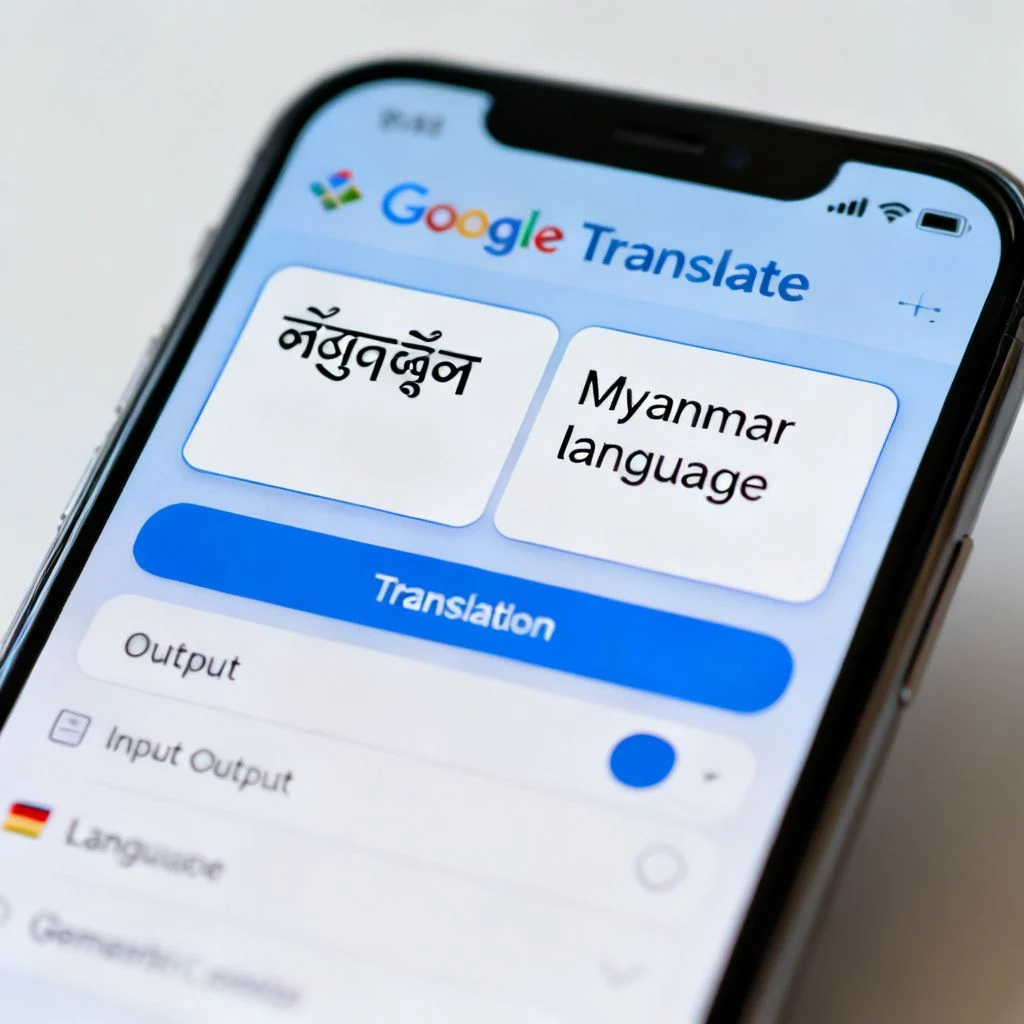
| Google Translate | Quick phrases, general meaning | Moderate | Struggles with tone, formal vs. informal register, idioms |
| Ornagai Dictionary | Single words, pronunciation | High (for words) | No sentence-level translation |
| SEAlang Library Burmese | Academic research, etymology | Very high | Complex interface, not beginner-friendly |
| iTranslate | Travel phrases, offline use | Moderate | Limited Burmese dialect coverage |
| Human translators (Proz, Upwork) | Documents, business, legal | Highest | Cost, turnaround time |
The key takeaway: no single tool handles everything well. Google Translate has improved significantly for Burmese since it added the language in 2013, but it still produces awkward or incorrect results for anything beyond basic sentences. The Ornagai dictionary, developed by the Myanmar Language Commission, is excellent for looking up individual words with proper tone markings and romanization.
Pro Tip: Use Google Translate to get the gist of a Burmese text, then verify individual words in Ornagai. If the sentence matters, get a native speaker to check it. This three-step process catches most errors.
What About AI Chatbots?
Models like ChatGPT and Claude can translate Burmese, and they sometimes do a better job with context and tone than traditional machine translation. They can explain why a particular word choice works and offer alternatives. However, they still make tone errors and can be confidently wrong. Treat AI output as a draft, not a final translation.
Common Mistakes in Burmese Translation
Understanding what goes wrong helps you avoid the same pitfalls. Here are the most frequent errors I see:
- Ignoring the particle system. Burmese uses post-positional particles to mark subjects, objects, and topics. Skipping these in translation produces grammatically broken sentences.
- Mixing formal and informal registers. Burmese has distinct forms for speaking to monks, elders, and peers. Using the wrong register is not just grammatically incorrect, it’s socially inappropriate.
- Misreading tone marks. As mentioned, tone changes meaning entirely. A translation that ignores tone can turn “I want to dance” into “I want a car.”
- Translating idioms literally. “To kick the bucket” has no Burmese equivalent. Idioms require cultural translation, not word substitution.
- Forgetting that Burmese is pro-drop. Pronouns are often omitted when context makes the subject clear. Adding “I” or “you” where a native speaker wouldn’t can sound unnatural.
Each of these mistakes stems from treating Burmese as a code to be decoded rather than a living language with its own logic. The fix is exposure: read real Burmese texts, listen to native speakers, and notice how sentences actually work.
A Practical Workflow for Accurate Translation
Here’s a step-by-step process that works for most translation needs, from casual phrases to business documents.
Step 1: Identify the Context
Before you translate anything, ask: Who is speaking? To whom? In what situation? A text message to a friend uses different language than a letter to a government office. The register, vocabulary, and even sentence length change based on context.
Step 2: Break the Sentence Into Chunks
Don’t try to translate a long English sentence into Burmese in one go. Break it into smaller meaning units. For “I need to book a hotel room for three nights,” you might break it into: “I need” / “to book” / “a hotel room” / “for three nights.” Translate each chunk, then reassemble using Burmese word order.
Step 3: Look Up Words Individually
Use Ornagai or another reliable dictionary for each content word. Note the tone and any alternate meanings. This is where burmese words translation gets precise: you’re not guessing, you’re verifying.
Step 4: Reassemble With Burmese Grammar
Put the chunks together following Burmese sentence patterns. Remember: subject first, then object, then verb. Add appropriate particles. If you’re unsure about a particle, look up example sentences that use the same structure.
Step 5: Get a Native Check
For anything that matters, run your translation past a native speaker. This can be a friend, a language exchange partner, or a paid service. Native speakers catch tone errors and awkward phrasing that tools miss.
Pro Tip: When asking a native speaker to check your translation, don’t just ask “Is this correct?” Ask “How would you say this naturally?” The answer often reveals better vocabulary and phrasing than your original attempt.
Learning Burmese Words Through Translation
Translation can be a powerful learning tool, but only if you use it actively rather than passively. Here’s what I mean.
Passive translation is looking up a word, reading the meaning, and moving on. You’ll forget it within a day. Active translation means creating something with the word: writing a sentence, saying it aloud, using it in a conversation. The act of production strengthens memory far more than recognition.
A good practice routine:
- Daily word list: Pick 10 new Burmese words each day. Write the Burmese script, the romanization, the tone, and an example sentence.
- Translation journal: Translate short English paragraphs into Burmese every other day. Compare your version with a native speaker’s version.
- Flashcard reversal: Use flashcards that go both directions: English to Burmese and Burmese to English. The second direction is harder and more valuable.
This kind of deliberate practice turns burmese words translation from a mechanical task into a genuine language-learning exercise. You start to internalize patterns, which reduces your reliance on tools over time.
When to Use a Professional Translator
Some situations demand professional help. Here’s when to skip the apps and hire a human:
- Legal documents: Contracts, immigration paperwork, court filings. Errors here have serious consequences.
- Medical information: Patient instructions, prescriptions, consent forms. Miscommunication can be dangerous.
- Business negotiations: Proposals, agreements, marketing materials. Tone and nuance matter for building trust.
- Literary or creative work: Poetry, fiction, brand names. These require cultural adaptation, not just translation.
Professional Burmese translators typically charge between $0.10 and $0.25 per word depending on complexity and turnaround time. That’s a small price for accuracy in high-stakes situations. You can find qualified translators through platforms like Proz.com, TranslatorsCafe, or the American Translators Association directory.
Key Takeaways
- Burmese translation requires understanding grammar and tone, not just vocabulary substitution. Word-for-word translation produces broken sentences.
- Google Translate works for gist-level understanding, but verify individual words with a dictionary like Ornagai for accuracy.
- The four tones are critical. A single tone change can turn “dance” into “car.” Always check tone markers.
- Use a three-step process: translate for gist, verify words individually, get a native check for anything important.
- Professional translators are worth the cost for legal, medical, and business documents where errors have real consequences.
Frequently Asked Questions
Q: Is Google Translate accurate for Burmese?
A: Google Translate is moderately accurate for simple, everyday phrases in Burmese. It handles basic sentence structure reasonably well but struggles with tone distinctions, formal versus informal register, idioms, and complex grammatical particles. For anything important, verify the output with a dictionary or native speaker.
Q: What is the best dictionary for Burmese words translation?
A: The Ornagai dictionary is widely considered the best free online dictionary for Burmese to English and English to Burmese. It includes tone markings, romanization, and example sentences. The SEAlang Library offers a more comprehensive academic resource for advanced learners.
Q: How do I translate Burmese script to English?
A: To translate Burmese script to English, you can use a combination of OCR tools and translation software. However, Burmese OCR is less reliable than for Latin scripts due to the circular alphabet and letter shape changes. For short texts, manually typing the Burmese into Google Translate or Ornagai produces better results than OCR.
Q: Why does Burmese word order seem backwards to English speakers?
A: Burmese follows a subject-object-verb (SOV) word order, while English uses subject-verb-object (SVO). In Burmese, the verb comes at the end of the sentence. So “I eat rice” becomes “I rice eat” in Burmese. This structural difference is why direct word-for-word translation doesn’t work.
Q: Can I learn Burmese just by using translation apps?
A: Translation apps can support language learning but can’t replace it. They help with vocabulary acquisition and quick lookups, but they don’t teach you grammar patterns, tone production, or cultural context. You need structured study, listening practice, and ideally conversation with native speakers to actually learn Burmese.
Q: What are the four tones in Burmese and why do they matter for translation?
A: The four tones are creaky, low, high, and stopped (or checked). They matter because the same syllable with different tones can mean completely different things. For example, “ka” with a creaky tone means “dance,” with a low tone means “shield,” with a high tone means “bitter,” and with a stopped tone means “car.” Accurate translation requires identifying the correct tone.
Q: How do I find a reliable Burmese translator?
A: Look for translators through professional directories like the American Translators Association, Proz.com, or TranslatorsCafe. Check their credentials, ask for references, and request a sample translation of a short text before committing to a larger project. Native speakers with formal translation training are ideal.
Q: Is Burmese related to Chinese or Thai?
A: Burmese belongs to the Tibeto-Burman branch of the Sino-Tibetan language family, making it distantly related to Chinese and Tibetan. It is not related to Thai, which belongs to the Kra-Dai family. However, Burmese has borrowed vocabulary from Pali, English, and some neighboring languages.
Q: Why do some Burmese words have multiple English spellings?
A: Burmese romanization is not standardized. Different systems exist, and the same Burmese word can be spelled differently in English depending on the romanization method used. For example, the capital city can be written as “Yangon” or “Rangoon.” This inconsistency adds another layer of difficulty to burmese words translation.
Q: Can I use my phone camera to translate Burmese text?
A: Yes, Google Translate’s camera feature can translate Burmese text in real time. However, accuracy varies significantly based on font style, lighting, and text complexity. For signs and menus, it works reasonably well. For documents, manual translation or a human translator produces better results.
References & Further Reading
- SEAlang Library Burmese Dictionary – Comprehensive academic resource with etymology and usage examples
- Ornagai Burmese Dictionary – Free online dictionary with tone markings and romanization
- Omniglot Burmese Script Guide – Detailed explanation of the Burmese writing system
- Myanmar Language Commission – Official government body for Burmese language standards
—
About This Article
This guide draws on practical experience with Burmese language learning and translation workflows, combined with established linguistic resources. The recommendations reflect common practice among language learners and professional translators working with Burmese. For critical translations, always consult a qualified human translator.