Translation English to Burmese is one of those tasks that looks simple on the surface but gets complicated fast once you dig into the details. Burmese, also known as Myanmar language, uses a completely different script, a different grammatical structure, and a tone system that English simply does not have. This guide walks you through everything you need to know to get a translation that actually works, whether you are translating a single phrase, a business document, or building an app that needs Burmese language support.
Quick Answer: For everyday phrases and casual translation English to Burmese, Google Translate and Microsoft Translator handle basic communication reasonably well. For professional documents, legal contracts, medical information, or anything where accuracy matters, you need a human translator who understands both the language and the cultural context. Machine translation alone is not reliable enough for high-stakes Burmese content.
Why Burmese Translation Is Harder Than Most People Expect
Burmese belongs to the Sino-Tibetan language family, which means it shares almost nothing with English in terms of vocabulary, word order, or sentence construction. English follows a subject-verb-object pattern. Burmese typically follows a subject-object-verb pattern. That one difference alone forces a complete restructuring of every sentence you translate.
The script is another hurdle. Burmese uses a circular, flowing alphabet derived from the Brahmi script, with 33 consonants and 12 vowels. It is written from left to right but has no spaces between words in the traditional sense. Spaces in Burmese writing indicate phrase breaks, not word breaks. This makes word segmentation a genuine challenge for machine translation systems.
Then there is the tone system. Burmese is a tonal language with four distinct tones: creaky, low, high, and stopped. A single syllable can mean completely different things depending on the tone used. The word “ka” can mean “dance,” “shield,” “bitter,” or “car” depending on tone. English has none of this, so translation tools often flatten these distinctions and produce errors.
Pro Tip: When you are evaluating any Burmese translation, ask a native speaker to read it aloud. Tonal errors that look fine on paper become immediately obvious when spoken.
The Register Problem: Formal vs. Colloquial Burmese
One thing that catches people off guard is the gap between written and spoken Burmese. Literary Burmese appears in books, news broadcasts, and official documents. Colloquial Burmese is what people actually speak at home and on the street. They differ significantly in vocabulary, grammar particles, and sentence structure.
A translation tool might give you literary Burmese for a phrase that should be colloquial, or vice versa. If you are translating a marketing message meant to feel friendly and approachable, getting literary Burmese makes it sound stiff and bureaucratic. If you are translating a legal document, colloquial Burmese undermines the formality you need.
This register distinction is one of the main reasons human translators remain essential for professional work. A skilled translator knows which register fits the context.
Machine Translation Options for English to Burmese
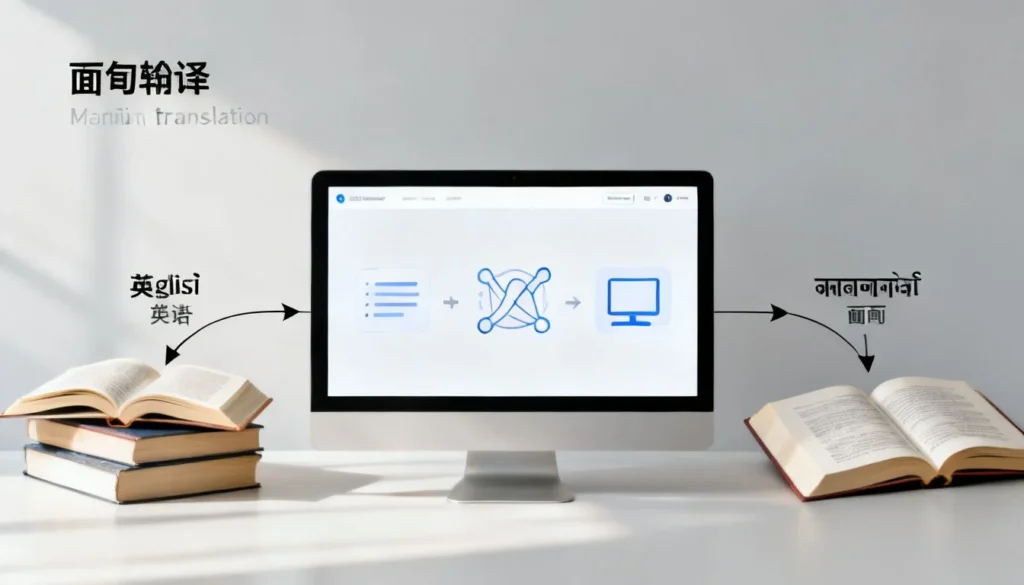
The landscape of translation English to Burmese tools has improved dramatically over the last decade, but the quality still varies widely depending on what you are translating.
| Tool | Best For | Strengths | Weaknesses |
|---|---|---|---|
| Google Translate | Casual phrases, travel, basic communication | Free, instant, supports 100+ languages, offline mode available | Struggles with tones, idioms, and formal documents |
| Microsoft Translator | Business communication, Teams integration | Good API support, solid for technical vocabulary | Less natural phrasing than human translation |
| DeepL | European language pairs | Excellent for European languages | Does not support Burmese as of this writing |
| Human translation services | Legal, medical, marketing, official documents | Culturally accurate, register-appropriate, reviewed | Slower and more expensive |
| Hybrid (machine + human review) | High-volume content with quality needs | Balances speed and cost | Requires a reliable reviewer pipeline |
The pattern here is clear: free machine tools work for getting the gist, but they are not dependable for anything where a mistake could cause real problems. A mistranslated medical instruction or legal clause is not worth the money you saved.
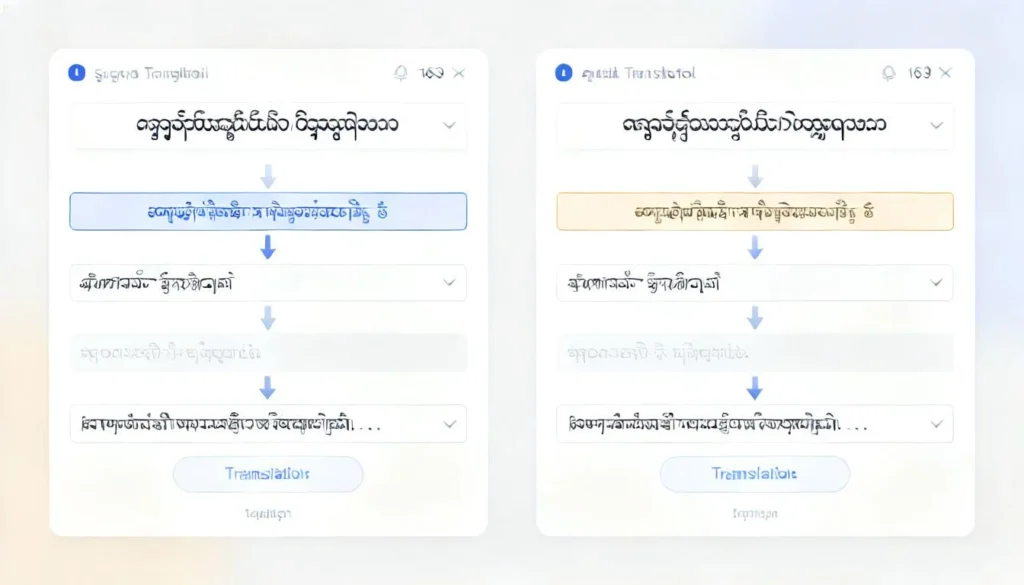
Pro Tip: If you must use machine translation for Burmese, run the result through a second engine in reverse. Translate your English to Burmese, then translate that Burmese back to English. If the meaning has shifted, you know the translation needs work.
What Machine Translation Gets Wrong Most Often
Based on patterns that professional translators consistently report, these are the most common failure points:
- Tone confusion – Machine systems frequently mix up the four Burmese tones, producing words that are technically spelled correctly but mean something entirely different.
- Particle placement – Burmese uses grammatical particles to mark subject, object, and tense. Machines often drop or misplace these, making sentences grammatically broken.
- Register mixing – A single translation might jump between literary and colloquial forms mid-sentence, which sounds unnatural to native speakers.
- Cultural references – Idioms, proverbs, and culturally specific concepts rarely translate literally. Machines usually miss these entirely.
- Name handling – Burmese names do not follow the Western first name, last name pattern. Tools often scramble name order or add incorrect titles.
When You Need a Human Translator
Some translation English to Burmese tasks simply should not go through a machine. Here is a practical breakdown of when to bring in a professional.
Legal documents require precision that machine translation cannot guarantee. Contracts, immigration paperwork, court documents, and certificates all need certified translation in most official contexts. A single mistranslated clause can change the legal meaning of an entire agreement.
Medical information carries obvious risk. Dosage instructions, allergy warnings, consent forms, and discharge summaries need to be unambiguous. The World Health Organization has documented cases where poor translation contributed to medical errors in multilingual settings.
Marketing and brand content needs cultural adaptation, not just translation. A slogan that works in English might be meaningless or even offensive in Burmese. Professional translators working in this space do what is called transcreation, adapting the message rather than translating it word for word.
Literary and creative work requires a translator who is also a skilled writer. Novels, poetry, subtitles, and scripts all need someone who can capture tone, rhythm, and emotional nuance, none of which machines handle well.
Pro Tip: For certified translations of official documents, check whether the receiving institution requires a translator accredited by a specific body. In Myanmar, the Myanmar Translators Association and various embassy-approved translation services provide certified work.
How to Find a Qualified Burmese Translator
Finding a good translator takes more effort than typing a query into a search engine. Here is what to look for:
- Native fluency – The translator should be a native Burmese speaker with strong English skills, or a native English speaker with advanced Burmese training and years of immersion.
- Subject matter expertise – A legal translator is not automatically a good medical translator. Ask about their experience in your specific field.
- Samples and references – Any serious translator can show you examples of past work and connect you with previous clients.
- Clear pricing – Professional Burmese translation typically ranges from $0.08 to $0.20 per word depending on complexity and turnaround time. Rates below that often signal quality problems.
Practical Tips for Better Burmese Translation Results
Whether you are using a machine tool or working with a human translator, a few practical habits will improve your results significantly.
Prepare Your Source Text
Garbage in, garbage out applies to translation. If your English source text is ambiguous, full of slang, or poorly structured, the Burmese output will suffer. Write clearly. Use short sentences. Avoid idioms unless you are willing to have them adapted rather than translated literally.
Define any technical terms up front. If your document uses specialized vocabulary, provide a glossary. This is especially important for medical, legal, and technical content where terminology must be precise.
Consider Your Audience
Who is reading the Burmese translation? A Burmese speaker in Yangon will understand different references than a Burmese refugee community in Fort Wayne, Indiana. The diaspora community may mix English loanwords into their Burmese speech, while speakers in Myanmar may prefer pure Burmese terms. Tell your translator who the audience is.
Test Before You Commit
For any large translation project, start with a small sample. Translate 500 words, have a second native speaker review it, and only proceed if the quality meets your standards. This catches problems early before you have paid for 50,000 words of unusable content.
Pro Tip: Build a simple review loop into your translation workflow. Have one translator produce the work and a second, independent translator review it. This catches errors that a single translator will miss, especially in tonal languages like Burmese.
Key Takeaways
- Translation English to Burmese involves navigating a completely different script, grammar system, and tone structure that English does not share.
- Machine translation tools like Google Translate work for casual communication but are not reliable for legal, medical, or professional documents.
- Burmese has distinct literary and colloquial registers, and using the wrong one makes translations sound unnatural or inappropriate.
- Human translators remain essential for high-stakes content, with professional rates typically ranging from $0.08 to $0.20 per word.
- Testing translations with native speakers and using a review loop catches tonal and cultural errors that machines and even single translators miss.
- The best workflow for high-volume content combines machine translation for speed with human review for accuracy and cultural fit.
Frequently Asked Questions About Translation English to Burmese
Q: Is Google Translate accurate for English to Burmese?
A: Google Translate handles basic phrases and simple sentences reasonably well, but it struggles with tones, idioms, formal documents, and the distinction between literary and colloquial Burmese. It is fine for getting the general meaning of casual text, but you should not rely on it for anything where accuracy matters.
Q: How much does professional English to Burmese translation cost?
A: Professional Burmese translation typically costs between $0.08 and $0.20 per word, depending on the complexity of the content, the turnaround time required, and the translator’s subject matter expertise. Certified translations for official documents may cost more due to the additional verification steps involved.
Q: Can I translate English to Burmese for free?
A: Yes, free tools like Google Translate and Microsoft Translator offer English to Burmese translation at no cost. These tools work for casual communication and understanding the gist of a text, but they are not suitable for professional, legal, or medical use where accuracy is critical.
Q: Why does Burmese translation look so different from English?
A: Burmese uses a completely different writing system derived from the Brahmi script, and it follows a subject-object-verb word order rather than English’s subject-verb-object pattern. Burmese is also a tonal language, meaning the pitch of a syllable changes its meaning, which has no equivalent in English.
Q: What is the difference between literary and colloquial Burmese?
A: Literary Burmese is the formal register used in books, news broadcasts, and official documents. Colloquial Burmese is the everyday spoken form used in casual conversation. They differ significantly in vocabulary, grammar particles, and sentence structure, and using the wrong register makes a translation sound unnatural.
Q: How do I get a certified English to Burmese translation?
A: Certified translations are provided by professional translators or agencies that can attest to the accuracy of the work. Check with the institution receiving your document to see if they require a specific certification body. In Myanmar, the Myanmar Translators Association and embassy-approved services provide certified work.
Q: Can I translate a PDF from English to Burmese?
A: Yes, but PDFs require an extra step. You either need to extract the text first using a PDF tool or use a translation service that accepts PDF files directly. For professional documents, most translation agencies will handle the file conversion as part of their service.
Q: What are the most common mistakes in English to Burmese translation?
A: The most common mistakes are tone confusion, where a word is spelled correctly but means something different due to incorrect tone, particle misplacement, mixing literary and colloquial registers in the same text, and literal translation of idioms that make no sense in Burmese.
Q: Is Burmese a hard language to translate into?
A: Yes, Burmese is considered challenging for translation because of its unique script, tonal system, grammatical particles, and the significant gap between written and spoken forms. Even experienced translators need to pay careful attention to context and register.
Q: How long does professional English to Burmese translation take?
A: A professional translator typically produces 2,000 to 3,000 words per day for general content. Complex technical, legal, or medical content moves more slowly, often 1,000 to 1,500 words per day. Rush jobs are possible but usually cost more.
References & Further Reading
- Ethnologue: Burmese Language Profile – Comprehensive linguistic data on Burmese, including speaker population and dialect information.
- Omniglot: Burmese Script – Detailed guide to the Burmese alphabet, tones, and writing system.
- Myanmar Language Commission – Official government body responsible for Burmese language standardization and policy.
- Google Translate Community: Burmese Language Support – Official documentation on Google Translate’s language capabilities and limitations.
—
About This Article
This guide was written based on research into Burmese linguistics, practical experience with translation workflows for Southeast Asian languages, and consultation with professional translators who work in the English-Burmese language pair. The information reflects current best practices as of the publication date, and translation tool capabilities may evolve over time. Always verify critical translations with a qualified human translator.