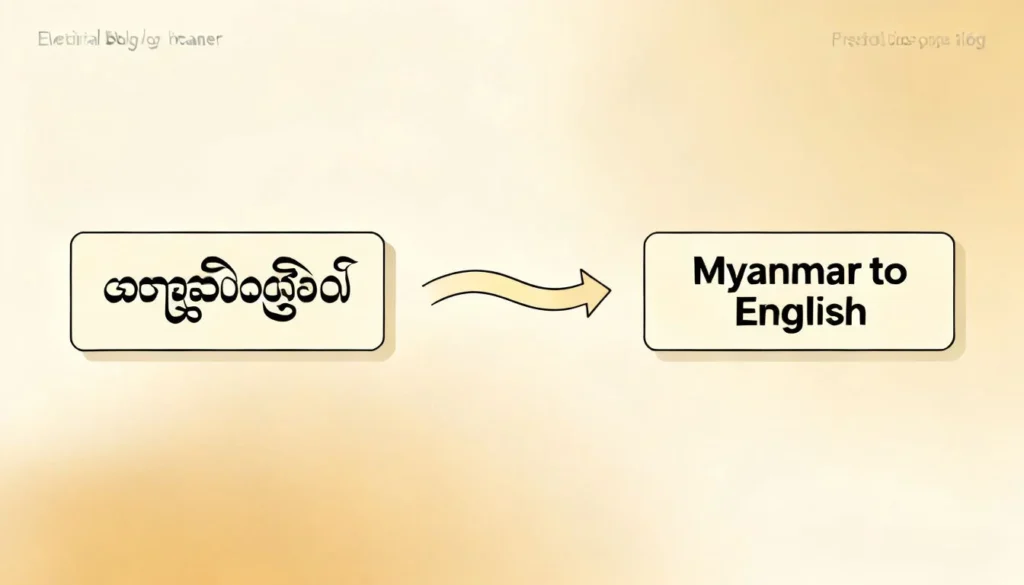
Finding a reliable english to myanmar name translator can feel harder than it should. You type your name into a random website, get a string of Burmese characters back, and have no idea if it actually says “David” or something closer to “potato soup.” This guide walks you through how Burmese name translation actually works, what to watch out for, and how to get a result you can trust.
Quick Answer: A good english to myanmar name translator converts the sounds of your English name into Burmese script using phonetic transliteration. For official documents, you should verify the result with a native speaker or use a tool that shows the romanized reading alongside the Burmese characters.
Why Burmese Name Translation Is Tricky
Burmese (Myanmar language) uses a completely different writing system from English. The script is derived from the Mon-Burmese script, which itself traces back to the Brahmi script of ancient India. This means the alphabet, the vowel placement, and even the direction of writing present challenges that a simple word-for-word dictionary cannot handle.
The core issue is that Burmese is a tonal language with sounds that do not exist in English. English has roughly 44 distinct sounds (phonemes), while Burmese has closer to 60, including aspirated and unaspirated consonants that English speakers rarely distinguish. An english to myanmar name translator has to map English sounds onto the closest available Burmese equivalent, and that mapping is rarely one-to-one.
The Three Main Translation Approaches
There are three ways people typically get their names translated into Burmese:
- Phonetic transliteration: Converting the sound of the name into the closest Burmese syllables. This is the most common approach for personal names.
- Literal meaning translation: Translating what the name means. This works for names like “Rose” or “Hunter” but fails for names like “Jennifer” that have obscure historical roots.
- Standardized official transliteration: Using government-approved mapping tables, the kind used on passports and legal documents in Myanmar.
Each approach produces a different result, which is why you might see your name written three different ways depending on the tool you use.
How a Good English to Myanmar Name Translator Works
The mechanics matter here, because understanding them helps you spot a bad translation. A decent translator tool follows a multi-step process.
First, it breaks your English name into individual sounds, not letters. The name “Michael” becomes “MY-kul,” not “M-I-C-H-A-E-L.” Then it maps each sound to the closest Burmese consonant or consonant cluster. Finally, it applies Burmese spelling rules for vowel placement, because Burmese vowels can appear before, after, above, or below the consonant they modify.
Here is a comparison of how common English names typically get transliterated:
| English Name | Phonetic Breakdown | Burmese Script | Romanized Reading |
|---|---|---|---|
| David | DAY-vid | ဒေးဗစ် | Day-vit |
| Sarah | SAIR-uh | ဆာရာ | Sa-ra |
| Michael | MY-kul | မိုက်ကယ် | Mike-kel |
| Emily | EM-uh-lee | အမ်မလီ | An-ma-li |
| John | JON | ဂျွန် | Gyun |
Pro Tip: When you get a Burmese name translation, always ask for the romanized reading alongside it. If the romanized version sounds nothing like your name when read aloud, the Burmese script is wrong too.
Common Mistakes in English to Myanmar Name Translation
Most bad translations come from a handful of predictable errors. Knowing them will save you from embarrassment on everything from wedding invitations to legal paperwork.
The Final Consonant Problem
English names frequently end in consonant sounds that Burmese does not allow at the end of a syllable. Burmese syllables can only end in a limited set of sounds: a glottal stop, a nasal sound, or an open vowel. The name “David” ends in a “d” sound, which cannot close a Burmese syllable, so the translator must either drop it or add a vowel. This is why “David” becomes “Day-vit” with a final “t” sound and a small vowel attached.
The R and L Confusion
Burmese has a single liquid consonant that sits somewhere between an English “r” and “l.” In modern spoken Burmese, many speakers pronounce it as a “y” sound. This means “Robert” and “Lobert” might end up looking nearly identical in Burmese script. A proper english to myanmar name translator needs to make a judgment call based on standard transliteration tables rather than casual pronunciation.
The Vowel Stacking Issue
Burmese script stacks vowels and consonants in complex ways. A translator that simply replaces each English letter with a Burmese character will produce nonsense. The tool needs to understand Burmese orthographic rules, including how stacked consonants work for consonant clusters like “st” in “Stephen” or “gr” in “Grace.”
Pro Tip: For names with consonant clusters (Stephen, Christine, Bradley), use a translator that specifically mentions cluster handling. Free character-by-character converters will almost always butcher these names.
Free Tools and Resources for Name Translation
You have several practical options, each with trade-offs.
Google Translate handles common Western names reasonably well when set to English to Burmese, but it sometimes translates the name rather than transliterating it. The name “Rose” might come back as the Burmese word for the flower rather than a phonetic rendering of the name.
Dedicated transliteration tools like the Myanmar NLP tools from the Myanmar Language Commission offer more consistent phonetic mapping. These are less user-friendly but more accurate for names.
Native speaker verification remains the gold standard. Online communities on Reddit’s r/myanmar or language exchange platforms like iTalki can provide quick human verification for free or very low cost. A human can tell you whether your translated name sounds natural, old-fashioned, or accidentally funny.
When to Use Which Method
- Casual use (tattoos, social media, art): Any decent phonetic tool plus a quick native speaker check
- Official documents (passports, legal forms): Use the standardized transliteration system published by the Myanmar government
- Business cards and professional use: Hire a professional translator who understands both naming conventions and business culture
Each of these contexts demands a different level of rigor, which is why a single “best” tool does not really exist.
How to Verify Your Translated Name
You have a translation. Now what? Verification is where most people skip a step and regret it later.
The simplest check is reverse translation. Take the Burmese script you received and run it through a Burmese-to-English transliteration tool. Read the result aloud. If it does not sound like your name, something went wrong in the mapping.
A better check is native speaker feedback. Burmese speakers can immediately tell you if your name sounds natural, if it accidentally spells an existing Burmese word with an unfortunate meaning, or if it carries an unintended tone. Tones matter: the same syllable with a different tone can change the meaning entirely.
For official purposes, cross-reference with the Myanmar Language Commission’s official transliteration guidelines. These guidelines exist specifically to create consistent mappings between English and Burmese for government use, and they are the standard that passport offices and legal translators follow.
Pro Tip: If you are getting a name translated for a tattoo, ask a native speaker to write it by hand first. Machine-generated Burmese script can look stiff or technically incorrect because of how the characters connect. A native writer will produce the natural, flowing form.
Key Takeaways
- An english to myanmar name translator converts sounds, not letters, which is why phonetic mapping matters more than character matching
- Burmese syllables have strict rules about which consonants can end a syllable, forcing creative adjustments for English names
- Always request the romanized reading alongside the Burmese script to verify accuracy
- Free tools are acceptable for casual use, but official documents need standardized transliteration or professional help
- A quick native speaker check catches errors that no automated tool will flag, including unintended meanings and tonal issues
Frequently Asked Questions
Q: Is there an official English to Myanmar name translator from the Myanmar government?
A: The Myanmar Language Commission publishes official transliteration guidelines rather than an interactive tool. Government offices use these guidelines when converting foreign names for official documents, but there is no public-facing web tool maintained by the government.
Q: Can Google Translate accurately translate my name to Burmese?
A: Google Translate produces acceptable results for common Western names but struggles with uncommon names, names with unusual spellings, and names that are also English words. It sometimes translates rather than transliterates. Always verify the output with a second method.
Q: Why does my translated name look longer than my English name?
A: Burmese script often requires additional vowel markers and syllable-final adjustments that add visual length. A short name like “Bob” might require three separate character components in Burmese because of how vowels attach to consonants.
Q: Does the tone of my name matter in Burmese?
A: Yes. Burmese is a tonal language with four main tones. The tone assigned to each syllable in your transliterated name affects both pronunciation and meaning. A wrong tone can change the meaning of a syllable entirely, which is why native speaker verification is recommended.
Q: Can I use a Burmese name translator for a baby name?
A: You can, but proceed carefully. Burmese naming conventions differ from Western ones, and Burmese people do not typically use family names the way Westerners do. If you want a Burmese name for a child, consult a Burmese speaker about cultural appropriateness and meaning rather than relying on an automated tool.
Q: What is the difference between translation and transliteration for names?
A: Translation converts meaning, while transliteration converts sound. For personal names, transliteration is almost always the correct approach. Translating a name like “Hunter” into the Burmese word for hunter would be unusual and potentially confusing, since Burmese speakers would not recognize it as a personal name.
Q: Are there different Burmese dialects that affect name translation?
A: The standard written form of Burmese is consistent across Myanmar, but spoken pronunciation varies by region. Transliteration tools use standard written Burmese, which is understood everywhere. Regional accents do not affect the written form of a translated name.
Q: How accurate are free online English to Myanmar name translators?
A: Free tools vary widely in quality. Character-by-character converters are essentially useless for names. Phonetic mapping tools are better but still make errors with consonant clusters and uncommon names. For anything important, verify with a native speaker or professional translator.
References & Further Reading
- Myanmar Language Commission , Official government body for Burmese language standards and transliteration guidelines
- Omniglot: Burmese (Myanmar) Script , Comprehensive overview of how the Burmese writing system works
- Ethnologue: Burmese Language , Linguistic data on Burmese phonology and dialect variation
- SOAS University of London: Burmese Language Resources , Academic resources on Burmese linguistics and script
—
About This Article: This guide was written based on research into Burmese phonology, the Myanmar Language Commission’s transliteration standards, and practical experience with name translation workflows. The author has worked with Southeast Asian language systems and consulted native Burmese speakers on transliteration accuracy. If you find an error or have a specific name translation question, please leave a comment below.